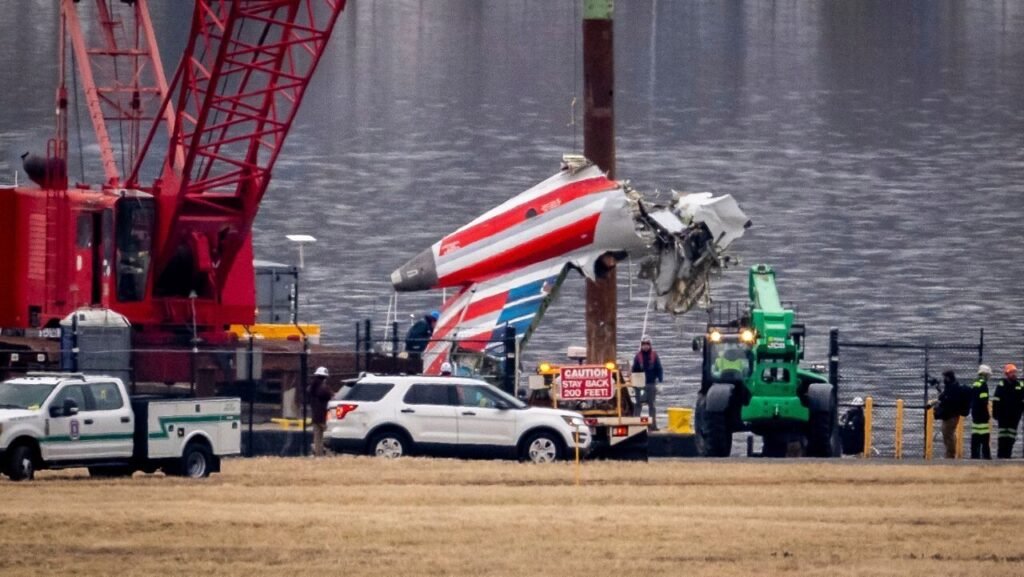
Washington, United States: The United States has moved a step closer to overhauling aviation safety rules following the passage of a major reform bill in April 2026, a direct response to the deadly midair collision near the nation’s capital that exposed critical gaps in airspace management and aircraft tracking. Lawmakers approved the legislation with strong bipartisan backing, signaling rare consensus on the need for systemic reform, though debate continues over whether the measures go far enough.
The push for reform stems from the January 29, 2025 disaster involving American Airlines Flight 5342 and a U.S. Army UH-60 Black Hawk helicopter near Ronald Reagan Washington National Airport. The regional jet, operated by PSA Airlines, was on final approach when it collided with the helicopter conducting a routine night training mission. Both aircraft fell into the Potomac River, killing all 67 people on board 64 on the jet and three military crew making it the deadliest U.S. aviation accident in more than two decades.
Investigations led by the National Transportation Safety Board quickly established that the crash was not caused by a single failure but by a chain of operational and systemic shortcomings. Air traffic controllers had cleared the jet for a runway change shortly before landing, while the helicopter crew, having been alerted to the aircraft’s presence, opted to maintain visual separation. However, a key part of the controller’s transmission indicating the jet’s altered flight path was likely not fully received, leaving both aircraft on converging trajectories in congested airspace.
The preliminary report highlighted the risks of mixed military and civilian operations around Reagan National, one of the busiest and most complex airspaces in the country. It confirmed that standard procedures were being followed but underscored how those procedures themselves allowed little margin for error, particularly at low altitude and at night.
The final report, released in early 2026, presented a far more critical assessment. Investigators pointed to flawed helicopter route design that permitted operations dangerously close to commercial flight paths, along with longstanding safety warnings that had not been adequately addressed. The report also cited high controller workload, gaps in communication, and a continued reliance on “see-and-avoid” practices instead of modern collision-avoidance systems. The NTSB concluded that the disaster resulted from systemic failures spanning regulatory oversight, airspace design, and operational decision-making.
In the immediate aftermath, regulators imposed restrictions on helicopter traffic near Reagan National and began revising procedures for aircraft separation in high-density airspace. Yet the broader policy response unfolded in Congress, where lawmakers introduced competing reform proposals. The stricter ROTOR Act, which aimed to mandate comprehensive aircraft tracking systems with firm deadlines, passed the Senate but narrowly failed in the House, intensifying pressure for an alternative solution.
That effort culminated in April 2026 with the passage of the ALERT Act in the House of Representatives. The legislation mandates the adoption of advanced collision-detection technologies, including ADS-B “In” systems, across much of the aviation fleet, while also requiring enhanced air traffic control procedures, expanded safety audits, and a comprehensive review of airspace design around major airports such as Reagan National. Investigators have indicated that the presence of such technology could likely have prevented the 2025 collision.
Despite its overwhelming support, the bill has drawn criticism for allowing certain exemptions, particularly for military operations, and for setting implementation timelines that extend several years into the future. Families of the victims and some lawmakers argue that the reforms do not fully incorporate all safety recommendations issued by investigators and risk falling short of meaningful change.
The legislation now moves to the Senate, where further negotiations are expected to reconcile differences between proposals and determine the final scope of reforms.