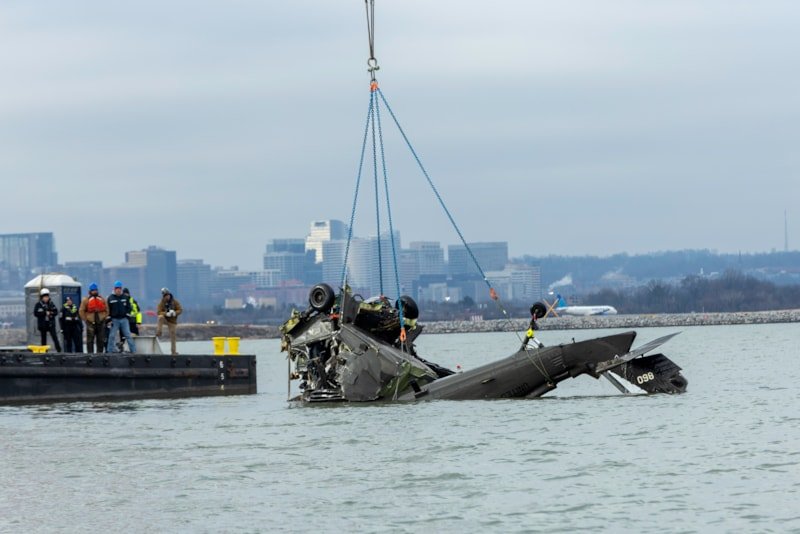
Washington, United States: The National Transportation Safety Board (NTSB) in its final report has concluded that a combination of flawed airspace design, inadequate oversight, and operational lapses led to the January 29, 2025 mid-air collision over the Potomac River near Ronald Reagan Washington National Airport, killing all 67 people on board both aircraft.
The accident involved a U.S. Army Sikorsky UH-60L Black Hawk helicopter operating under military call sign PAT25 and a Mitsubishi CRJ700 regional jet operating as PSA Airlines Flight 5342, a scheduled passenger service bound for Washington. The aircraft collided at approximately 8:48 pm local time while on converging flight paths, before plunging into the Potomac River. There were no survivors.
According to the NTSB’s final investigation, the helicopter was flying along a published helicopter transit route used for military and government operations near the capital. At the same time, the CRJ700 was descending on approach into Reagan National Airport.
The two aircraft converged in a narrow section of congested airspace where helicopter routes and fixed-wing arrival paths run in close proximity. Investigators found that:
- The helicopter crew was operating at an altitude that placed it within the arrival corridor of commercial traffic.
- Air traffic control provided limited traffic advisories and did not issue timely safety alerts.
- Both crews were primarily relying on visual separation (“see-and-avoid”) in busy nighttime conditions.
Moments before impact, neither aircraft made an effective evasive maneuver. The collision occurred over the river, destroying both aircraft on impact.
In its probable cause determination, the NTSB concluded that the crash was not the result of a single failure, but rather a systemic breakdown in safety architecture.
The NTSB found that the Federal Aviation Administration (FAA) had approved helicopter routes that passed dangerously close to commercial arrival paths without sufficient vertical or lateral separation. Despite years of operational data showing high traffic density, the FAA failed to redesign or reassess these routes.
Investigators criticised the continued dependence on pilots visually detecting and avoiding other aircraft in one of the most congested and complex airspaces in the United States. The NTSB said this concept is inherently unreliable, especially at night and in high-workload environments.
Controllers handling the sector were managing heavy traffic volumes. The NTSB found that this high workload delayed conflict recognition, resulting in late or ineffective traffic advisories to both crews.
The U.S. Army was faulted for failing to ensure that helicopter pilots fully understood barometric altitude tolerances on the published route. Investigators said small altitude deviations placed the helicopter directly in the jet’s descent profile.
The report highlighted limitations in existing collision alerting systems for mixed civilian-military operations. The NTSB noted that neither aircraft received a timely automated warning that could have prompted immediate evasive action.
The NTSB also criticised both civilian and military aviation authorities for poor use of safety data. Despite previous internal warnings and historical near-miss incidents in the same airspace, regulators failed to conduct a comprehensive risk assessment.
The NTSB concluded that the collision was entirely preventable and stemmed from long-standing structural weaknesses rather than pilot error alone. The board warned that without major reforms, similar accidents remain a serious risk in complex shared airspace environments.
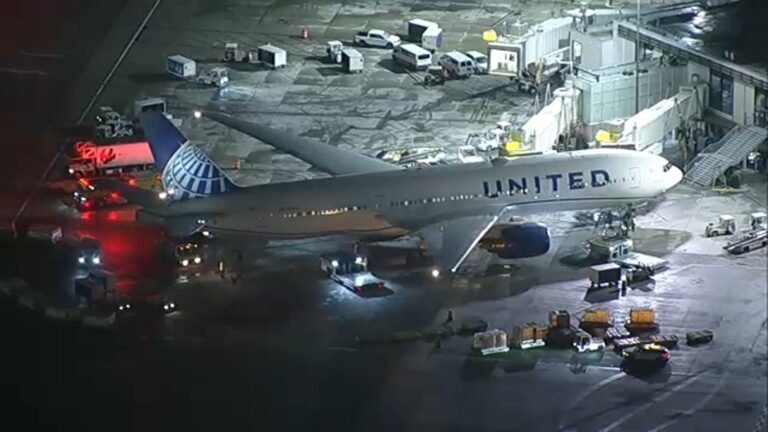
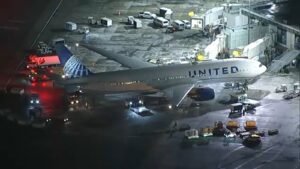
![Washington, United States: A United Airlines flight bound for Guatemala City made an emergency diversion to Washington Dulles International Airport after a passenger allegedly attempted to open a cabin door at cruising altitude and assaulted another traveler, according to air traffic control communications and federal authorities. The incident involved United Airlines Flight 1551, operated by a Boeing 737 MAX 8, which departed from Newark Liberty International Airport on Thursday evening carrying 145 passengers and six crew members. The aircraft had been en route to Guatemala City when the crew declared an emergency and diverted to Washington Dulles International Airport in Virginia. According to audio between the flight crew and air traffic controllers, the pilot informed controllers that the disruptive passenger attempted to open Door 2L while the aircraft was cruising at approximately 36,000 feet. The pilot also reported that the passenger later assaulted another individual onboard. During the exchange, the tower asked the crew which door the passenger had attempted to access. The pilot responded: “Door 2L at 36,000 feet and then [the passenger] assaulted a fellow passenger.” When controllers asked whether there were any injuries onboard, the pilot replied: “Not to our knowledge.” The aircraft landed safely at Washington Dulles at approximately 8:38 p.m. local time. Law enforcement and emergency personnel met the aircraft upon arrival. The FBI later confirmed that agents responded to the incident at the airport, although the agency did not immediately release additional details regarding the passenger’s identity, possible charges, or whether the individual was taken into federal custody. Flight tracking data showed the aircraft remained airborne for a period before diverting toward the Washington region instead of continuing south toward Guatemala. The diversion temporarily disrupted the scheduled international service but no injuries among passengers or crew were officially reported. United Airlines had not issued a detailed public statement at the time of publication regarding the circumstances surrounding the diversion or the status of the passenger involved. Federal authorities are expected to review crew reports, passenger statements, and onboard evidence as part of the investigation.](https://aviationtoday.in/wp-content/uploads/2026/05/AVIATION-TODAY-UNITEDV-AIRLINES-RUDE-PASSENGER-768x432.jpg)


![Washington, United States: A United Airlines flight bound for Guatemala City made an emergency diversion to Washington Dulles International Airport after a passenger allegedly attempted to open a cabin door at cruising altitude and assaulted another traveler, according to air traffic control communications and federal authorities. The incident involved United Airlines Flight 1551, operated by a Boeing 737 MAX 8, which departed from Newark Liberty International Airport on Thursday evening carrying 145 passengers and six crew members. The aircraft had been en route to Guatemala City when the crew declared an emergency and diverted to Washington Dulles International Airport in Virginia. According to audio between the flight crew and air traffic controllers, the pilot informed controllers that the disruptive passenger attempted to open Door 2L while the aircraft was cruising at approximately 36,000 feet. The pilot also reported that the passenger later assaulted another individual onboard. During the exchange, the tower asked the crew which door the passenger had attempted to access. The pilot responded: “Door 2L at 36,000 feet and then [the passenger] assaulted a fellow passenger.” When controllers asked whether there were any injuries onboard, the pilot replied: “Not to our knowledge.” The aircraft landed safely at Washington Dulles at approximately 8:38 p.m. local time. Law enforcement and emergency personnel met the aircraft upon arrival. The FBI later confirmed that agents responded to the incident at the airport, although the agency did not immediately release additional details regarding the passenger’s identity, possible charges, or whether the individual was taken into federal custody. Flight tracking data showed the aircraft remained airborne for a period before diverting toward the Washington region instead of continuing south toward Guatemala. The diversion temporarily disrupted the scheduled international service but no injuries among passengers or crew were officially reported. United Airlines had not issued a detailed public statement at the time of publication regarding the circumstances surrounding the diversion or the status of the passenger involved. Federal authorities are expected to review crew reports, passenger statements, and onboard evidence as part of the investigation.](https://aviationtoday.in/wp-content/uploads/2026/05/AVIATION-TODAY-UNITEDV-AIRLINES-RUDE-PASSENGER-300x169.jpg)