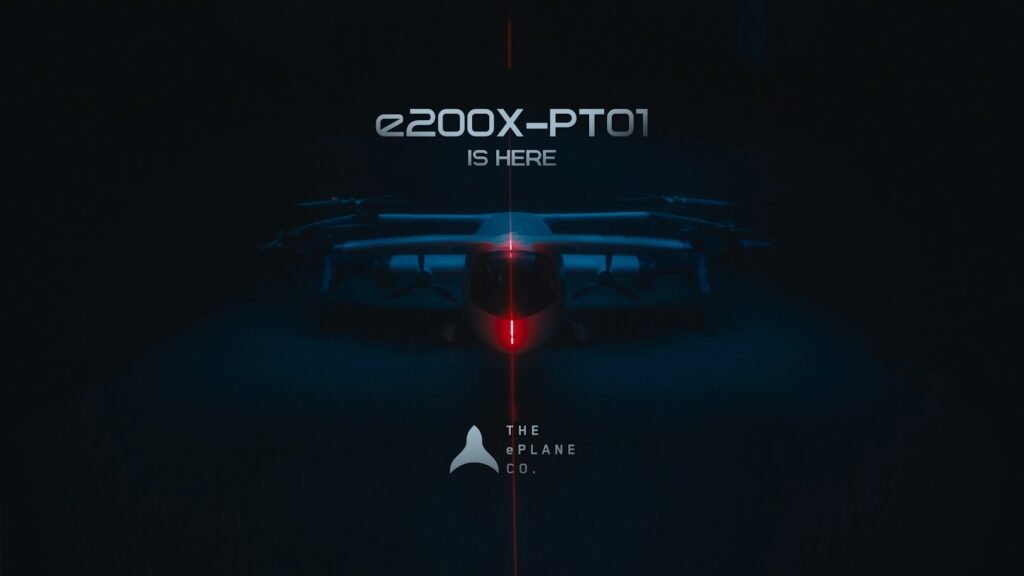
Chennai, India: The ePlane Company is an IIT Madras-incubated aerospace startup developing electric vertical take-off and landing (eVTOL) aircraft for urban air mobility. The company was incorporated in 2019 around Prof. Satya Chakravarthy’s work on electric aviation and its proprietary Synergistic Lift architecture, which separates vertical-lift propulsion from forward-flight propulsion. Its flagship e200X is being developed as a multi-role electric aircraft for passenger air-taxi services, urban cargo and emergency medical transport. The company’s approach uses its patented “Synergistic Lift” architecture, which separates vertical-lift propulsion from forward-flight propulsion rather than relying on tilt-rotor technology. ePlane received DGCA Design Organisation Approval in 2023, while the DGCA formally accepted its e200X Type Certification application in 2024.
In the recent developments, the programme reached a major milestone in June 2026, when ePlane completed assembly of the full-scale e200X PT-01 prototype at its new 60,000 sq ft facility at the IIT Madras Discovery Campus in Chennai, moving the programme from design and simulation into physical ground testing. The company subsequently unveiled PT-01 publicly in July. The 2.2-tonne carbon-fibre aircraft is designed to carry one pilot and two passengers, or up to 200 kg of cargo, with a stated range of about 110 km. It uses an 800V distributed electric propulsion system and is designed around an approximately 8 m × 11 m footprint, allowing the company to target existing helipads and relatively compact urban operating spaces.
The PT-01 rollout follows more than 10,000 km of cumulative flight testing using ePlane’s earlier technology demonstrators, including the ATVA and e50, and is now being followed by structured ground testing ahead of flight testing. As reported, certified flight testing is targeted for 2027, while the company has previously indicated plans for initial commercial operations, beginning with the air-ambulance segment, in 2028, subject to certification and regulatory approvals.
The company has also been building the wider ecosystem around the aircraft. In July, ePlane announced supplier and technology partnerships covering areas including electrical wiring, composites, avionics, fasteners and interiors, while in August it announced a partnership with Apollo Hospitals focused on electric air ambulances and medical-delivery drones. The company says it has secured commitments for more than 800 aircraft, although these commitments include agreements and MoUs rather than necessarily representing firm aircraft orders.
Against this backdrop, Aviation Today held an exclusive conversation with the leadership team of The ePlane Company on the e200X PT-01 programme, its six-year development journey and the lessons gained from more than 10,000 km of earlier flight testing. The conversation focuses on what the full-scale PT-01 rollout means internally for the team, how real-world testing of previous demonstrators influenced the aircraft’s design and systems integration, and what the company is now validating during the ground-test phase. It also examines how ePlane sees the compact e200X fitting into dense urban markets, its approach to existing helipad infrastructure, and the programme’s next milestones including the first hover of PT-01, the certification-compliant Prototype 2 and the planned DGCA certification flight campaign.
Conversation In Details
Aviation Today:
The e200X PT-01 marks a significant milestone for the programme. What does this rollout represent internally for the team after years of development and testing?
Leadership Team:
This rollout is the culmination of six years of hard work and relentless engineering. We didn’t arrive here in one step – we worked patiently through multiple subscale prototypes, testing and refining at each stage before committing to full-scale hardware. Internally, this represents grit: we started in a single lab, at a time when drones weren’t even legal in this country, and worked alongside regulators to help structure the framework the programme now operates under. Getting from that single lab to a 60,000 sq ft facility, and from a regulatory blank slate to PT-01 on the hangar floor, is the kind of milestone that’s hard to reduce to a single feeling. None of it would have been possible without the conviction of our investors and well-wishers, who backed this before there was much to point to beyond belief in the team.
But this isn’t the finish line. It’s the point where the real testing begins – where everything validated in simulation and at subscale gets proven on the actual aircraft. The harder work is still ahead. It primarily validates a lot of the conviction we have had on multiple fronts – both engineering and commercial front. For us this is just the start of a journey.
Aviation Today:
You’ve accumulated over 10,000 km of flight testing across previous demonstrators. What was the most valuable lesson from those flights that directly influenced the design of the e200X PT-01?
Leadership Team:
The learnings were across the spectrum- right from aerodynamics to thermal behavior, structures, supply chain etc. Running thousands of kilometers across ATVA and the e50 in real operating conditions taught us things no datasheet tells you. A component might be rated a certain way on paper, but how it actually performs under our duty cycles is something that lets us refine our internal SOP’s and how we integrate systems.
That’s the biggest single lesson: component testing to validate the datasheet, not just trust it. We learned to fine-tune every subsystem based on what the flight data actually showed us, not what the spec sheet promised. That discipline – testing to verify rather than testing to confirm is what shaped how we approached every decision on the e200X PT-01, from component selection to system integration.
Aviation Today:
As the aircraft enters its structured ground testing phase, what are the key parameters you’ll be validating before moving to first flight?
Leadership Team:
Ground testing is about earning the right to lift off. Right now, we’re stress-testing our custom 800V powertrain architecture, running static propeller thrust sweeps, validating structural vibration resonance, and verifying full-system telemetry between avionics, flight control systems, and the Ground Control Station. We are systematically proving every failure mode on the ground so that when PT01 leaves the ground, the flight envelope is already understood.
Aviation Today:
With several global players developing electric air taxis, where do you believe the e200X differentiates itself whether in design philosophy, technology, operational capability, or the Indian market?
Leadership Team:
What we’ve focused on is the segment that actually uses taxis, the most dense urban commuters moving through cities like Bangalore, Mumbai, or Bangkok, where the daily reality is traffic, not distance.
Most urban trips carry less than one passenger on average, which tells you something important: the demand isn’t for large, multi-seat aircraft; it’s for frequent trips at a scale that matches how people actually move through cities. That shaped the design.
Most global players are building larger aircraft that need runway space or purpose-built infrastructure. Urban environments don’t have that kind of real estate to spare, and the trip profile doesn’t call for it either. So we designed the e200X around an 8x11m footprint compact enough to operate from existing helipads and tight urban spaces without waiting for new infrastructure to be built. In that sense, it’s the most compact aircraft in its class, and that’s by design, not coincidence – it’s a direct response to both the physical constraint of dense cities and how people actually travel within them.
Aviation Today:
Looking ahead, what are the next major milestones for the e200X programme, and what should the aviation industry be watching for over the next 12–24 months?
Leadership Team:
The immediate milestone is the hover of Prototype 1. Following that is Prototype 2, which will be the certification-compliant aircraft, stepping into the DGCA’s certification flight campaigns.
Alongside the aircraft fleet, we’re already putting together the ecosystem for this infrastructure and partnerships to support it. We’re not just building a single aircraft; we’re establishing a full-scale aviation pipeline to support the ecosystem around electric aviation.
For ePlane, the e200X programme now moves from years of technology development and subscale testing into the more demanding stages of full-scale validation and certification. With PT-01 entering ground testing, a certification-compliant Prototype 2 planned next and DGCA flight testing targeted for 2027, the company is transitioning from proving individual technologies to demonstrating an integrated aircraft.
Its focus on compact urban operations, existing helipad infrastructure and applications including passenger mobility, cargo and air ambulance services will ultimately be tested against certification requirements and real-world operating conditions. The coming stages will therefore be critical in determining whether ePlane can translate its six-year development effort and growing industry partnerships into a commercially viable Indian eVTOL platform.
Recent Developments
Beyond the company’s latest progress outlined in the interview other developments includes, on 23 September 2026, India’s Technology Development Board (TDB), under the Department of Science and Technology (DST), approved ₹285 crore in financial support to Chennai-based Ubifly Technologies, which operates as The ePlane Company, under the Research Development and Innovation (RDI) Fund to advance its indigenous ePlane programme. The project has an approved cost of ₹570 crore, with the funding aimed at taking the technology from Technology Readiness Level (TRL) 6 to TRL 9 through further engineering, testing, validation and scale-up.
The company’s e200X is a three-seater, zero-emission electric aircraft designed to carry one pilot and two passengers, with a targeted range of 110 km and an ideal speed of 160 kmph. The support will be provided through optionally convertible debentures, marking a significant government-backed investment in the aircraft’s development and progress towards commercial deployment.
On 8 October 2026, The ePlane Company signed a memorandum of understanding (MoU) with Noida International Airport to develop the infrastructure and operational framework required for future e200X operations.
Under the agreement, Yamuna International Airport Private Limited (YIAPL), the airport’s concessionaire, will allocate space for proof-of-concept trials, vertiports and charging stations, while both organisations will work on operating procedures, vertiport management systems and safety frameworks in coordination with regulators, air traffic control and state governments. The collaboration is intended to support future airport-to-airport connectivity, intra-city travel and emergency air ambulance services.
The company will continue working on the e200X prototype and flight testing while pursuing the necessary clearances from the Directorate General of Civil Aviation (DGCA) and Bureau of Civil Aviation Security (BCAS). The airport said the partnership would allow infrastructure and operational preparations to progress alongside aircraft development; it does not constitute certification or approval for commercial flights.