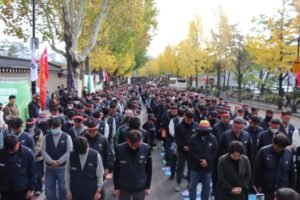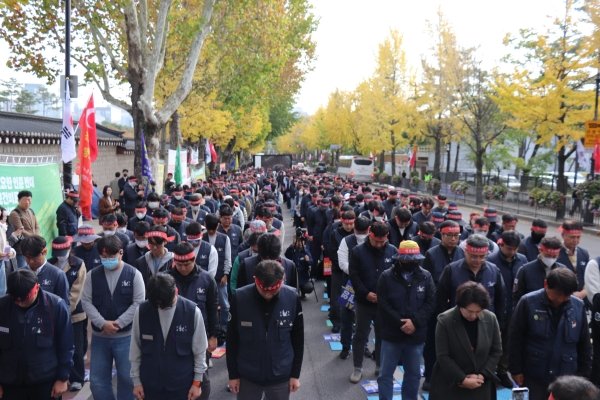
Sacheon, South Korea: The labour union of Korea Aerospace Industries (KAI) staged its third mass protest in Seoul on 3 November, 2026 opposing Hanwha Group’s attempts to expand its influence over the aircraft manufacturer and demanding guarantees of KAI’s independent management. Approximately 1,300 union members participated in the demonstration outside Cheong Wa Dae Sarangchae at 2 p.m. local time, marking the largest turnout across the three protests held since October.
The demonstration followed earlier protests on 14 and 20 October, when KAI’s union, representing approximately 3,800 members, began a three-stage campaign against Hanwha’s growing influence in the company. The union is demanding that the South Korean government prevent a potential takeover, retain KAI’s existing independent management structure and provide clear answers on the future ownership of the state-linked aerospace manufacturer.
Hanwha Group increased its combined shareholding in KAI to 15.89% in August, becoming the company’s second-largest shareholder after the Export-Import Bank of Korea (KEXIM), which holds 26.41%. Hanwha also changed the declared purpose of its shareholding to management participation, raising concerns among KAI employees about its potential involvement in the company’s decision-making. The union argues that Hanwha’s existing position as a supplier of aircraft engines, avionics and defence systems to KAI, while also competing in certain government space projects, could create conflicts of interest and weaken competition if it gains greater management control.
The union has also warned that a potential combination of KAI with Hanwha Aerospace and Hanwha Systems could concentrate nearly 70% of South Korea’s domestic market in the hands of one defence group. This figure represents the union’s assessment, as reported by BigGo Finance, rather than an independently verified market-share calculation. It has further raised concerns about possible restructuring following an acquisition, employment security, the protection of sensitive business information and the future of South Korea’s aerospace industrial ecosystem.
Another major issue raised during the 3 November demonstration was KEXIM’s 18 billion won aerospace and space industry competitiveness consulting project. The union demanded disclosure of the project’s commissioning background, objectives, scope of work, interim and final findings, and the conflict-of-interest verification process involving AT Kearney, which was selected as the preferred negotiating bidder. It also called on KEXIM to retain its KAI shareholding and provide a clear commitment to protecting the company’s independent management. The union further demanded an official government response to concerns raised by lawmakers during parliamentary audits over defence-sector monopolisation and vertical integration.
KEXIM chairman Hwang Ki-yeon told lawmakers during a parliamentary audit on 20 October that there was no current plan to sell the bank’s stake in KAI, adding that the consulting project was not initiated with privatisation or a sale in mind. However, he said he could not make definitive statements about future plans. KAI chief executive Kim Jong-chool separately warned that Hanwha gaining management control could weaken competition and potentially shrink South Korea’s wider aerospace industry ecosystem.
The KAI Labour Union said it would continue its campaign through cooperation with lawmakers and the local community until the government provides a responsible response and concrete measures to protect KAI’s independent management. The 3 November demonstration marks the completion of the three scheduled mass protests announced by the union in October, although its wider campaign remains ongoing.