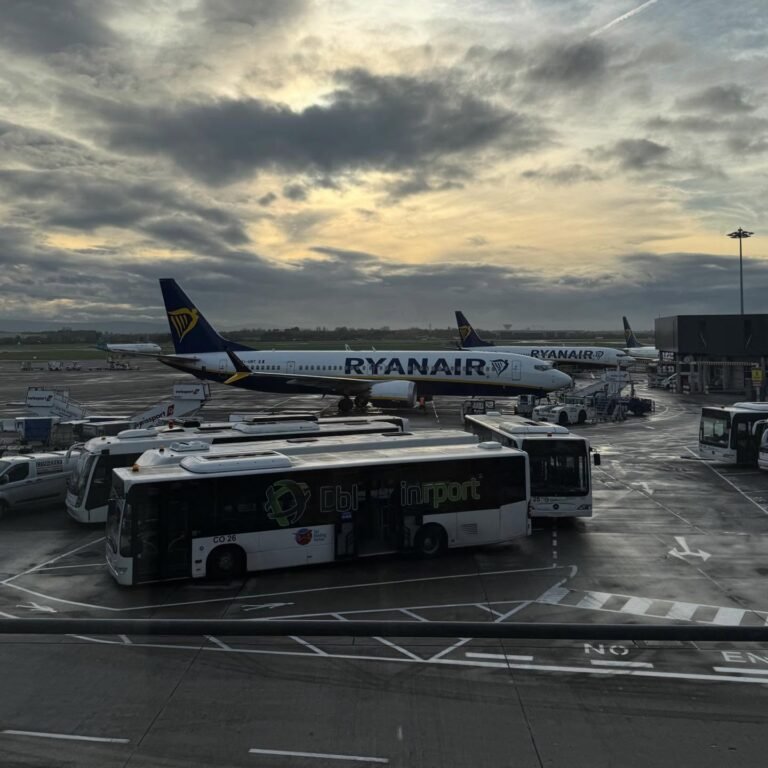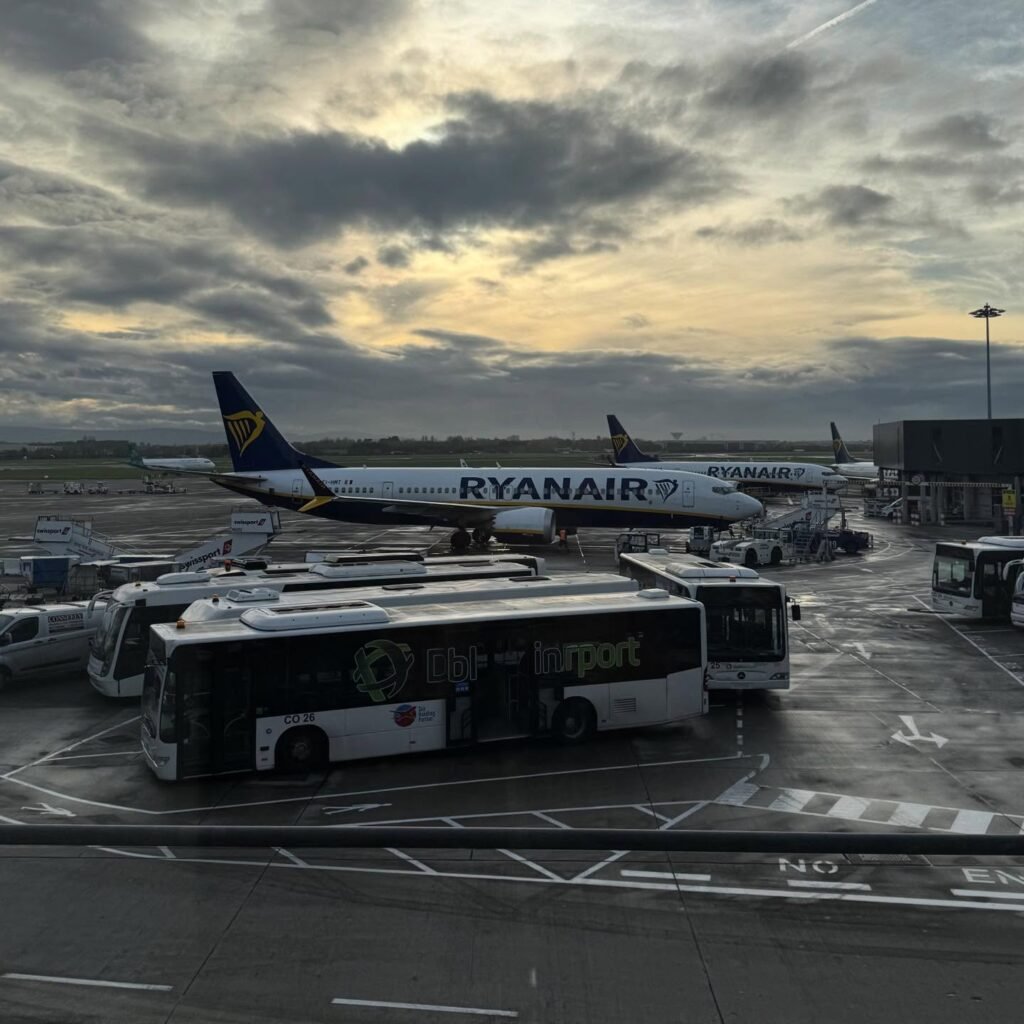
Dublin, Ireland: Ryanair reported a 15% decline in its first-half profit after tax (PAT) to €2.15 billion for the six months ended 30 September 2026, compared with €2.54 billion in the corresponding period last year. The decline came as the price of its unhedged jet fuel doubled and average fares fell 4%, despite a 6% increase in passenger traffic to 125.8 million. The airline is now reviewing potential cost-cutting measures, including temporary pay freezes and lower crewing ratios, as it prepares for a significantly higher fuel bill in the next financial year.
In its financial results released on 2 November 2026, Ryanair reported that operating costs increased 10% to €7.69 billion during H1 FY27, against €6.96 billion in H1 FY26. Revenue, meanwhile, grew 3% to €10.08 billion from €9.82 billion. Average fares declined from €58 to €55.70, while revenue per passenger fell 3%, with ancillary revenue remaining flat on a per-passenger basis. The airline attributed the pressure on fares partly to the Middle East conflict, which contributed to consumer uncertainty and later bookings, alongside the absence of a full Easter period in April.
The airline’s second-quarter PAT also declined 6% to €1.61 billion from €1.72 billion, even as passenger numbers increased 5% to 64.5 million from 61.2 million. Quarterly revenue rose 4% to €5.70 billion, while operating costs increased 10% to €3.88 billion. The average fare for the quarter fell 2% to €63.40 from €64.80, while the load factor remained unchanged at 96%. For the first half, the load factor was also stable at 95%.
The airline’s proposed cost-control measures come against the backdrop of an estimated €2 billion increase in its FY28 fuel bill, based on current forward prices. Ryanair expects jet-fuel prices to remain elevated well into 2027 unless the Middle East conflict is resolved swiftly. It also warned that the expiry of lower-cost fuel hedges ahead of Summer 2027 will expose European airlines to substantially higher fuel expenses.
Ryanair expects European short-haul airfares to increase materially to reflect higher fuel prices and reduced competitor capacity. However, it believes fare increases will not fully offset the projected rise in its fuel bill.
The company stated, “To help address this, we’re reviewing all costs across Group airlines with a particular focus on airport churn negotiations (as the fuel efficient MAX-10s deliver from Spring 2027), maturing labour agreements (which may require temporary pay freezes), lower crewing ratios and increased use of AI to drive further operational and back-office/support functions productivity.”
The statement places labour agreements, staffing levels and technology among the areas being examined to control expenditure. The reference to lower crewing ratios indicates that Ryanair is considering reducing the crew complement relative to its operations, although it has not specified the number of crew members involved, the affected aircraft or whether any changes will be made to minimum onboard staffing.
Similarly, temporary pay freezes remain a possibility under maturing labour agreements rather than a confirmed company-wide decision.
Ryanair said 20% of its jet-fuel requirements remained unhedged, with prices doubling to approximately $130 per barrel. This contributed to a 5% increase in unit costs during H1 FY27. The airline also reported that supplier compensation ceased following the delivery of its final Boeing 737-8200 Gamechanger aircraft in Spring 2026.
CEO Michael O’Leary said, “H1 Revenue rose 3% to €10.08bn. Scheduled revenue rose 1% to €7.0bn as traffic grew 6% but at 4% lower fares. H1 fares fell (April didn’t have a full Easter) as the Middle East conflict led to consumer hesitancy and later bookings. Ancillary revenue grew 6% to €3.08bn. Operating costs rose 10% to €7.69bn as the price of our 20% unhedged jet-fuel doubled and supplier compensation ceased following delivery of our final B-8200 ‘Gamechanger’ in Spring 2026.”
Ryanair said 80% of its FY27 jet-fuel requirements were hedged at approximately $67 per barrel until March 2027. This has helped protect its current-year earnings from oil-price volatility and widened its cost advantage over other European competitors. The company also extended its FY28 fuel hedge coverage to 25% at approximately $95 per barrel following recent price declines.
The airline’s H1 financial highlights also included:
- Passenger traffic increased 6% to 125.8 million.
- Revenue per passenger declined 3%.
- Average fares fell 4%, while ancillary revenue per passenger remained flat.
- Unit costs increased 5%.
- The final €1.2 billion bond was repaid in May 2026.
- An interim dividend of €0.273 per share was declared, payable in February 2027.
- Ryanair had 126 additional routes and one new base at Rimini on sale for Summer 2027.
Despite the decline in profit, Ryanair reported a strong financial position, supported by its BBB+ credit ratings, an unencumbered fleet of 620 Boeing 737 aircraft and available liquidity.
On 30 September 2026, the airline reported gross cash of €2.6 billion, following €1.3 billion in debt repayments, €0.8 billion in capital expenditure and €0.4 billion in shareholder distributions. Its €1.1 billion revolving credit facility (RCF) provided additional liquidity, with approximately €0.7 billion remaining undrawn.
In September, Ryanair completed a €750 million share buyback programme, cancelling approximately 28.6 million shares. The company said it had retired more than 40% of its issued share capital since 2008.
The board also declared an interim dividend of €0.273 per share, payable in late February 2027, and announced another €800 million share buyback programme. The new programme is expected to begin in February 2027, when cash flows are typically stronger ahead of the summer travel season, and run for approximately 10 months, subject to market conditions.
Ryanair welcomed the US Federal Aviation Administration’s recent certification of the Boeing 737 MAX 10 and expects the European Union Aviation Safety Agency (EASA) to certify the aircraft before the end of 2026. This would allow the airline to take delivery of its first 16 MAX 10 aircraft in Spring 2027, ahead of the Summer 2027 schedule.
The airline has reduced its FY27 passenger traffic target from 216 million to 214 million to limit its exposure to unhedged fuel costs. Consequently, winter traffic between November 2026 and March 2027 is expected to remain broadly flat year-on-year.
For the following year, Ryanair plans to grow passenger traffic to more than 220 million, an increase of approximately 3%, supported by the introduction of 16 MAX 10 aircraft.
The airline said it would continue allocating its limited aircraft capacity to countries, regions and airports that reduce aviation taxes and airport fees to encourage growth. These include Albania, Italy, Morocco, Slovakia and Sweden. It will also shift flights and capacity away from higher-tax or rising-cost markets, including Austria, Germany and regional Spain.
Ryanair expects European short-haul capacity to remain constrained into the early 2030s. It cited delays in aircraft production by the two major manufacturers, continuing Pratt & Whitney engine delays, airline mergers and acquisitions, and financial pressure on unprofitable carriers affected by higher fuel prices and a stronger US dollar. The company also noted that some European airlines were already facing Chapter 11 proceedings.
Combining these expected capacity constraints with its cost advantage, financial position, fuel-efficient aircraft orders and operational resilience, Ryanair expects to grow to more than 300 million passengers annually by FY34.
During H1 FY27, Ryanair operated 210 Boeing 737 aircraft, which offer 4% more seats and use 16% less fuel, according to the company.
The airline expects its first 16 Boeing 737 MAX 10 aircraft to join the fleet in Summer 2027. Ryanair said the aircraft would provide 20% more seats and consume 20% less fuel.
It also plans to complete the winglet retrofit programme across its Boeing 737NG fleet during winter 2026. The modifications are expected to reduce fuel consumption by 1.5% and noise by 6%.
Ryanair said investments in new technology, operational resilience and sustainable aviation fuel (SAF) targets support its position as one of Europe’s most environmentally efficient airlines.
Customer satisfaction scores increased to 90% during Summer 2026, compared with 89% in the previous year. The airline’s Customer Panel also met recently to provide feedback on customer-facing services, including the future role of artificial intelligence in travel.
On 30 September 2026, EU nationals held 30% of Ryanair’s issued share capital, unchanged from 31 March 2026. The company stated that EU nationals are entitled to exercise 100% of the voting rights in Ryanair Holdings plc, ensuring compliance with EU ownership and control requirements applicable to its European airline subsidiaries.
For FY27, Ryanair expects passenger traffic to increase 3% to 214 million. Its 80% fuel hedge at approximately $67 per barrel through March 2027 is expected to protect earnings from current oil-price volatility.
The airline said this protection had also helped offset an additional €300 million in EU environmental taxes, significant crew pay increases under new multi-year collective labour agreements (CLAs) and higher maintenance costs.
However, the final FY27 unit-cost outcome will depend on the price of the remaining unhedged fuel requirements during the second half of the financial year.
Ryanair reported strong Q3 demand, with fares trending modestly ahead of the same quarter last year. However, the airline said the booking window remained closer to departure, limiting forward visibility. Q3 fares will depend heavily on October and November school mid-term and Christmas bookings. It also said it had no visibility for Q4 at this stage and that it was too early to provide meaningful FY27 PAT guidance.