News
Civil Aviation
Pilot Training
Flight School Analysis
Aviation Jobs
Training
Services
About Us
Contact Us

UK Unveils £46.5 Million In Initiative To Fast-Track Drones And Flying Taxis By 2028 

Picture of Aviation Today News Desk

Aviation Today News Desk

UK Unveils £46.5 Million In Initiative To Fast-Track Drones And Flying Taxis By 2028 SEO DES: The initiative improves regulations, enables wider drone use & strengthens airspace management while streamlining approvals for commercial drone operations SOCIAL: The United Kingdom has launched a £46.5 million funding package to speed up the development of drones and eVTOL aircraft, aiming to support commercial air mobility and flying taxi services by 2028. The initiative focuses on improving regulations, enabling wider drone use, and strengthening airspace management. Part of the funding will streamline approvals for commercial drone operations in sectors like emergency response, logistics, and infrastructure inspection. The rest will establish a national drone tracking system to enhance safety and prevent illegal drone activity. Officials said the move will boost the UK’s position in advanced air mobility, with strong industry support from firms like Vertical Aerospace, as the sector moves toward large-scale commercial deployment. London, United Kingdom: The United Kingdom has launched a major £46.5 million (US$63.3 million) funding initiative aimed at accelerating the deployment of drones and electric vertical take-off and landing (eVTOL) aircraft, marking one of the country’s largest commitments to advanced air mobility (AAM) and autonomous aviation technologies to date. The package, announced on May 5 by the Department for Transport (DfT), Home Office and the UK Civil Aviation Authority (CAA), seeks to streamline drone regulations, support commercial eVTOL operations and strengthen drone security enforcement across British airspace. Under the programme, £26.5 million will be allocated to the CAA to modernise and simplify regulatory approvals for commercial drone operations. The funding is intended to reduce administrative bottlenecks that have slowed industry growth and help integrate drones into routine public and commercial services including emergency response, medical logistics, infrastructure inspections and supply chain operations. The initiative also aims to establish the regulatory framework required to introduce commercial flying taxi services in the UK from 2028. Authorities said drone operators will gain access to a streamlined digital application system designed to significantly reduce approval timelines and improve operational scalability. The move aligns with the UK CAA’s eVTOL Delivery Model published in September 2025, which confirmed SC-VTOL as the certification basis for future air taxi aircraft and outlined operational provisions for both day and night flights under visual and instrument flight rules. The remaining £20.5 million will fund the development of the UK’s first national Hybrid Remote ID system for drones, effectively a digital “number plate” for unmanned aircraft. The technology will broadcast a drone’s identity and live location during flight, allowing nearby compatible receivers and authorised agencies to monitor operations in real time. The system will also maintain historical flight records through a secure online platform, enabling law enforcement agencies to identify and prosecute illegal or unsafe drone operators more efficiently. The government said the new identification network is aimed at addressing rising concerns surrounding rogue drone activity near airports, prisons, critical infrastructure and urban areas. Security Minister Dan Jarvis described the initiative as “a numberplate system for the skies,” adding that authorities would be able to identify operators violating aviation laws and remove illegal drones from UK airspace. UK Aviation, Maritime and Decarbonisation Minister Keir Mather said the investment would support British innovation while ensuring safety and public confidence remain central to the expansion of autonomous aviation technologies. He stated that the programme would “unlock barriers to growth,” create jobs, lower emissions and reinforce Britain’s position as a global aviation leader. Mather added that the advanced air mobility sector could contribute as much as £103 billion to the UK economy by 2050. Industry leaders welcomed the announcement, viewing it as a critical step toward scaling real-world commercial drone and eVTOL operations. Bristol-based eVTOL developer Vertical Aerospace said faster-moving regulation combined with high safety standards would be essential for the UK to lead the global advanced air mobility sector. The company’s VX4 eVTOL aircraft recently completed piloted transition flight testing as it progresses toward certification and commercial deployment targets later this decade. Autonomous cargo drone company Windracers also supported the reforms, stating that targeted investment and practical regulation were necessary to unlock large-scale autonomous aviation operations. The company highlighted its ULTRA drone platform, which is already being deployed in challenging operational environments including Ukraine and remote logistics missions across the Scottish Highlands and Islands. The funding package forms part of a broader UK aviation and decarbonisation strategy that includes £2.3 billion for green aircraft development programmes and an additional £63 million for sustainable aviation fuel (SAF) initiatives. Officials say the latest investment demonstrates the government’s intention to position Britain as an “aviation superpower” in next-generation aerospace technologies including drones, autonomous cargo aircraft and urban air mobility systems. While the announcement has been widely welcomed by industry stakeholders, analysts note that the UK still faces competition from the United States, China and the United Arab Emirates, all of which are investing aggressively in advanced air mobility ecosystems, certification frameworks and commercial eVTOL infrastructure. Nevertheless, the latest funding package is expected to accelerate Britain’s transition from experimental drone operations to routine commercial deployment over the coming years.
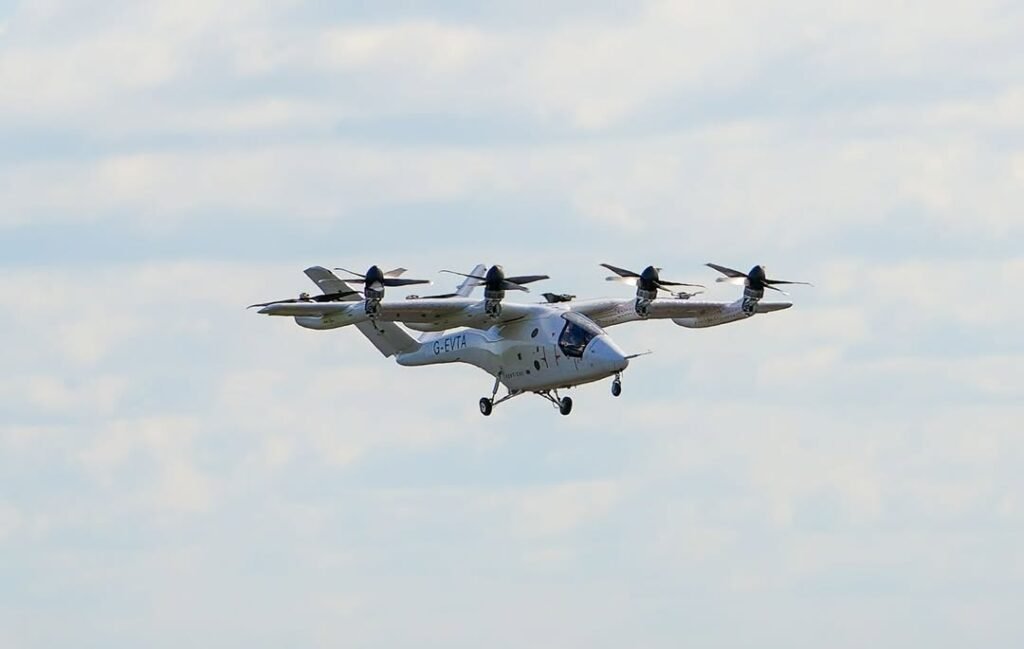
Image: Vertical Aerospace

London, United Kingdom: The United Kingdom has launched a major £46.5 million (US$63.3 million) funding initiative aimed at accelerating the deployment of drones and electric vertical take-off and landing (eVTOL) aircraft, marking one of the country’s largest commitments to advanced air mobility (AAM) and autonomous aviation technologies to date. The package, announced on May 5 by the Department for Transport (DfT), Home Office and the UK Civil Aviation Authority (CAA), seeks to streamline drone regulations, support commercial eVTOL operations and strengthen drone security enforcement across British airspace.

Under the programme, £26.5 million will be allocated to the CAA to modernise and simplify regulatory approvals for commercial drone operations. The funding is intended to reduce administrative bottlenecks that have slowed industry growth and help integrate drones into routine public and commercial services including emergency response, medical logistics, infrastructure inspections and supply chain operations. The initiative also aims to establish the regulatory framework required to introduce commercial flying taxi services in the UK from 2028.

Authorities said drone operators will gain access to a streamlined digital application system designed to significantly reduce approval timelines and improve operational scalability. The move aligns with the UK CAA’s eVTOL Delivery Model published in September 2025, which confirmed SC-VTOL as the certification basis for future air taxi aircraft and outlined operational provisions for both day and night flights under visual and instrument flight rules.

The remaining £20.5 million will fund the development of the UK’s first national Hybrid Remote ID system for drones, effectively a digital “number plate” for unmanned aircraft. The technology will broadcast a drone’s identity and live location during flight, allowing nearby compatible receivers and authorised agencies to monitor operations in real time. The system will also maintain historical flight records through a secure online platform, enabling law enforcement agencies to identify and prosecute illegal or unsafe drone operators more efficiently.

The government said the new identification network is aimed at addressing rising concerns surrounding rogue drone activity near airports, prisons, critical infrastructure and urban areas. Security Minister Dan Jarvis described the initiative as “a numberplate system for the skies,” adding that authorities would be able to identify operators violating aviation laws and remove illegal drones from UK airspace.

UK Aviation, Maritime and Decarbonisation Minister Keir Mather said the investment would support British innovation while ensuring safety and public confidence remain central to the expansion of autonomous aviation technologies. He stated that the programme would “unlock barriers to growth,” create jobs, lower emissions and reinforce Britain’s position as a global aviation leader. Mather added that the advanced air mobility sector could contribute as much as £103 billion to the UK economy by 2050.

Industry leaders welcomed the announcement, viewing it as a critical step toward scaling real-world commercial drone and eVTOL operations. Bristol-based eVTOL developer Vertical Aerospace said faster-moving regulation combined with high safety standards would be essential for the UK to lead the global advanced air mobility sector. The company’s VX4 eVTOL aircraft recently completed piloted transition flight testing as it progresses toward certification and commercial deployment targets later this decade.

Autonomous cargo drone company Windracers also supported the reforms, stating that targeted investment and practical regulation were necessary to unlock large-scale autonomous aviation operations. The company highlighted its ULTRA drone platform, which is already being deployed in challenging operational environments including Ukraine and remote logistics missions across the Scottish Highlands and Islands.

The funding package forms part of a broader UK aviation and decarbonisation strategy that includes £2.3 billion for green aircraft development programmes and an additional £63 million for sustainable aviation fuel (SAF) initiatives. Officials say the latest investment demonstrates the government’s intention to position Britain as an “aviation superpower” in next-generation aerospace technologies including drones, autonomous cargo aircraft and urban air mobility systems.

While the announcement has been widely welcomed by industry stakeholders, analysts note that the UK still faces competition from the United States, China and the United Arab Emirates, all of which are investing aggressively in advanced air mobility ecosystems, certification frameworks and commercial eVTOL infrastructure. Nevertheless, the latest funding package is expected to accelerate Britain’s transition from experimental drone operations to routine commercial deployment over the coming years.

Leave a Comment

Subscribe to our Newsletter

Recent News