News
Civil Aviation
Pilot Training
Flight School Analysis
Aviation Jobs
Training
Services
About Us
Contact Us

Joby Aviation Partners With ASI To Enable Scalable eVTOL Operations In U.S. Airspace

Picture of Aviation Today News Desk

Aviation Today News Desk

California, United States: Joby Aviation has announced a strategic partnership with Air Space Intelligence (ASI) to accelerate the integration of electric vertical take-off and landing (eVTOL) aircraft into the United States National Airspace System (NAS), marking a critical shift from aircraft development to airspace readiness. The collaboration, revealed on April 7, 2026, focuses on deploying ASI’s AI-powered Flyways platform as a core coordination layer to manage high-density eVTOL traffic, an emerging challenge as the industry approaches commercialization. While much of the eVTOL race has historically centered on aircraft design such as range, noise, and efficiency the partnership highlights a growing industry concern: airspace congestion at scale. With Joby eVTOL nearing FAA type certification and preparing for early commercial operations under the White House-backed eVTOL Integration Pilot Program, the focus is now shifting toward managing potentially hundreds of simultaneous flights across major urban corridors such as New York, Miami, and Dallas. The companies aim to address this challenge before large-scale deployment begins. At the center of the collaboration is ASI’s Flyways AI, built on its PRESCIENCE platform, which creates a four-dimensional digital model of airspace by integrating real-time traffic data, weather inputs, and demand forecasts. This system enables air traffic controllers to anticipate congestion and optimize routing proactively rather than reacting after disruptions occur. Bernard Asare, President of Civil Aviation at Air Space Intelligence, emphasized the importance of this shift, stating, “Scaling advanced air mobility requires more than new aircraft… it requires a new operating system for the airspace.” He added that the platform provides predictive awareness to coordinate high-density operations “proactively, not reactively,” bringing these capabilities to eVTOL operations from the outset. Unlike earlier initiatives that focused primarily on drone traffic management systems, this partnership of eVTOL is designed to integrate directly with existing air traffic control (ATC) workflows rather than operate as a parallel system. Flyways AI will augment controller decision-making within the current NAS infrastructure, a move that could prove critical in gaining regulatory acceptance and operational scalability. The companies confirmed that joint demonstrations, including live operational exercises, are expected before the end of 2026, aligning with Joby’s planned commercial launch timeline. These trials are expected to validate how AI-driven coordination performs in real-world, high-density airspace environments. The partnership builds on ASI’s existing experience in conventional aviation, where its technology already supports major stakeholders, including airlines and U.S. defense operations. The company’s systems reportedly manage a significant portion of U.S. air traffic, strengthening its credibility in safety-critical environments. Meanwhile, Joby eVTOL continues to advance toward commercialization. The company recently completed piloted demonstration flights in California and has been selected to participate in multiple projects under the U.S. government’s eVTOL Integration Pilot Program, which enables early operations across several states.

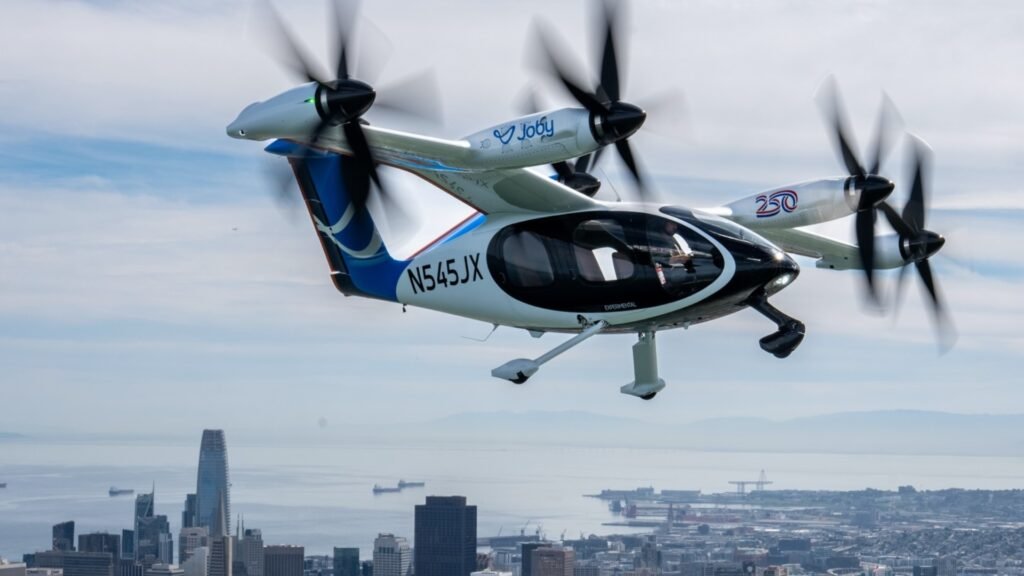
Image: Joby Aviation

California, United States: Joby Aviation has announced a strategic partnership with Air Space Intelligence (ASI) to accelerate the integration of electric vertical take-off and landing (eVTOL) aircraft into the United States National Airspace System (NAS), marking a critical shift from aircraft development to airspace readiness.

The collaboration, revealed on April 7, 2026, focuses on deploying ASI’s AI-powered Flyways platform as a core coordination layer to manage high-density eVTOL traffic, an emerging challenge as the industry approaches commercialization.

While much of the eVTOL race has historically centered on aircraft design such as range, noise, and efficiency the partnership highlights a growing industry concern: airspace congestion at scale.

With Joby eVTOL nearing FAA type certification and preparing for early commercial operations under the White House-backed eVTOL Integration Pilot Program, the focus is now shifting toward managing potentially hundreds of simultaneous flights across major urban corridors such as New York, Miami, and Dallas. The companies aim to address this challenge before large-scale deployment begins.

At the center of the collaboration is ASI’s Flyways AI, built on its PRESCIENCE platform, which creates a four-dimensional digital model of airspace by integrating real-time traffic data, weather inputs, and demand forecasts.

This system enables air traffic controllers to anticipate congestion and optimize routing proactively rather than reacting after disruptions occur.

Bernard Asare, President of Civil Aviation at Air Space Intelligence, emphasized the importance of this shift, stating, “Scaling advanced air mobility requires more than new aircraft… it requires a new operating system for the airspace.”

He added that the platform provides predictive awareness to coordinate high-density operations “proactively, not reactively,” bringing these capabilities to eVTOL operations from the outset.

Unlike earlier initiatives that focused primarily on drone traffic management systems, this partnership of eVTOL is designed to integrate directly with existing air traffic control (ATC) workflows rather than operate as a parallel system.

Flyways AI will augment controller decision-making within the current NAS infrastructure, a move that could prove critical in gaining regulatory acceptance and operational scalability.

The companies confirmed that joint demonstrations, including live operational exercises, are expected before the end of 2026, aligning with Joby’s planned commercial launch timeline.

These trials are expected to validate how AI-driven coordination performs in real-world, high-density airspace environments.

The partnership builds on ASI’s existing experience in conventional aviation, where its technology already supports major stakeholders, including airlines and U.S. defense operations. The company’s systems reportedly manage a significant portion of U.S. air traffic, strengthening its credibility in safety-critical environments.

Meanwhile, Joby eVTOL continues to advance toward commercialization. The company recently completed piloted demonstration flights in California and has been selected to participate in multiple projects under the U.S. government’s eVTOL Integration Pilot Program, which enables early operations across several states.  

Leave a Comment

Subscribe to our Newsletter

Recent News