Manitoba, Canada: The Transportation Safety Board of Canada (TSB), in its final investigation report released on 19 November 2026, identified an aircraft weight-and-balance exceedance in a fatal De Havilland DHC-2 Mk. I Beaver crashed near Makepeace Lake, Manitoba, on 13 September 2025. The investigation determined that the aircraft’s centre of gravity (CG) was positioned 109.2 inches, 3.1 inches beyond the permitted aft limit of 106.1 inches, at take-off.
The aircraft weighed approximately 5,274 pounds, below its maximum allowable take-off weight of 5,370 pounds. However, the TSB stated that it could not determine the final moments of the flight or establish the precise sequence that led to the aircraft colliding with trees and terrain.
The aircraft, registration C-FDPW, was operated by MHA Enterprises Ltd. and was conducting a visual flight rules (VFR) operation from St. Theresa Point to a remote camp at Makepeace Lake, carrying one pilot and four passengers. All four passengers sustained fatal injuries, while the pilot was seriously injured and subsequently evacuated to hospital in Winnipeg. A post-impact fire destroyed most of the aircraft.
According to the TSB, the aircraft’s weight-and-balance amendment dated 1 May 2023 was used to calculate its centre of gravity. The investigation found that the aircraft’s CG was 109.2 inches, compared with the rear limit of 106.1 inches.
The manufacturer indicated that the typical empty CG of a DHC-2 Mk. Mark I on floats is approximately 95 inches. However, the most recent weight-and-balance amendment showed that the occurrence aircraft’s empty CG on floats was 103.52 inches.
The operator had previously noticed that the calculated CG after loading the aircraft was usually outside the aft limit. It believed that the empty CG calculation was inaccurate, but no steps were taken to verify the calculation. The aircraft’s historical weight-and-balance records were destroyed in the post-impact fire, preventing investigators from confirming the accuracy of the calculated empty CG.
The TSB explained that an aircraft loaded with its CG behind the aft limit becomes less stable in pitch, more sensitive to control inputs and significantly harder to recover from a stall. An aft CG can also make stall recovery difficult or even impossible because the elevator may not have sufficient authority to lower the aircraft’s nose.
The occurrence aircraft was a single-engine De Havilland Aircraft of Canada Limited DHC-2 Mk. I, manufactured in 1959. It was equipped with EDO 4930 floats, had five seats and had accumulated an estimated 15,166 hours of total time since new.
The aircraft had several supplemental type certificates installed, including an engine relocation modification that moved the engine 9.75 inches forward, a gross-weight increase approval allowing a maximum weight of 5,370 pounds, upgraded pilot and co-pilot seats with lap straps and shoulder harnesses, and a Baron STOL system incorporating an aerodynamic stall warning system. The rear passenger seats were equipped with lap straps only.
The pilot held a commercial pilot licence – aeroplane, with 1,910 total flight hours, including approximately 140 hours on the aircraft type. The pilot’s Category 1 medical certificate was valid. The TSB found no indication that fatigue or medical factors negatively affected the pilot’s performance.
The aircraft had no outstanding recorded defects before the occurrence, and investigators found no indication that a component or system malfunction contributed to the accident.
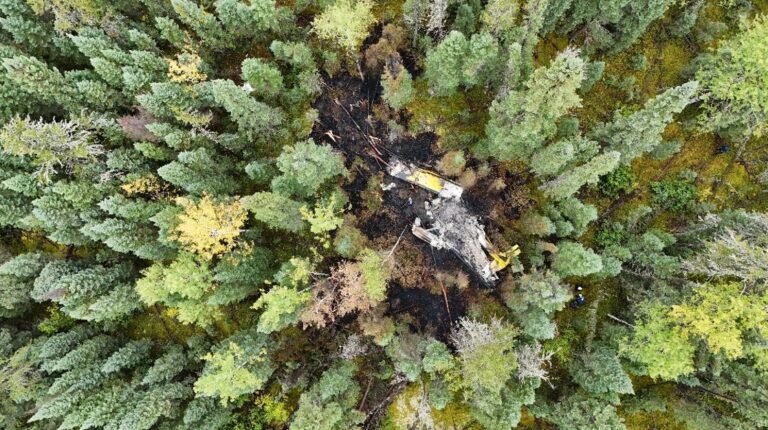
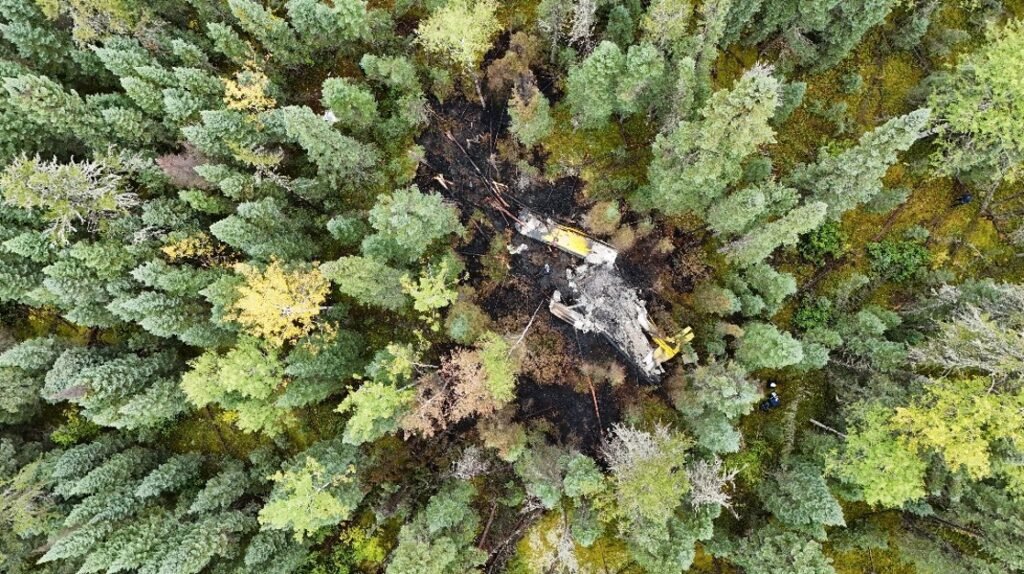
The TSB examination established that the aircraft collided with trees and terrain in a forested area at a very steep angle of descent. There was no indication of an in-flight breakup, and all aircraft components were found at the site, with the wing, tail and flight-control attachment points intact.
The fuselage was found lying on its right side, facing west-northwest, while the direction of travel was east-southeast. The engine and propeller remained attached to the aircraft.
The post-impact fire destroyed most of the aircraft, including parts of the engine and firewall, cockpit instruments, the entire fuselage and the cabin up to the rear bulkhead. The tail remained upright, with fire damage to the horizontal stabilizer and left elevator.
Investigators could not complete continuity checks of all cockpit flight controls and the right wing because of the extensive damage. However, continuity was established for the elevator and rudder controls at the tail, as well as the left-wing aileron and flap controls at the left-wing root. The flap position at the time of the accident could not be determined.
The TSB also stated that the origin of the post-impact fire could not be established because of the extent of the destruction. The DHC-2’s main fuel tanks were located directly beneath the passenger cabin floor, between the main landing gear attachment points. The report noted that this positioning makes the tanks vulnerable during an accident and can expose occupants to a fuel-fed fire if ignition occurs.
The engine and propeller were examined by overhaul facilities under TSB supervision, with no indication of malfunction. Further examination by the aircraft type certificate holder determined that the propeller was in fine pitch at the time of the accident.
The investigation also examined the transportation of two jerricans filled with gasoline inside the aircraft cabin.
The TSB stated that the transportation of the fuel containers was permitted under the Limited Access provision of Canada’s Transportation of Dangerous Goods Regulations, Section 12.9, and MHA Enterprises’ 702/703 Dangerous Goods Operations Manual.
However, the report highlighted the additional fire risk associated with carrying fuel or other flammable materials inside an aircraft cabin, noting that such materials can significantly increase the size and intensity of a fire following a crash.
Another significant issue raised in the final report concerns the absence of flight recording equipment aboard the aircraft.
The DHC-2 was not equipped with a flight data recorder (FDR) or cockpit voice recorder (CVR), and neither was required under the applicable regulations.
The TSB reiterated its longstanding Recommendation A18-01, issued on 26 April 2018, calling on Transport Canada to require commercial and private operators not already covered by existing requirements to install lightweight flight recording systems.
The recommendation states, “The Transportation Safety Board of Canada recommends that the Department of Transport require the mandatory installation of lightweight flight recording systems by commercial operators and private operators not currently required to carry these systems.”
According to the report, Transport Canada indicated in December 2024 that it had removed the development of regulations mandating lightweight data recorders from its forward regulatory plan, meaning work would not begin before 2028 at the earliest.
In its December 2025 response, Transport Canada reiterated that it agreed in principle with the recommendation but said priorities would continue to be reassessed and work would resume when resources permitted.
The TSB consequently considered it unlikely that regulatory requirements for lightweight flight recorders would be introduced before 2030, 20 years after the International Civil Aviation Organization introduced the requirement and 12 years after the TSB issued its recommendation.
The Board described its response as “Unsatisfactory” and assigned the recommendation a “Dormant” status, reflecting its concerns over lengthy delays, limited progress and potential changes in the scope of the proposed regulations.
The TSB report detailed how the pilot was located following the accident through emergency alerts generated by the aircraft’s emergency locator transmitter (ELT) and the pilot’s mobile phone.
The ELT activated following the crash, and the Joint Rescue Coordination Centre (JRCC) in Trenton, Ontario, was notified. However, the signal stopped transmitting shortly afterwards, presumably because of the post-impact fire.
The Island Lake RCMP responded and arrived at the accident site. The four passengers had sustained fatal injuries, while the seriously injured pilot was found approximately 150 metres from the aircraft. Officers began providing medical assistance before search and rescue technicians arrived at and took over.
The pilot was subsequently evacuated by helicopter from the crash site to Island Lake Airport (CYIV) before being transported by aircraft to a hospital in Winnipeg.
The report explained that the phone’s crash detection system uses sensors and algorithms to identify severe impacts, including sudden changes in movement detected through an accelerometer and gyroscope, impact-related sounds recorded through the microphone and cabin pressure changes detected by the barometer. If the user does not respond to the alert and its 20-second countdown, the phone automatically contacts emergency services. Where cellular or Wi-Fi connectivity is unavailable, it attempts to establish contact through satellite communication.
According to the TSB’s reconstruction, the aircraft was scheduled to complete three round-trip flights under day VFR from MHA Enterprises’ float operations base in St. Theresa Point on 13 September 2025. The first two flights to locations in northern Manitoba were reported to have been uneventful.
The third flight was scheduled to depart at approximately 1500 (3:00 PM) , carrying four passengers to a remote camp at Makepeace Lake. At approximately 1430 (2:30 PM), the pilot loaded the aircraft with camp supplies, including rifles and two jerricans filled with gasoline.
The pilot made two attempts to take off but was asked to return to the dock by one of the passengers, who was experiencing anxiety about flying. Following the return, the decision was made to unload the aircraft and cancel the flight for the day.
At approximately 1700, the passengers called to reschedule the journey for 1800. The cargo was reloaded, and the passengers boarded the aircraft.
At approximately 1830, the aircraft completed its take-off and proceeded towards Makepeace Lake. The flight was reported to have been smooth and uneventful.
As the aircraft approached the lake, the pilot turned right and flew along its north shore for approximately 600 metres, based on the last position recorded by the pilot’s SPOT satellite tracking device. The aircraft subsequently collided with trees and terrain in the forest, followed by a post-impact fire.
The closest weather station, CYIV, located 27 nautical miles north-northeast of the accident site, recorded conditions suitable for VFR operations. The 1800 (6:00 PM) automatic weather report indicated winds from 140° true at 5 knots, visibility of 9 statute miles, clear skies, a temperature of 20.6°C, a dew point of 8.7°C and an altimeter setting of 30.09 inches of mercury. The TSB did not consider weather a factor in the occurrence.
The TSB concluded that the final moments of the flight could not be determined. It reiterated the importance of lightweight flight recording systems in providing investigators with information that can help advance aviation safety.
The report emphasised the responsibility of aircraft owners and operators to provide pilots with accurate weight-and-balance information before dispatching an aircraft.
It stated, “Before dispatching an aircraft, owners and operators must make an accurate weight and balance report available to pilots so that they can load cargo and passengers within the aircraft’s CG limit.”
The TSB further reminded pilots of the potential consequences of operating an aircraft outside its approved centre-of-gravity limits, stating, “Pilots must remain aware that an aircraft loaded outside its CG limits can change flight characteristics in unanticipated ways that can result in a loss of control.”
The report concludes the TSB’s investigation into the occurrence. The Board authorised its release on 19 August 2026, and it was officially published on 19 November 2026.