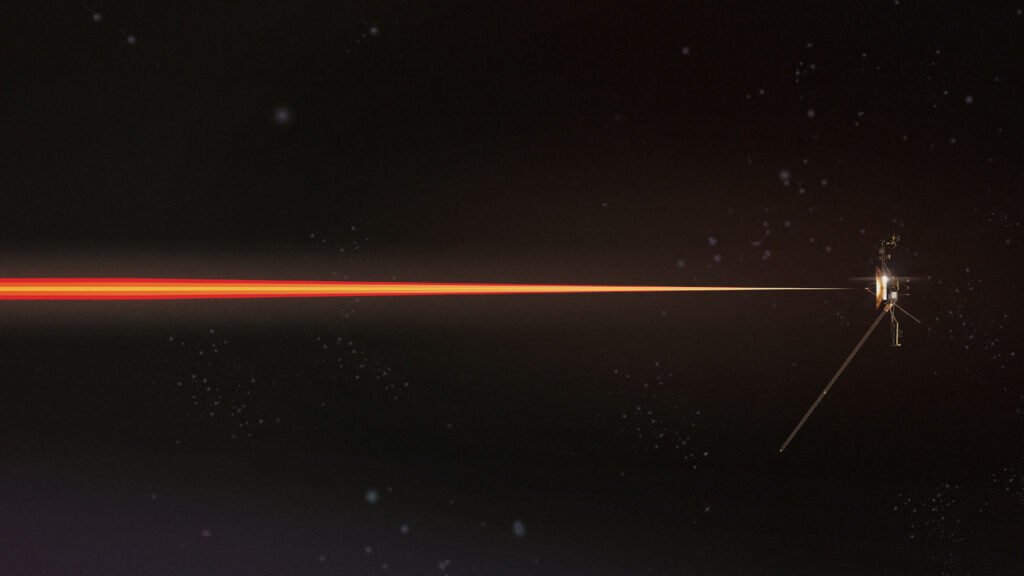
California, United States: NASA’s Voyager 1, humanity’s farthest-flying spacecraft, reached a distance of one light-day from Earth on November 18, 2026, marking a historic milestone after more than 49 years of continuous travel through space.
According to NASA’s November 19 press release, the spacecraft achieved the milestone at 2:16 a.m. Pacific Standard Time (PST), corresponding to 5:16 a.m. Eastern Standard Time (EST). One light-day represents the distance light travels in 24 hours, approximately 16.1 billion miles (25.9 billion kilometres).
Mission team members at NASA’s Jet Propulsion Laboratory (JPL) in Southern California, which is managed by Caltech, received the spacecraft’s signal 24 hours after the milestone, early Thursday, November 19. The delay reflects the time required for its radio transmission, travelling at the speed of light, to reach Earth.
Joe Westlake, director of NASA Headquarters’ Heliophysics Division in Washington, described travelling a light-day as “a singular feat for a spacecraft”. He highlighted that Voyager’s contribution extends beyond its extraordinary distance, noting that its exploration of the outer planets transformed planetary science and subsequently made the spacecraft an important part of NASA’s heliophysics mission fleet, providing insights into the Sun.
NASA explained that scientists use light to measure the enormous distances involved in space exploration. Light travels at approximately 186,000 miles (299,000 kilometres) per second in a vacuum. A ray of sunlight takes approximately 1.3 seconds to reach the Moon from Earth, around four hours to reach Neptune and another 20 hours to reach Voyager 1. For comparison, one light-year represents approximately 5.88 trillion miles (9.46 trillion kilometres).
However, the milestone comes amid a communication challenge. NASA has not received science and engineering data from Voyager 1 since November 14, 2026. The spacecraft continues transmitting a carrier signal, which typically accompanies the scientific and engineering data sent to Earth.
Mission engineers used this carrier signal, alongside trajectory calculations, to confirm that Voyager 1 had crossed the one-light-day threshold. The team continues investigating the issue affecting the transmission of science and engineering data.
Voyager 1 and its twin spacecraft, Voyager 2, were launched in 1977 to take advantage of a rare alignment of the planets. Managed by NASA’s Jet Propulsion Laboratory, they became the third and fourth spacecraft to visit Jupiter and Saturn, respectively, and the first to return high-resolution images of these planets, significantly advancing scientific understanding of their environments and moons.
Voyager 2 subsequently continued its journey to study the ice giants Uranus and Neptune. Both spacecraft continue measuring changes in the Sun’s magnetic field across vast distances.
Dave Gallagher, director of JPL, described Voyager 1’s crossing of the one-light-day threshold as another historic achievement in an extraordinary journey of discovery. He credited the teams responsible for building, programming and operating the spacecraft, highlighting their efforts to overcome numerous technical challenges and maintain communication across interstellar distances.
Gallagher also emphasised that Voyager and the people behind the mission continue to inspire future generations as NASA advances human and robotic exploration towards new frontiers.
In addition to their scientific instruments, both Voyager spacecraft carry the Golden Record, a gold-plated copper phonograph containing images and sounds from Earth. The record was designed as a message for any advanced civilization that might encounter the spacecraft in the distant future.
Ray Jayawardhana, president of Caltech, highlighted the mission’s enduring scientific and human significance, recognising the vision of Ed Stone, the Caltech physicist and former JPL director who guided Voyager for decades, alongside generations of scientists and engineers who continued his work. He noted that the mission represents humanity’s curiosity and determination to explore beyond Earth, with its ultimate destination still unknown.
Voyager 1 travels at approximately 38,000 miles per hour (61,155 kilometres per hour). In 2012, it became the first human-made spacecraft to leave the heliosphere, the enormous bubble of particles and magnetic fields generated by the Sun that helps deflect cosmic radiation, and enter interstellar space. Voyager 2, following a different trajectory, crossed the heliosphere’s boundary in 2018.
Linda Spilker, Voyager project scientist at JPL, highlighted how the spacecraft are transforming scientific understanding of interstellar space, a region beyond the heliosphere that had previously remained unexplored. One significant discovery has been the extent to which the Sun continues to influence the surrounding interstellar environment, even at Voyager 1’s present distance. The mission may eventually help scientists determine where the Sun’s influence ends and pristine interstellar space begins.
Maintaining the spacecraft over nearly five decades has required creative engineering solutions to conserve power and address ageing hardware. NASA identified challenges including clogged thrusters and a malfunctioning onboard computer.
Earlier in 2026, engineers successfully switched off three devices on Voyager 1 and replaced them with three lower-power alternatives. The measure, which involved technical risks, was intended to extend the operating life of the spacecraft by reducing its energy consumption.
The probes rely on radioisotope thermoelectric generators, which function as nuclear batteries by converting heat produced through the radioactive decay of plutonium into electricity. With their plutonium supplies continually depleting, both Voyager spacecraft lose approximately four watts of electrical power every year.
NASA expects the latest energy-saving measures to provide sufficient power for both spacecraft to continue operating their existing suites of scientific instruments until at least their 50th launch anniversaries next summer, in 2027.
Communication with Voyager 1 and Voyager 2 is managed through NASA’s Deep Space Network, a system of large antennas located at three facilities around the world. The network supports communications with NASA spacecraft travelling beyond the Moon and across the solar system.
Suzanne Dodd, Voyager project manager at JPL, explained that the team listens to Voyager 1 every day and sends commands to the spacecraft weekly. At its current distance, signals require approximately 24 hours to travel from Earth to the spacecraft and another 24 hours for a response to return.
Dodd also reflected on the mission’s eventual future, when Voyager 1 will no longer be able to communicate with Earth, describing its anticipated role as humanity’s “silent ambassador to the stars”.
Nearly half a century after launch, Voyager 1 continues its journey beyond the boundaries of the solar system, carrying scientific instruments and a record of life on Earth into interstellar space.