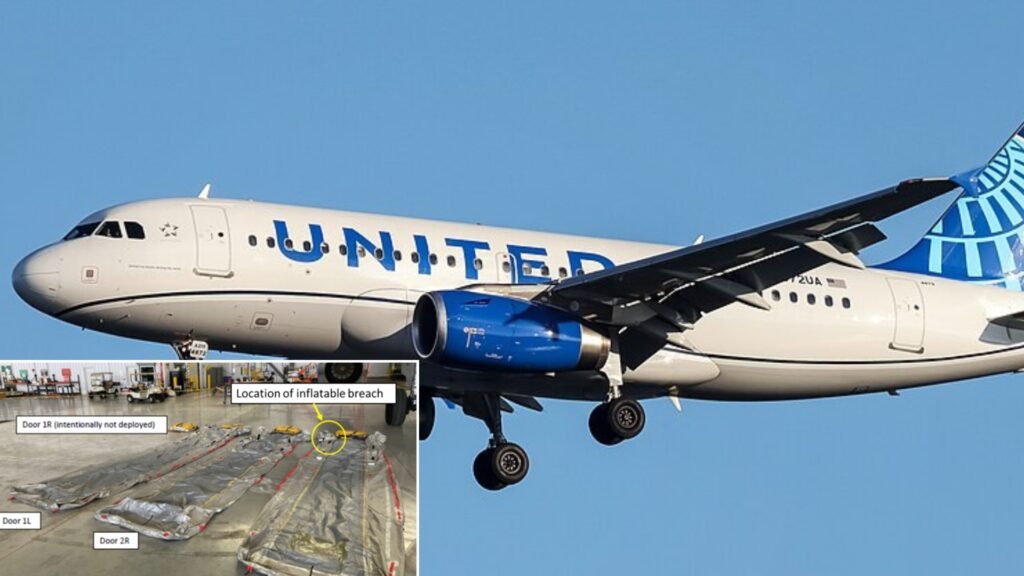
Houston, United States: The National Transportation Safety Board (NTSB) has released its final investigation report into a rejected takeoff and emergency evacuation involving a United Airlines Airbus A319 in Houston, concluding that breakdowns in crew coordination and escalating passenger panic significantly increased risk during the incident.
The occurrence took place on February 2, 2025, at 08:16 local time at George Bush Intercontinental Airport. United Airlines Flight 1382, bound for New York LaGuardia, was accelerating for departure when a loud bang was heard from the right engine, followed by an “ENG 2 FAIL” indication. The aircraft had not yet reached decision speed when the flight crew rejected the takeoff and brought the jet to a stop on the runway. All 112 occupants, 107 passengers and five crew members remained unharmed.
According to the final report, the incident was triggered by a failure within the right engine’s high-pressure compressor. A detailed teardown later confirmed that a third-stage rotor blade fractured due to high cycle fatigue after accumulating more than 40,000 flight hours and over 19,500 cycles. The failure caused internal damage to the engine but remained contained, preventing further structural consequences to the aircraft.
What followed inside the cabin, however, became the central focus of the investigation. Despite repeated instructions from both pilots and cabin crew to remain seated, several passengers began shouting that the engine was on fire. Panic quickly spread, particularly in the rear cabin, where passengers stood up, retrieved carry-on baggage, and moved toward the exits. Cabin crew efforts to restore order were increasingly ineffective as congestion built in the aisle and near the aft galley.
Faced with escalating pressure and unable to establish communication with the cockpit, a flight attendant initiated an evacuation from the rear left door without direct authorization from the flight crew. Investigators found that the evacuation alarm was not activated, a critical procedural step designed to alert the cockpit and coordinate actions. As a result, the evacuation began while the aircraft’s left engine was still running.
The premature opening of the rear left door created a hazardous situation. The evacuation slide deployed into the exhaust airflow of the operating engine, causing it to whip violently and twist for nearly 100 seconds.
During this period, three passengers descended the slide before it fully stabilized. The slide subsequently deflated after a structural component failed under stress, rendering the exit unusable. Evacuation was then redirected to the rear right door, where the slide deployed normally and passengers were able to exit safely.
The investigation determined that the slide failure was not due to manufacturing defects but was caused by structural overload when exposed to engine exhaust forces beyond its design limits. Safety analysis confirmed that evacuation slides are not certified to operate under such conditions, underscoring the risks of initiating evacuation procedures without full engine shutdown.
The NTSB’s final report, published on April 29, 2026, identified the probable cause as the failure of the cabin crew to activate the evacuation alarm and maintain effective communication with the flight crew after deciding to evacuate.
This breakdown resulted in passengers evacuating while an engine remained operational. The report also highlighted passenger noncompliance as a major contributing factor, noting that individuals ignored instructions, retrieved baggage, and in some cases forced access to exits, accelerating the breakdown of order in the cabin.
The findings align with longstanding safety concerns about passenger behavior during emergencies. The Federal Aviation Administration has repeatedly warned that retrieving carry-on baggage during evacuations can delay egress and increase risk.
In response to similar incidents, the agency issued Safety Alert for Operators (SAFO) 25003 in September 2025, urging airlines to strengthen passenger briefings and improve communication strategies to discourage such behavior. No injuries were reported in this incident, investigators emphasized that the outcome could have been far more serious.