Doha, Qatar: The Arab Air Carriers’ Organization (AACO) has projected that its member airlines will collectively record a net loss of approximately US$4.3 billion in 2026, reversing the strong financial performance achieved in the previous year. The projection was outlined in AACO’s Annual Report and Arab Air Transport Statistics 2026, whose highlights were released on 3 November 2026 following the organisation’s 59th Annual General Meeting (AGM) in Doha, Qatar.
According to AACO’s State of the Industry report, presented by Secretary General Abdul Wahab Teffaha during the AGM working sessions on 3 November, regional conflict, rising energy costs and operational disruptions have placed considerable pressure on the Arab aviation sector. The report also highlighted that the outlook for 2026 remains challenging, with airlines facing varying levels of exposure depending on their hub locations and operations in conflict-affected markets.
AACO expects passenger traffic among its member airlines, measured in revenue passenger kilometres (RPKs), to decline by 10.3% in 2026, while available seat kilometres (ASKs), which measure offered passenger capacity, are projected to fall by 4.7%. Consequently, the passenger load factor is expected to decrease to 77%, compared with stronger demand and capacity performance in 2025. The operating margin is also projected to fall to -2.7%, against 11.8% recorded in 2025.
The financial outlook marks a significant reversal from 2025, when AACO member airlines collectively recorded approximately US$11 billion in net profit, with a net margin of 10.8%. During the same year, passenger traffic measured in RPKs grew by 7.6%, while seat capacity, measured in ASKs, increased by 5.8%. Air cargo traffic, measured in cargo tonne kilometres (CTKs), also registered growth of 4%.
The pressure is expected to extend to the region’s cargo sector. AACO projects a 5.2% decline in air cargo traffic among its member airlines in 2026, reflecting the challenging operating environment and disruptions affecting regional and international air transport.
The report also highlighted the impact of aircraft and engine delivery delays on airline operations. According to AACO, continuing delays in deliveries of aircraft, engines and spare parts are constraining fleet renewal and increasing operating costs. The global aircraft order backlog stood at 17,250 aircraft in 2025 and is expected to exceed 18,000 by the end of 2026.
In response to supply-chain challenges, AACO Secretary General Abdul Wahab Teffaha outlined the Executive Committee’s direction to establish a working group to examine the possibility of jointly managing spare parts inventories among member airlines, with potential cooperation extending to procurement.
Despite the difficult 2026 outlook, the report highlighted the region’s growth in the preceding year. Passenger traffic at Arab airports increased by 8.1% in 2025, exceeding 500 million passengers. AACO member airlines operated a fleet of 1,587 aircraft as of 31 July 2025 and received 121 aircraft during 2025, taking their combined aircraft order backlog to 1,734.
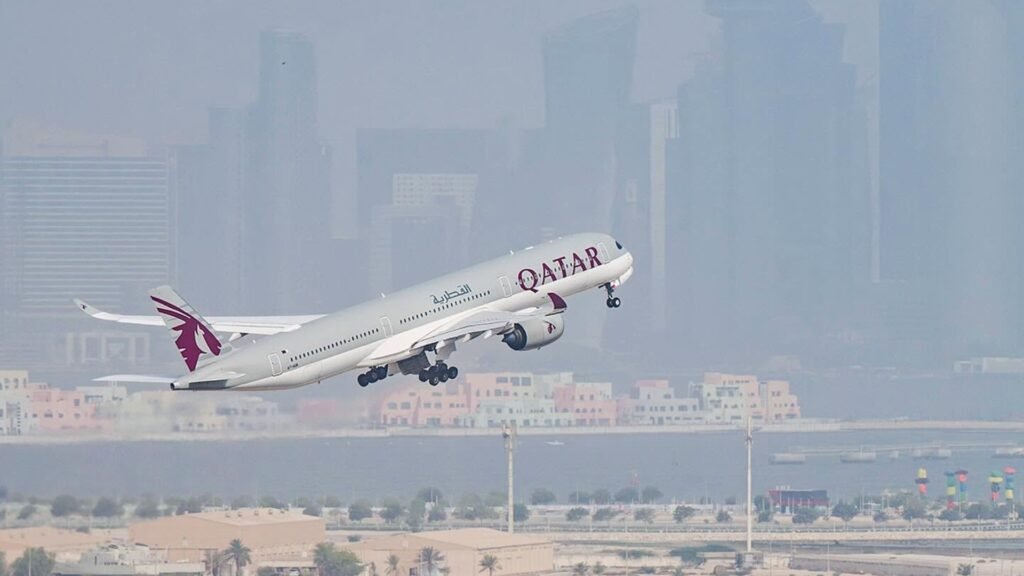
The 59th AACO AGM was held from 2 to 4 November 2026 at the Sheraton Grand Doha Resort & Convention Hotel in Doha, under the patronage of Qatar’s Prime Minister and Minister of Foreign Affairs, Sheikh Mohammed bin Abdulrahman bin Jassim Al-Thani, and hosted by Qatar Airways. The working sessions on 3 November brought together airline executives, industry representatives and regional aviation organisations to discuss the industry’s economic outlook, operational challenges and strategic priorities.
AACO also made its Annual Report and Arab Air Transport Statistics 2026 available electronically to delegates during the AGM. The report covers the organisation’s work across aviation policy, environmental sustainability, digital transformation and cooperation among member airlines.
The projected US$4.3 billion loss underscores the financial and operational challenges facing Arab airlines in 2026, particularly as regional instability, higher operating costs and aircraft supply constraints continue to affect the industry’s recovery and growth prospects.