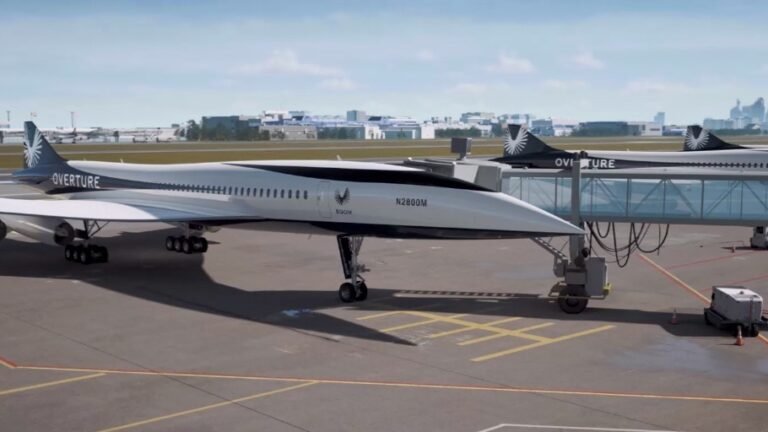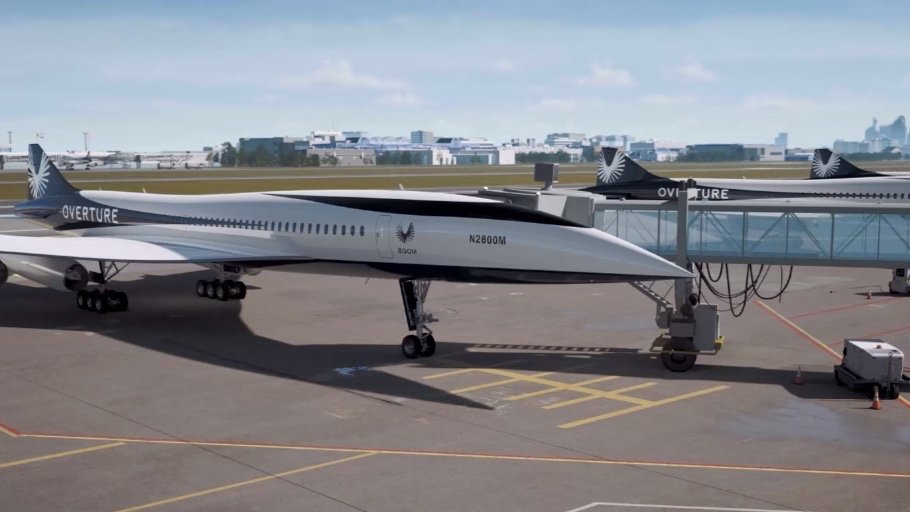
Denver, United States: United Airlines CEO Scott Kirby has cast doubt on Boom Supersonic planned 2029 entry into commercial service for its Overture supersonic aircraft, saying the programme will take longer than the company has projected and still faces significant development and certification challenges.
Speaking to Monica Langley on the Office Hours: Business Edition podcast, published on 28 October 2026, Kirby said: “It’s not going to happen in ’29. It’s going to take longer.” The interview was recorded at United Airlines’ pilot training facility in Denver, Colorado, where Langley met Kirby to discuss aviation, supersonic travel and the airline’s business.
Kirby acknowledged that United could become the first airline to operate the Overture if the programme succeeds. However, he cautioned that the aircraft must clear several regulatory and technical hurdles before entering service.
“United, I think will be, if it happens, will likely be the first airline,” Kirby told Langley. “However, they have to get through all the certification they got. They’ve got a lot of hurdles to overcome. So it’s not guaranteed that they’re going to overcome it.”
The comments highlight uncertainty surrounding Boom’s previously announced timeline. When United signed its agreement with Boom in June 2021, the companies outlined plans for the Overture aircraft to roll out in 2025, complete its first flight in 2026 and begin carrying passengers in 2029.
Under the agreement, United committed to purchasing 15 Overture aircraft, with an option for another 35, subject to the aircraft meeting the airline’s safety, operating and sustainability requirements. United was the first US airline to sign a commercial aircraft purchase agreement with Boom.
Despite questioning the aircraft’s development schedule, Kirby expressed confidence in Boom founder and CEO Blake Scholl, praising his leadership and ability to adapt the company’s business strategy.
“He’s a great guy. He’s done a great job,” Kirby said, adding that Scholl had done “an incredible job of pivoting when he needed to.”
Kirby specifically referred to Boom’s move into developing gas turbines for electricity generation at data centres. He explained that the technology being developed for supersonic propulsion could also have applications in the energy sector.
“They’re building turbines for data centers now,” Kirby said. “It turns out that a supersonic turbine runs really hot, runs even hotter than a regular engine, and has the potential to be one of the best power sources.”
Kirby also recalled his first meeting with Scholl, describing how he joked about the company’s name and its marketing strategy.
“I said, ‘Blake, like you’re an amazing engineer. It’s incredible what you’ve done, but you’re a terrible marketer.’”
Kirby recalled that Scholl initially appeared confused before explaining the connection between the company’s name and the sound associated with supersonic flight.
“And I said, ‘Well, you, you got an aircraft company; you named it Boom.’ And he’s like, ‘No, no, you get it. Like it’s a supersonic boom.’ Like ‘Blake, I get it, but boom means other things too.’”
Kirby clarified that the exchange was light-hearted, saying, “I was just giving him grief. I like doing that to people.”
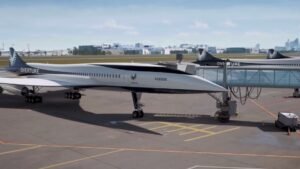
Boom is developing the Overture as a supersonic passenger aircraft designed to cruise at Mach 1.7, with a projected range of 4,250 nautical miles and seating capacity for 60 to 80 passengers. The company plans to manufacture the aircraft at its facility at Piedmont Triad International Airport in Greensboro, North Carolina.
Beyond United, Boom has secured conditional orders and pre-orders involving American Airlines and Japan Airlines. The company’s advertised commercial order book stands at 130 aircraft, including orders and pre-orders.
A major part of the aircraft’s development depends on its Symphony engine programme. Boom is also pursuing a parallel energy business through its Superpower natural gas turbines, intended to supply electricity to AI data centres.
On 22 October 2026, Boom announced that it had completed its first prototype turbine core, named Sprint Core. The assembly combines the compressor, combustor and high-pressure turbine and is intended to support the development of both the Superpower turbine and the Symphony engine for Overture.
The company said the prototype incorporates more than 1,000 sensors to measure operating conditions, including temperatures, pressures, strains, timing and vibrations. Initial turbine firing was expected before Thanksgiving 2026 at its Colorado test facility.
Boom has also unveiled a nearly 200,000-square-foot Superpower manufacturing campus in Centennial, Colorado, representing a planned investment of $150 million. The company has outlined plans for initial Superpower deliveries in mid-2027, followed by annual production targets of 25 turbines in 2028 and 50 in 2029.
The energy programme is intended to provide an additional commercial application for the company’s turbine technology while supporting the longer-term development of its aircraft propulsion system.
The Overture programme faces a complex certification process, with Kirby’s remarks underscoring that the aircraft’s development schedule cannot be treated as assured.
The challenge also comes more than two decades after Concorde’s final commercial flight in October 2003. While Boom aims to bring supersonic passenger travel back into commercial aviation, the aircraft and its engines must still demonstrate compliance with applicable safety and certification requirements.
The US Federal Aviation Administration has separately proposed changes to regulations governing civil supersonic flight over land, but changes to operating restrictions would not remove the requirement for aircraft and engine certification.
Kirby’s latest assessment follows his earlier comments in March 2026, when he reportedly put the chances of Overture entering commercial service at around 50-50.
Although United remains a prospective launch operator, Kirby’s latest comments indicate that the airline is not treating Boom’s 2029 target as a firm delivery or operational timeline. The aircraft’s eventual entry into service will depend on Boom overcoming the engineering, testing and certification challenges that remain.