News
Civil Aviation
Pilot Training
Flight School Analysis
Aviation Jobs
Training
Services
About Us
Contact Us

India’s Pilot Training Boom Faces Test Of Safety, Standards And Industry Maturity

Picture of Aviation Today Perspectives

Aviation Today Perspectives

A hard look at the system behind the licence before speed and hype define the future of Indian aviation. India is producing pilots at a pace the country has never seen before. This is a positive development. A large and growing airline market needs trained professionals, and a nation with India’s aviation ambition cannot remain dependent on foreign flight schools forever. But growth is not maturity. The real question before Indian aviation is not whether we can produce pilots faster. It is whether we are building a pilot-training system strong enough to produce them safely, consistently and honestly. By 30 June 2026, India had issued 1,331 Commercial Pilot Licences. Of these, 540, or 41 percent, were issued to cadets trained outside India. This tells us two things at once: demand is real, and domestic capacity still has substantial work to do. The country is expanding its FTO network, aircraft fleet and cadet intake. Yet the system cannot measure its success only by licences issued, aircraft inducted or advertisements released. A CPL is not the finish line. It is the beginning of professional formation. The dangerous language of fast track flying: The most worrying development in pilot training is not ambition. It is the language surrounding ambition: fast-track CPL, airline pilot in record time, guaranteed placement, finish early, fly early, earn early. Such promises may attract students, but they can quietly distort the purpose of training. Aviation is not a product that becomes better because it is delivered faster. A student pilot is not a customer moving through a production line. Flying competence takes time: time to make errors under supervision, time to develop judgement, time to understand weather, time to learn restraint, and time to build respect for procedures. An industry built around the fastest possible licence will eventually face the consequences of the slowest-developing element in aviation: judgement. There is nothing wrong with efficient training. There is everything wrong with training efficiency becoming a commercial pressure that competes with operational discipline. A cadet should never feel that a delay caused by weather, maintenance, instructor assessment or a failed standard is an injustice. In aviation, delay is often the system protecting the student. The truth must be stated without hesitation: no FTO can ethically guarantee an airline job. It can guarantee transparent training, good instruction, aircraft availability, fair standards, honest counselling and employability support. It cannot guarantee the airline market, medical fitness, individual performance, type-rating outcomes or future hiring cycles. “A licence may be promised. A career cannot.” Safety must be a value not a priority: A priority can change with the day’s pressure. It can move when a target is missed, an aircraft is unavailable, admissions slow down or an investor asks difficult questions. A value does not move. This distinction is at the heart of India’s present training challenge. When safety is treated as a priority, it may be pushed aside in the name of utilisation, student completion, revenue or reputation. When safety is treated as a value, every decision dispatch, weather, fuel, aircraft serviceability, instructor release, solo authorisation, continuation or diversion must pass through it. The record of accidents and serious incidents is not an argument against flight training. Flying training will always involve risk because it is where people learn to manage aircraft, weather, workload and error. But the record must force us to ask better questions. In one final investigation report, the Aircraft Accident Investigation Bureau reviewed ten years of FTO accidents through December 2022 and recorded 28 accidents, including 10 involving fatalities. IMAGEEEEEEEEEE : PG 33 GRAPH It identified repeated themes: deviation from standard procedures, unauthorised activity, low flying, operations below visual conditions, incorrect take-off and landing patterns, weak supervision and shortcomings in safety culture. These are not merely technical failures. They are organisational warnings. The lesson is not that every accident has one cause or that every FTO is unsafe. Investigation must never be used to apportion blame before facts are established. The lesson is that a system cannot market speed and scale while treating safety reporting, instructor standardisation, maintenance discipline and independent oversight as paperwork. Every FTO should be able to answer simple questions with evidence: How many unstable approaches were discontinued? How many weather-related no-go decisions were supported by management? How many maintenance defects were reported, repeated and permanently rectified? How are instructors standardised, checked and supervised? What hazards are reported voluntarily, and what corrective action follows? How is student pressure identified before it becomes unsafe decision-making? If these answers are not visible inside the organisation, safety is probably being managed as a document, not lived as a value. The overseas training question: The 41 percent overseas share is not proof that Indian training is inferior. It is proof that Indian students are making practical choices in response to capacity, aircraft availability, weather, timelines, perceived quality, international exposure and confidence in completion schedules. Foreign training can offer advantages: reliable flying weather in some regions, larger fleets, established training systems, exposure to controlled airspace and a more predictable training calendar. But it also brings conversion complexity, regulatory differences and the challenge of adapting back to Indian airspace, procedures and airline expectations. India should not respond by criticising foreign training. It should respond by becoming the more dependable option. That means Indian FTOs must compete on quality of outcomes, not merely on lower advertised fees or shorter timelines. The goal should be a mature domestic system where training is transparent, safe, professionally supervised and globally credible. Why MPL should wait? The Multi-Crew Pilot Licence is not inherently unsafe. Properly designed, it is a sophisticated, competency-based airline pathway. ICAO introduced MPL provisions in 2006, and EASA’s Part-FCL framework has developed detailed requirements around it for years. But MPL is not simply a cheaper CPL with more simulator hours. It requires a tightly controlled ecosystem: a genuine and continuing airline-ATO relationship; validated competency standards; high-fidelity, well-supervised simulation; instructors with substantial multi-crew operational experience; calibrated assessors; robust data monitoring; transparent safeguards; and an airline culture capable of taking responsibility for the cadet from selection through line operations. EASA’s framework recognises this depth. MPL is linked to structured ATO–operator arrangements and instructor requirements rooted in multi-pilot experience and crew-resource-management competence. This is not an off-the-shelf programme to be inserted into a fragmented training market. India should therefore resist any hurried, mass-market MPL rollout for at least the next decade. This is not opposition to innovation. It is respect for sequencing. Before MPL is introduced at scale, India should first demonstrate: A stable and independently audited FTO oversight system. Stronger instructor training, standardisation and recurrent-checking systems. Mandatory safety-management systems that produce usable, protected occurrence data. Clear national standards for simulator qualification, availability, fidelity and data capture. Airline-linked MPL programmes where the airline, not merely the student, holds genuine responsibility for the training outcome. Public reporting of completion rates, washout rates, safety events, instructor ratios and post training performance. A regulatory workforce with the capacity to supervise competency-based programmes continuously, not only approve them on paper. “MPL may become right for India. But it will become right only when India is ready to regulate it as an airline-integrated safety system, not as another commercial shortcut.” The choice before Indian aviation: “India does not need fewer pilots. It needs better-developed pilots, better-supported instructors, better-governed FTOs and more mature oversight.” The next decade should not be about producing the largest number of CPLs. It should be about building the most trustworthy pilot-development system in the region. The aviation industry must reject the culture of hype. It must stop selling certainty where none exists. It must stop treating time as the only measure of success. A pilot is not produced when the logbook reaches a number. A pilot is formed when competence, judgment, humility, discipline and safety values become stronger than commercial pressure. India has the demand. It has talent. It has the opportunity. Now it must prove that its rules, institutions and mindset can mature at the same speed as its ambition. National Pilot Training Agenda & Flight Training Bharat Standards: The National Pilot Training Maturity Agenda can be advanced through Flight Training Bharat Standards: an industry-led, voluntary benchmark designed to complement DGCA requirements, not replace regulatory approval, surveillance or enforcement. Its purpose is to raise common expectations for safety, instructional quality, cadet protection and transparent outcomes across the training ecosystem.
Image: Representational

A hard look at the system behind the licence before speed and hype define the future of Indian aviation. 

India is producing pilots at a pace the country has never seen before. This is a positive development. A large and growing airline market needs trained professionals, and a nation with India’s aviation ambition cannot remain dependent on foreign flight schools forever. But growth is not maturity. The real question before Indian aviation is not whether we can produce pilots faster. It is whether we are building a pilot-training system strong enough to produce them safely, consistently and honestly.

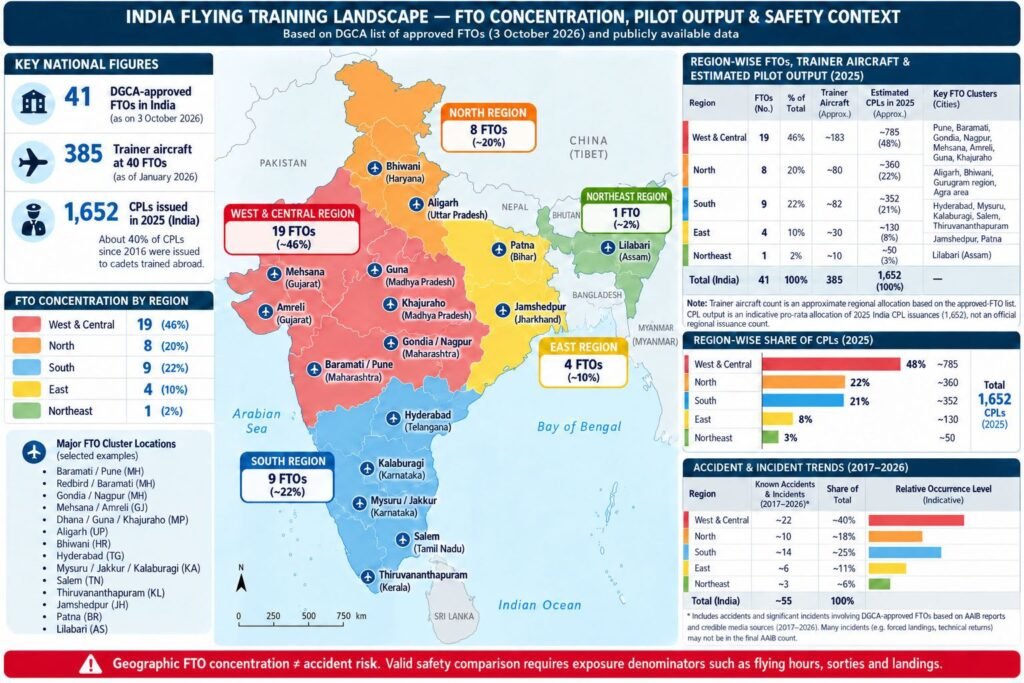
By 30 June 2026, India had issued 1,331 Commercial Pilot Licences. Of these, 540, or 41 percent, were issued to cadets trained outside India. This tells us two things at once: demand is real, and domestic capacity still has substantial work to do. The country is expanding its FTO network, aircraft fleet and cadet intake. Yet the system cannot measure its success only by licences issued, aircraft inducted or advertisements released. A CPL is not the finish line. It is the beginning of professional formation. 

The dangerous language of fast track flying: 

The most worrying development in pilot training is not ambition. It is the language surrounding ambition: fast-track CPL, airline pilot in record time, guaranteed placement, finish early, fly early, earn early. 

Such promises may attract students, but they can quietly distort the purpose of training. Aviation is not a product that becomes better because it is delivered faster. A student pilot is not a customer moving through a production line. Flying competence takes time: time to make errors under supervision, time to develop judgement, time to understand weather, time to learn restraint, and time to build respect for procedures. An industry built around the fastest possible licence will eventually face the consequences of the slowest-developing element in aviation: judgement. 

There is nothing wrong with efficient training. There is everything wrong with training efficiency becoming a commercial pressure that competes with operational discipline.

A cadet should never feel that a delay caused by weather, maintenance, instructor assessment or a failed standard is an injustice. In aviation, delay is often the system protecting the student. 

The truth must be stated without hesitation: no FTO can ethically guarantee an airline job. It can guarantee transparent training, good instruction, aircraft availability, fair standards, honest counselling and employability support. It cannot guarantee the airline market, medical fitness, individual performance, type-rating outcomes or future hiring cycles. “A licence may be promised. A career cannot.”

Safety must be a value not a priority:

A priority can change with the day’s pressure. It can move when a target is missed, an aircraft is unavailable, admissions slow down or an investor asks difficult questions. A value does not move. 

This distinction is at the heart of India’s present training challenge. When safety is treated as a priority, it may be pushed aside in the name of utilisation, student completion, revenue or reputation. When safety is treated as a value, every decision dispatch, weather, fuel, aircraft serviceability, instructor release, solo authorisation, continuation or diversion must pass through it. 

The record of accidents and serious incidents is not an argument against flight training. Flying training will always involve risk because it is where people learn to manage aircraft, weather, workload and error. But the record must force us to ask better questions. 

In one final investigation report, the Aircraft Accident Investigation Bureau reviewed ten years of FTO accidents through December 2022 and recorded 28 accidents, including 10 involving fatalities.
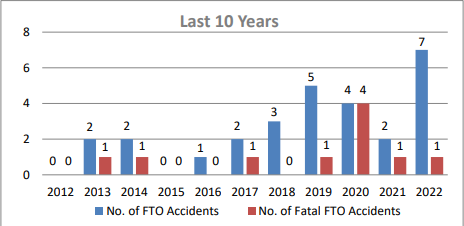
Image: AAIB

It identified repeated themes: deviation from standard procedures, unauthorised activity, low flying, operations below visual conditions, incorrect take-off and landing patterns, weak supervision and shortcomings in safety culture. These are not merely technical failures. They are organisational warnings. 

The lesson is not that every accident has one cause or that every FTO is unsafe. Investigation must never be used to apportion blame before facts are established. The lesson is that a system cannot market speed and scale while treating safety reporting, instructor standardisation, maintenance discipline and independent oversight as paperwork. 

Every FTO should be able to answer simple questions with evidence:

  • How many unstable approaches were discontinued?  
  • How many weather-related no-go decisions were supported by management?  
  • How many maintenance defects were reported, repeated and permanently rectified? 
  • How are instructors standardised, checked and supervised?  
  • What hazards are reported voluntarily, and what corrective action follows?  
  • How is student pressure identified before it becomes unsafe decision-making? 

If these answers are not visible inside the organisation, safety is probably being managed as a document, not lived as a value.
The overseas training question: 

The 41 percent overseas share is not proof that Indian training is inferior. It is proof that Indian students are making practical choices in response to capacity, aircraft availability, weather, timelines, perceived quality, international exposure and confidence in completion schedules. 

Foreign training can offer advantages: reliable flying weather in some regions, larger fleets, established training systems, exposure to controlled airspace and a more predictable training calendar. But it also brings conversion complexity, regulatory differences and the challenge of adapting back to Indian airspace, procedures and airline expectations. 

India should not respond by criticising foreign training. It should respond by becoming the more dependable option. That means Indian FTOs must compete on quality of outcomes, not merely on lower advertised fees or shorter timelines. The goal should be a mature domestic system where training is transparent, safe, professionally supervised and globally credible. 

Why MPL should wait?

The Multi-Crew Pilot Licence is not inherently unsafe. Properly designed, it is a sophisticated, competency-based airline pathway. ICAO introduced MPL provisions in 2006, and EASA’s Part-FCL framework has developed detailed requirements around it for years. 

But MPL is not simply a cheaper CPL with more simulator hours. It requires a tightly controlled ecosystem: a genuine and continuing airline-ATO relationship; validated competency standards; high-fidelity, well-supervised simulation; instructors with substantial multi-crew operational experience; calibrated assessors; robust data monitoring; transparent safeguards; and an airline culture capable of taking responsibility for the cadet from selection through line operations. 

EASA’s framework recognises this depth. MPL is linked to structured ATO–operator arrangements and instructor requirements rooted in multi-pilot experience and crew-resource-management competence. This is not an off-the-shelf programme to be inserted into a fragmented training market. 

India should therefore resist any hurried, mass-market MPL rollout for at least the next decade. This is not opposition to innovation. It is respect for sequencing. 

Before MPL is introduced at scale, India should first demonstrate: 

  • A stable and independently audited FTO oversight system. 
  • Stronger instructor training, standardisation and recurrent-checking systems. 
  • Mandatory safety-management systems that produce usable, protected occurrence data. 
  • Clear national standards for simulator qualification, availability, fidelity and data capture. 
  • Airline-linked MPL programmes where the airline, not merely the student, holds genuine responsibility for the training outcome.
  • Public reporting of completion rates, washout rates, safety events, instructor ratios and post training performance. 
  • A regulatory workforce with the capacity to supervise competency-based programmes continuously, not only approve them on paper. 

“MPL may become right for India. But it will become right only when India is ready to regulate it as an airline-integrated safety system, not as another commercial shortcut.”

The choice before Indian aviation: 

“India does not need fewer pilots. It needs better-developed pilots, better-supported instructors, better-governed FTOs and more mature oversight.”

The next decade should not be about producing the largest number of CPLs. It should be about building the most trustworthy pilot-development system in the region. 

The aviation industry must reject the culture of hype. It must stop selling certainty where none exists. It must stop treating time as the only measure of success. 

A pilot is not produced when the logbook reaches a number. A pilot is formed when competence, judgment, humility, discipline and safety values become stronger than commercial pressure. 

India has the demand. It has talent. It has the opportunity. Now it must prove that its rules, institutions and mindset can mature at the same speed as its ambition. 

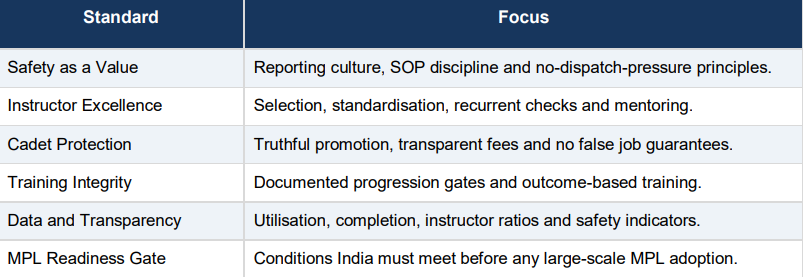
National Pilot Training Agenda & Flight Training Bharat Standards:

The National Pilot Training Maturity Agenda can be advanced through Flight Training Bharat Standards: an industry-led, voluntary benchmark designed to complement DGCA requirements, not replace regulatory approval, surveillance or enforcement. 

Its purpose is to raise common expectations for safety, instructional quality, cadet protection and transparent outcomes across the training ecosystem. 
Disclaimer: The views and opinions expressed in this article are solely those of the author and do not necessarily reflect the views or editorial position of Aviation Today.


Captain Shahinsha S.K.

Captain Shahinsha S.K.

Capt. Shahinsha S.K. is the Founder and Director of Trans Aviacons and a former DGCA-approved Examiner and Chief Flight Instructor, with over 5,000 hours of instructional flying experience.

View LinkedIn Profile

Leave a Comment

Subscribe to our Newsletter

Recent News

Aviation Today Perspectives