Kurnool, India: India is preparing to enable Beyond Visual Line of Sight (BVLOS) drone operations by the end of 2026 as the government moves to establish a regulatory and manufacturing ecosystem capable of supporting large-scale commercial drone deployment.
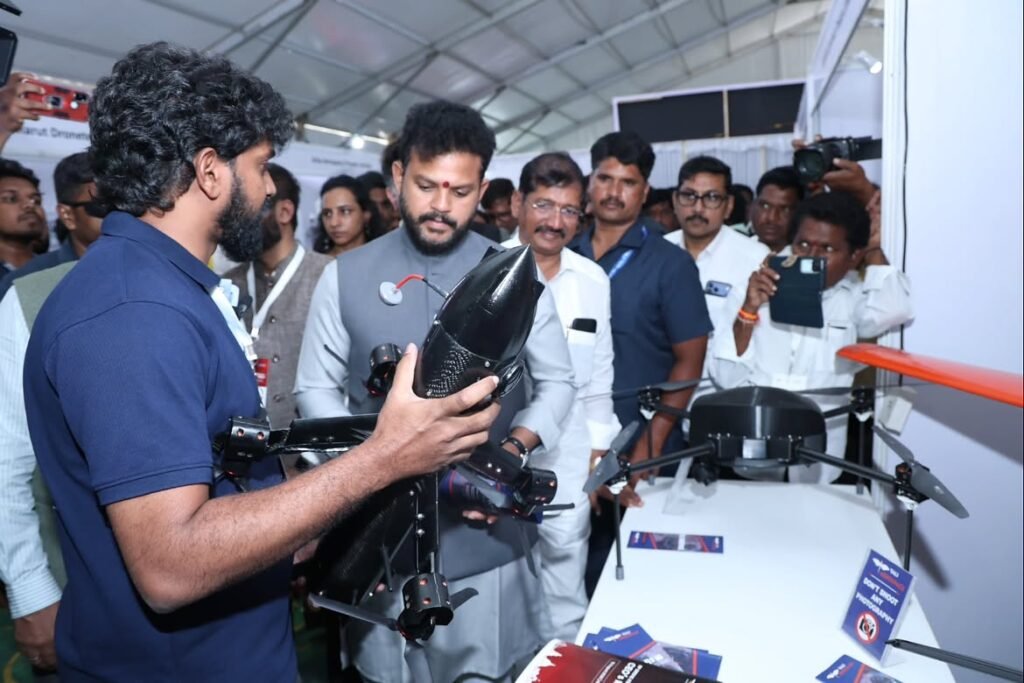
Union Civil Aviation Minister Kinjarapu Rammohan Naidu announced the plan during the AP Drone Industry CEO’s Round Table at Orvakal Drone City near Kurnool, Andhra Pradesh, on August 18, 2026. The meeting was jointly hosted by the Drone Federation India (DFI) and the Government of Andhra Pradesh and brought together more than 150 companies from the drone, counter-drone and critical-component sectors, along with representatives from the Central and state governments, the Directorate General of Civil Aviation (DGCA), academia and research institutions.
Naidu said the government is working on a refined certification framework that will include provisions for BVLOS certification by the end of this year. “By the end of this year, we will have a refined certification framework with the enablement of BVLOS certification. As the industry moves into its next phase of growth, the regulatory framework must evolve with it, enabling innovation while maintaining the highest standards of safety and security,” he said.
The proposed framework is aimed at allowing India’s drone sector to move beyond smaller, line-of-sight and experimental operations toward commercially scalable networks. BVLOS capability could support wider drone use in logistics, healthcare, agriculture and infrastructure, where aircraft would need to operate beyond the direct visual range of their pilots.
Alongside the regulatory push, the Ministry of Civil Aviation is preparing a new financial incentive scheme to strengthen domestic manufacturing of drones and critical components. The government has not yet disclosed the final size, structure or implementation date of the new scheme. The objective, according to the minister, is to help Indian manufacturers expand production and develop more critical technologies domestically.
The round table also addressed the infrastructure and regulatory requirements needed to support BVLOS operations. Discussions covered certification, testing and sandboxing, UAS Traffic Management, airspace access, live tracking, restricted and red-zone operations, government-led adoption and the development of a stronger domestic component ecosystem. Industry representatives called for predictable, risk-based certification procedures, dedicated flight-testing environments and clear operating protocols.
A special inter-departmental committee involving officials from the Civil Aviation Ministry, DGCA, the Quality Council of India and other agencies is being constituted to examine industry requirements. The committee is expected to initiate measures covering testing, certification, sandbox facilities and airspace permissions within three months.
The regulatory push is closely linked to the development of Orvakal Drone City, a 600-acre integrated facility being developed to bring manufacturing, research and development, testing, certification, training, logistics and supporting infrastructure together at one location. Eight of the first 12 plots, covering around 55 acres, have already been allotted to drone companies, while investments of about ₹130 crore have been attracted so far.
“Over the next two to three years, we aim to complete the allotment of all the plots and facilitate the commencement of drone manufacturing activities,” Naidu said.
The minister said the Orvakal ecosystem could attract investments of up to ₹5,000 crore once fully developed. The project is expected to generate about 5,000 direct and 25,000 indirect employment opportunities. The facility is intended to operate as a cluster in which manufacturers, technology providers, testing agencies and training institutions can work alongside one another.
Naidu also highlighted the country’s projected demand for drones. India could require more than six lakh drones across sectors, compared with a current fleet of more than 40,000, according to figures he cited at the Orvakal programme. “This gap represents a huge opportunity for the domestic drone manufacturing industry,” he said.
Healthcare was among the applications highlighted by the minister, with drones potentially being used to transport blood samples, medicines and other essential medical supplies between locations. The government also wants to expand drone-related training, including through Flying Training Organisations at Kurnool Airport.
Drone Federation India President Smit Shah said the sector had reached a stage where the priority should shift from establishing the basic ecosystem to scaling it. “A lot of good work has been done over the last few years. The Government of India and State Governments have played a great role in establishing an industry that barely existed a decade ago. We now have the foundations of a strong Indian drone ecosystem. The next push has to be about scale,” Shah said.
He added that the next round of reforms should allow Indian companies to increase manufacturing, undertake advanced BVLOS operations, access high-quality testing infrastructure, develop critical components domestically and compete in international markets.
Naidu also said the government sees drones becoming a broader part of India’s infrastructure. In a post referenced during the event coverage, he said, “With the amplification of drone usage across sectors and progress towards unmanned traffic management and BVLOS operations, I see drones as a new layer of infrastructure!”
The Orvakal discussions therefore mark a shift in India’s drone policy focus from establishing the foundations of the industry toward scaling operations, strengthening domestic manufacturing and creating the regulatory and testing infrastructure needed for wider commercial deployment. The proposed BVLOS framework, new manufacturing incentives and three-month regulatory review will be key steps in determining how quickly that transition takes place.