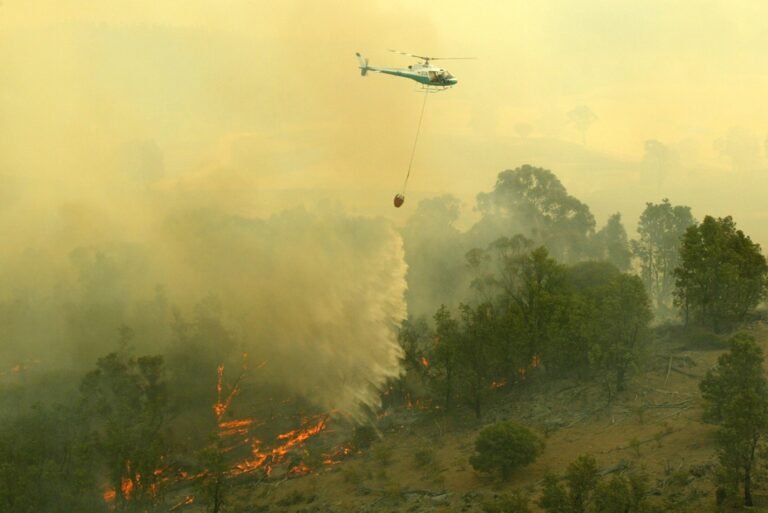
London, United Kingdom: The UK Government announced on 22 October 2026 that Royal Air Force (RAF) Chinook helicopters and A400M aircraft will be equipped with specialist firefighting equipment, establishing a permanently UK-based military aerial firefighting capability for the first time.
The announcement was made ahead of a wildfire summit at which Prime Minister Andy Burnham was scheduled to meet fire chiefs, local leaders and experts to strengthen the country’s response to increasingly severe wildfire events. The aircraft will be made available when requested to assist emergency crews tackling fires on remote moorland, steep hillsides and other terrain that is difficult to reach by ground.
According to the government, the investment will enable the Ministry of Defence (MOD) to establish an aerial firefighting capability permanently based in the UK Civilian fire and rescue services across England, Scotland, Wales and Northern Ireland will continue to be able to request military assistance through the Military Aid to the Civil Authorities (MACA) process.
Alongside the aircraft programme, the government announced funding of up to £45 million for additional specialist wildfire teams and advanced, lightweight personal protective equipment for frontline firefighters in England.
The new equipment is intended to be lighter and more breathable than conventional protective clothing, which is primarily designed for structural fires and is not intended for prolonged wear. The government said the changes would allow firefighters to work for longer periods while tackling wildfires without compromising their safety.
A further £25 million will be invested in restoring dried-out peatlands in England. Restored peatlands can retain more water and act as natural barriers to fire spread. The government will also support farmers in reducing wildfire risks through measures such as digging ponds and removing combustible materials from high-risk areas.
The government is additionally considering tougher local restrictions or product bans to prevent people from starting fires during periods of high wildfire risk. No specific restrictions or product bans were detailed in the announcement.
The new Peatland Restoration Grant Scheme will be administered by Natural England and is expected to operate from April 2027 to April 2029, building on the existing Nature for Climate Peatland Grant Scheme.
Prime Minister Andy Burnham said the destruction witnessed in Stourbridge, where families lost their homes, had reinforced the need to strengthen firefighting capabilities. He described firefighters as heroes and said they should not have to operate without adequate resources.
Burnham added that crews would receive the equipment needed to remain safe, while military aircraft would stand ready to help tackle wildfires from the air. He said the government wanted to prevent a repeat of the devastation experienced during the summer.
Communities Secretary Angela Rayner said the wildfires experienced during 2026 had caused extensive damage to communities, homes and the countryside. She said the government was taking immediate action while working with public authorities and the wider sector to build a stronger, more resilient national wildfire response.
Defence Secretary Wes Streeting said the growing wildfire threat required the defence sector to provide greater support to emergency services and protect military training areas across the country. He confirmed that RAF Chinook helicopters and A400M aircraft would receive specialist equipment to enable aerial firefighting for the first time.
Environment Secretary Dame Angela Eagle highlighted the need to adapt to climate change and improve the condition of landscapes. She said healthier landscapes retain more moisture, helping prevent fires from starting and spreading, and pointed to the £25 million peatland investment and support for farmers as part of the government’s prevention strategy.
First Secretary of State Louise Haigh said the UK would bring together the National Situation Centre, academic institutions and international partners to strengthen wildfire tracking, technology development and national preparedness. She said the initiative would help establish a centre of excellence within government for sharing expertise and best practices.
Minister for Climate Transition Katie White said the summer’s extreme heat and wildfires demonstrated that climate-related risks were already affecting communities. She said the government could not prevent every wildfire, flood or storm but could improve emergency service readiness, protect communities and strengthen national resilience.
The government also announced the creation of a new Wildfires AI Unit within the Cabinet Office Briefing Rooms (COBR) National Situation Centre. The unit will bring together universities, technology companies and governments to improve the speed at which wildfires can be detected and tackled.
Work with the Met Office will focus on improving wildfire forecasts and risk assessments, with the aim of strengthening public awareness and prevention.
The government will develop England’s first Wildfire Action Plan, covering prevention, preparedness, response and recovery. It will also work more closely with the devolved governments to improve coordination, share expertise and adopt international best practices.
An inter ministerial meeting involving the UK Government and devolved administrations will be convened to strengthen coordination across the country.
The announcement follows the first meeting of the Climate and Nature Security Taskforce, hosted by the government in September 2026. The taskforce is intended to identify the most significant climate and nature-related security risks facing the UK and inform the government’s approach to preparing for the climate crisis.
The government cited findings from the Met Office that climate change made the extreme heat experienced during the UK’s hottest summer on record around 130 times more likely.
Businesses including Airbus, Google and VodafoneThree were due to attend the wildfire summit to discuss how technology could improve preparedness and response, including satellite monitoring, early-warning systems, connectivity and aerial capabilities.
Kata Escott, Managing Director of Airbus Defence and Space UK and Head of UK Public Affairs, described the summit as an important step towards strengthening wildfire preparedness and prevention. She highlighted the company’s capabilities in aviation, digital technology and space-based early-warning systems.
Nick Gliddon, Chief Business Officer at VodafoneThree, emphasised the role of resilient connectivity in national emergency preparedness. He said reliable networks help communities access trusted information, enable emergency services to coordinate and support recovery after disruption.
Gliddon also highlighted VodafoneThree’s work with the National Emergencies Trust and National Parks UK, including a new wildfire resilience programme in the Cairngorms National Park. He said combining connectivity, local expertise and long-term investment could help communities prepare for emergencies, remain connected during incidents and recover more quickly.
The MOD said its position as the UK’s second-largest landowner made aerial firefighting capability increasingly important as wildfire risks grow, including across military training areas.
The government’s announcement follows growing concern over the scale of wildfire incidents during the summer of 2026. The wider response combines aerial firefighting, specialist ground teams, improved protective equipment, landscape restoration, forecasting and stronger national coordination.
The measures are intended to strengthen the UK’s ability to respond to wildfires while reducing the risk of fires starting and spreading in the first place.