The Middle East Demonstrates the Value of Government-Led Integration
The Middle East offers a different but equally important lesson: AAM deployment becomes more credible when governments coordinate infrastructure, regulation, airspace integration, operators, and passenger demand as one program.
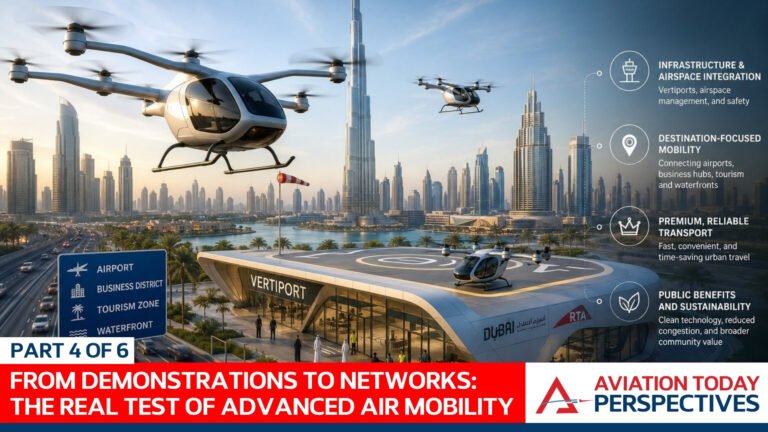
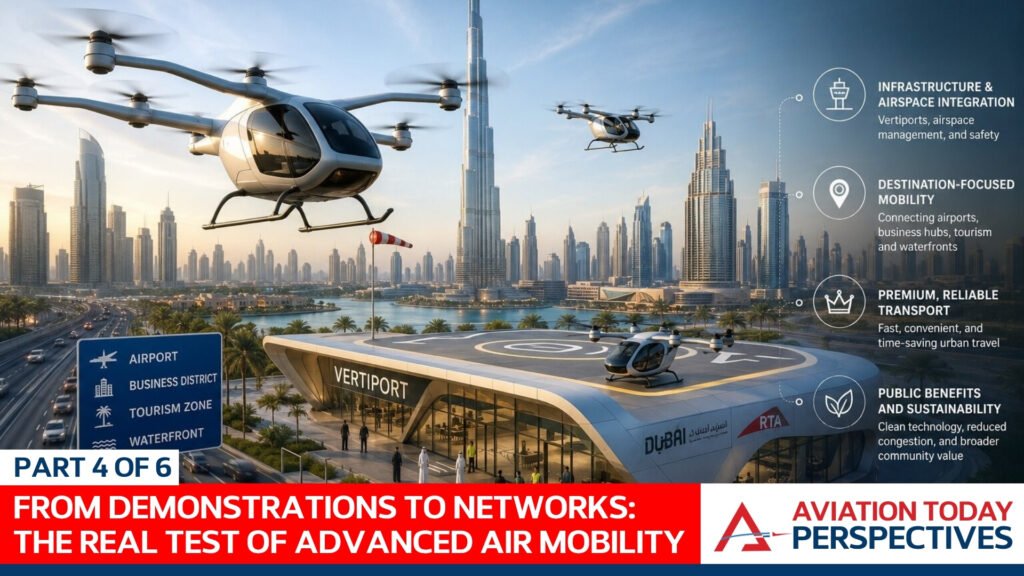
Dubai has positioned aerial mobility as part of a broader smart-city and transportation strategy, not as an isolated aviation experiment. Its partnership model brings together the Roads and Transport Authority, aviation regulators, infrastructure providers, and aircraft operators.
This approach is particularly significant because it focuses on connecting high-value destinations, including airports, business districts, tourism zones, and waterfront destinations where travelers face expensive and unpredictable road congestion. Dubai’s model recognizes that AAM’s first customers will likely be residents and visitors who value speed, reliability, and convenience.
In that sense, it is explicitly aligned with a premium transportation-on-demand model. The service is designed around high-value urban journeys rather than generic aircraft operations. Qatar has also demonstrated the potential of route-specific AAM deployment. In Doha, EHang conducted human-carrying, point-to-point pilotless eVTOL trial flights between the Port of Doha and Katara Cultural Village.
The selected route linked two recognizable urban destinations and demonstrated a transportation proposition: replacing a road journey affected by congestion with a short aerial connection. That is the right kind of pilot. It is not merely a vehicle demonstration. It assesses an identifiable mobility use case.
These examples should be interpreted carefully. Much of the Middle East remains in the demonstration, readiness, and early-market-development phase rather than full citywide commercial operations, but the region’s progress is still instructive because it shows the importance of government coordination, destination-oriented planning, infrastructure commitment, and premium travel demand.
Governments Must Become Network Integrators
AAM cannot scale through aircraft manufacturers alone. Governments must function as network integrators. This does not mean the government should operate air-taxi fleets. It means the government should establish conditions under which safe, competitive, and publicly legitimate AAM networks can emerge.
That includes coordinating airspace policy, certifying infrastructure, defining safety oversight, aligning local zoning, establishing emergency-response protocols, integrating noise and environmental standards, ensuring accessibility, and connecting AAM planning with transit and airport strategies. The public sector must also protect against a narrow vision in which AAM becomes a mobility amenity only for wealthy travelers while consuming public space and public attention.
Premium operations may be the appropriate early commercial model, but public legitimacy will depend on visible broader benefits. Those benefits may include improved airport access, reduced pressure on congested corridors, support for medical transport, emergency-response capability, regional connectivity, high-value job creation, cleaner aviation technologies, and infrastructure that can eventually support more affordable services.
AAM will earn public acceptance through performance. Communities will judge the industry not on futuristic renderings but on safety, noise, reliability, transparency, and whether the service improves the transportation system around it.
This is the 4th of a series of 6 articles on: “From Demonstrations to Networks: The Real Test of Advanced Air Mobility”
Read Part 3 of this six-part series here
This article is part of Aviation Today’s Perspectives, a dedicated series that publishes expert viewpoints from aviation authorities and industry leaders on emerging trends, policy developments, and the future of global aviation.
Disclaimer: The views and opinions expressed in this article are solely those of the authors and do not necessarily reflect the views or editorial position of Aviation Today.
About The Authors