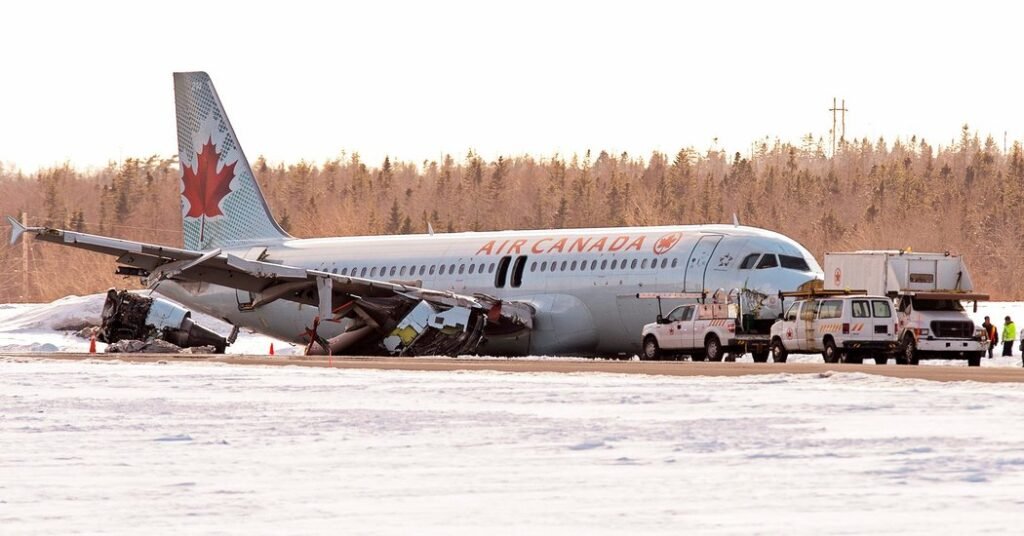
Halifax, Canada: A Nova Scotia court has approved an C$18.075 million class-action settlement involving passengers of Air Canada Flight AC624, which crashed short of the runway while attempting to land at Halifax Stanfield International Airport during a snowstorm in March 2015. The Supreme Court of Nova Scotia approved the settlement on June 26, 2026, with the approval publicly announced by the court-appointed class-action administrator, CFM Lawyers, through the Wagners class-action website on July 6, 2026.
Justice Ann Smith found the settlement “fair, reasonable and in the best interests of the Class.” The settlement is expected to become effective in early August, with compensation payments currently expected to be issued in fall 2026.
The settlement involves Air Canada, NAV Canada and the Halifax International Airport Authority (HIAA), which together will pay C$18.075 million to resolve claims arising from the crash. Air Canada will contribute C$15.075 million, NAV Canada C$2 million and HIAA C$1 million. The settlement amount covers damages, private and public health-insurer subrogated claims, legal fees, disbursements, administration expenses, honoraria, taxes, costs and interest. The settlement agreement states that the defendants do not admit liability or wrongdoing, making the agreement a negotiated resolution of the litigation rather than a finding of fault.
The latest settlement update also says class members do not need to submit a claim form to receive compensation. Before payments can be made, however, the court-appointed administrator will require proof of identity, such as government-issued photo identification or a passport. Compensation is expected to be issued by cheque, while individual amounts will be determined under the court-approved distribution protocol. The court also approved C$6,761,891.65 in class counsel fees, disbursements and applicable taxes.
The case relates to Air Canada Flight AC624, an Airbus A320-211 registered C-FTJP, which was operating from Toronto Pearson International Airport to Halifax Stanfield International Airport on March 29, 2015. There were 133 passengers and five crew members aboard. Shortly after midnight, while the aircraft was conducting a non-precision localizer approach to Runway 05 in snow and poor visibility, the aircraft struck power lines and terrain approximately 225 metres before the runway threshold. It subsequently struck the localizer antenna array, bounced and slid along the runway before coming to rest. All passengers and crew evacuated the aircraft, 25 people were injured and taken to hospital, and there were no deaths. The aircraft was destroyed, but there was no post-impact fire.
The Transportation Safety Board of Canada (TSB), which investigated the accident independently of the civil litigation, released its final report on May 18, 2017. The investigation found that the crash resulted from a combination of factors rather than a single cause. The TSB identified the approach procedure, poor visibility and airfield lighting as factors. The crew had set the autopilot to the appropriate constant descent flight-path angle, but Air Canada’s procedures at the time did not require the pilots to monitor the aircraft’s altitude and distance from the runway during that phase of the approach. Wind variations subsequently moved the aircraft away from the intended flight path without the crew recognizing the deviation in time.
TSB Chair Kathy Fox said during the 2017 findings briefing: “Accidents are almost never caused by just one factor, organization or person.” She said the Flight 624 accident involved a combination of poor weather, airfield lighting and Air Canada’s practice of not requiring pilots to monitor the flight path during a critical part of the approach.
The TSB said the crew had requested that the runway lights be turned to their maximum setting, but the tower controller did not make the adjustment because the controller was occupied with snowplows on the runway and another aircraft on a taxiway. When the aircraft reached the minimum descent altitude, the crew saw some lights and interpreted them as sufficient visual references to continue the approach. Only in the final seconds, after the pilots disengaged the autopilot to land manually, did they realize the aircraft was too low and too far from the runway. The crew initiated a go-around, but the aircraft struck terrain before it could climb away.
The crash sequence was severe. The aircraft’s engines and landing gear struck the ground and snowbank, the aircraft hit the airport’s antenna array and then bounced along the runway. The left engine and landing gear were torn away, while the aircraft sustained substantial structural damage. The TSB reported that there was no post-crash fire. The passengers and crew evacuated using the aircraft’s emergency slides.
The TSB also found that passengers were not in the brace position because no emergency had been anticipated before impact. Its report said most passenger injuries were consistent with the occupants not adopting a brace position. The investigation further examined the evacuation and the delay in moving uninjured passengers from the aircraft area. Severe weather, failures involving the airport’s standby generators and the loss of the airport operations radio network contributed to delays in arranging transportation from the site. Media and court filings have described passengers remaining outside in blowing snow for roughly 50 minutes before being taken to an indoor holding area.
The TSB subsequently identified several safety actions. Air Canada introduced more specific guidance on visual references required during approaches, warnings concerning the limitations of autopilot and Flight Path Angle mode, and requirements for instrument monitoring below minimum descent altitude. HIAA upgraded the approach lighting on Runway 05, reviewed its emergency response plan and upgraded emergency assets, including backup power. NAV Canada also published a satellite-based approach for Runway 05 providing lateral and vertical guidance to suitably equipped aircraft.
The civil litigation began shortly after the accident. The class action, Carroll-Byrne et al. v. Air Canada et al., Nova Scotia Supreme Court filed Hfx. No. 438657, was filed on April 28, 2015 and was certified as a class proceeding in December 2016. The plaintiffs alleged that Air Canada, Airbus, NAV Canada, HIAA and the Attorney General of Canada, among others, were responsible for the circumstances that caused the crash and the resulting injuries. The litigation also addressed physical injuries and psychological trauma suffered by passengers.
A major legal issue involved the aircraft’s cockpit voice recorder (CVR). The plaintiffs and certain defendants sought access to the recording, while the TSB and Air Canada Pilots Association opposed its disclosure. The matter eventually reached the Supreme Court of Canada. In its November 25, 2022 decision in Canada (Transportation Safety Board) v. Carroll-Byrne, the Supreme Court dismissed the TSB’s appeal and upheld the order allowing disclosure of the CVR for the civil proceedings. The Supreme Court said the recording could be disclosed because it was necessary to fill gaps in the pilots’ evidence relevant to determining causation and liability.
The litigation had been heading toward a lengthy common-issues trial scheduled to begin in January 2026. Instead, the parties reached the settlement recorded in December 2025, with the formal settlement agreement executed in February 2026. A March 23, 2026 notice announced that the Nova Scotia Supreme Court would consider approval of the proposed C$18.075 million settlement on June 22. The proposed resolution was intended to avoid a lengthy trial and possible appeals.
At that stage, Wagner’s lawyer Ray Wagner described the settlement as a “reasonable settlement” and said it was a “hard-fought, mediated settlement.” He also said the 10-year litigation had been unusually long and that the resolution could help passengers who continued to experience psychological effects from the crash. Air Canada separately stated: “We are satisfied the matter has been resolved.”
In December 2025, Wagner also described the accident as “a major traumatic event”, citing the severe nature of the crash and the time passengers spent waiting outside for assistance. The proposed settlement was reported at the time as covering passengers’ injuries, including physical injuries and psychological harm such as post-traumatic stress.
The final settlement does not mean a court found Air Canada, NAV Canada or HIAA liable for the crash. The settlement agreement expressly states that the defendants deny the allegations and that the agreement does not constitute an admission of liability. Airbus and the Attorney General of Canada were defendants in the litigation but are not contributing to the C$18.075 million settlement.
The settlement now brings the decade-long civil case toward its final distribution stage, more than 11 years after Flight AC624 struck terrain while approaching Halifax. The latest administrator update says the settlement became effective in early August 2026, with CFM Lawyers responsible for issuing the approval notice and individual valuation information to class members. Payments are currently expected in fall 2026.