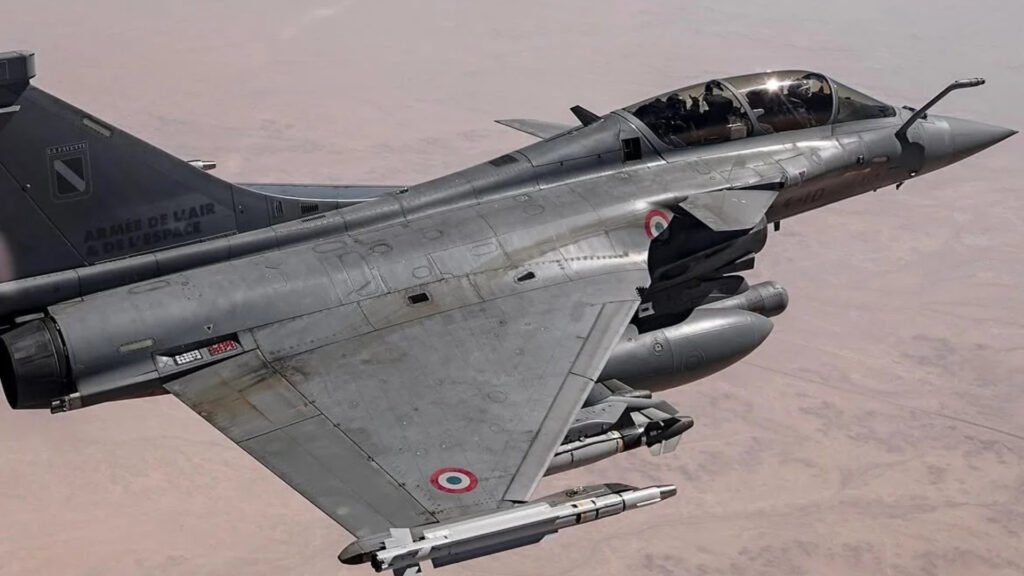
Paris, France: France’s Air and Space Force is operating its combat aircraft more than 15% above the planned level, Chief of Staff General Jérôme Bellanger told France’s National Assembly as he warned that the current fighter fleet is under growing pressure from nuclear deterrence, airspace protection, overseas deployments and preparations for high-intensity warfare.
Bellanger made the remarks during a hearing of the National Assembly’s Defence and Armed Forces Committee on 14 October 2026, held as lawmakers examined the proposed 2027 defence budget. The hearing was scheduled for 11:00 and covered the future size and structure of France’s combat aviation, the evolving Russian air threat, counter-drone capabilities and the country’s next-generation fighter plans.
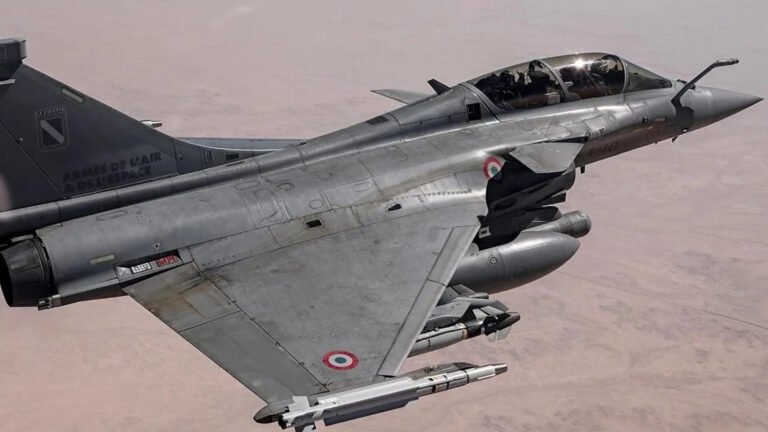
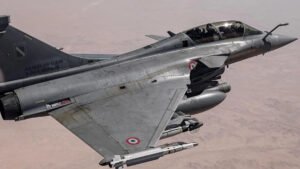
France had 184 combat aircraft at the end of 2025, comprising 112 Rafales, 50 Mirage 2000Ds and 22 Mirage 2000-5Fs. Bellanger said the fleet was being used more than 15% above its planned operational rate because the force must simultaneously maintain the permanent air-security posture and the airborne nuclear component while meeting overseas and NATO commitments.
The pressure was illustrated by the period before summer 2026, when around 80% of France’s fighter fleet was committed to operations or other operational tasks. The commitments included nuclear-deterrence activity, deployments in the Near and Middle East, operations on NATO’s eastern flank, an exercise in Côte d’Ivoire and the continued protection of French airspace. Bellanger said the number of missions was increasing while the number of available aircraft remained limited.
The Air and Space Force is not expected to receive a significant numerical boost in the immediate term. France is due to receive only two new Rafales in 2027 while additional Mirage 2000 aircraft are retired. The proposed 2027 budget includes €4.4 billion in commitment authorisations and €1.8 billion in payment appropriations for Rafale procurement and modernisation, including work on the Rafale F5.
Bellanger has called for the size of the fighter fleet to be reconsidered in the next military programming law. He also warned that collaborative combat drones cannot simply replace crewed fighters. “A collaborative combat drone is not a fighter aircraft. It is not a one-for-one replacement,” he told lawmakers.
The warning comes alongside a broader reassessment of France’s airpower requirements as the Russian missile and drone threat intensifies. Bellanger said, “At the East of Europe, the war of drones and missiles has only intensified” during 2026, while warning that Russia’s ability to combine greater production volumes with improved drone technology is becoming increasingly concerning.
France is consequently accelerating its counter-drone and long-range strike capabilities. Bellanger said counter-drone warfare was a priority and outlined plans for interceptor drones, including a dedicated interceptor-drone squadron. France is also preparing to receive its first MBDA DELUGE long-range one-way attack munitions in summer 2027, which are expected to form the basis of a new bombing and reconnaissance drone squadron.
The future French combat-aircraft programme is also being reshaped following the collapse of the Franco-German-Spanish Future Combat Air System fighter project. France now intends to develop the Avion de Combat du Futur, or ACF, primarily as a national programme while remaining open to international cooperation.
“We’re now moving on to work that will prefigure and enable the birth of this ACF, this future combat aircraft as a national program,” Bellanger said. He added that cooperation with other countries could continue, but under frameworks that would not be structurally essential to the aircraft’s development.
The ACF is intended to fly conventional missions by 2040 and eventually assume the Rafale’s nuclear-deterrence role. Bellanger said the future aircraft will need to carry France’s ASN4G hypersonic nuclear cruise missile by 2050. Before that, France plans to introduce the Rafale F5 around 2035, incorporating technologies intended to form part of the future combat aircraft, including new propulsion, sensors and the Stratus RS weapon for suppressing enemy air defences.
Bellanger said the years of FCAS development had not been wasted, with work on the aircraft, stealth, drones, connectivity and combat cloud providing a technological base for the national programme. France also intends to continue working with Germany and other European partners on combat-cloud interoperability.
France’s fighter fleet is also being affected by Rafale exports and the retirement of older aircraft. France has transferred 24 used Rafales to Greece and Croatia, while a 42-aircraft Rafale F4 order is intended to replace part of that lost inventory. Dassault Aviation has increased production to four Rafales a month, while 220 aircraft remained in its order backlog at the end of 2025, including 45 for France and 175 for export.
France is also negotiating with India for 114 Rafale F4 fighters, with a proposal under which 22 aircraft would be produced in France and 92 assembled in India. However, any additional industrial capacity resulting from such an agreement would not provide an immediate solution to France’s fighter-fleet shortage.
The immediate issue for Paris therefore remains the gap between the number of missions assigned to the Air and Space Force and the number of crewed combat aircraft available to sustain them. Bellanger’s warning puts the size of the fighter fleet alongside modernisation as a central issue for the next French military programming law, while the Rafale F5 and ACF programmes address longer-term capability requirements.