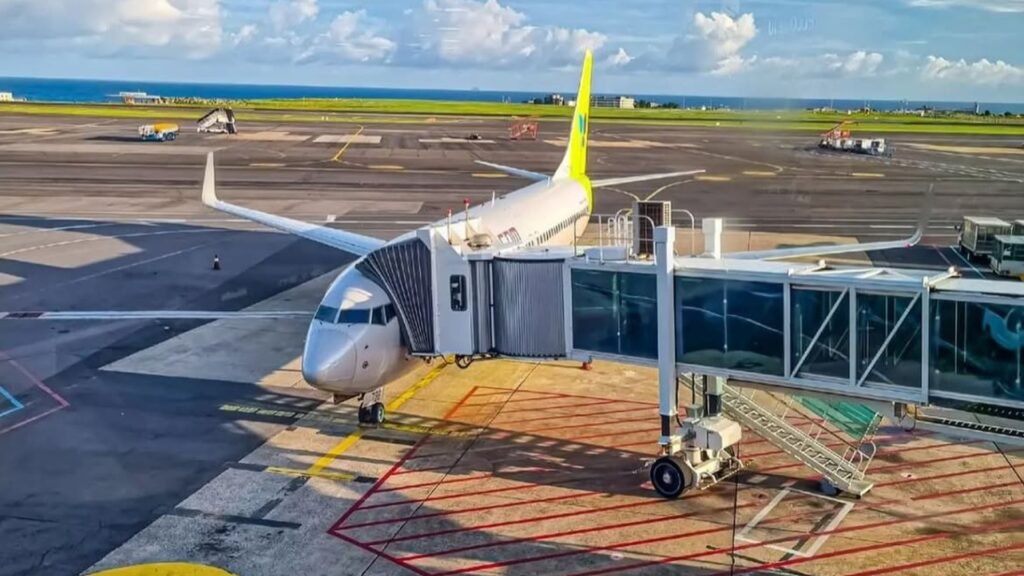
Seoul, South Korea: South Korea’s three Hanjin Group-affiliated low-cost carriers Jin Air, Air Busan and Air Seoul have signed a merger agreement that will bring them together under the Jin Air brand, with the integrated carrier scheduled to launch on March 17, 2027, subject to shareholder and regulatory approvals.
The merger was formally approved and announced on August 21, 2026, when the boards of directors of all three airlines separately approved the transaction and signed the merger agreement. The companies disclosed the decision through South Korea’s corporate disclosure system, while Jin Air and the other carriers subsequently issued statements on the planned integration. Yonhap reported the board approvals and agreement signing the same day.
Under the agreement, Jin Air will remain the surviving company and absorb Air Busan and Air Seoul. It will assume their assets, liabilities, rights and obligations, employees and legal status. The agreed merger ratio is 1 Jin Air share to 0.2862684 Air Busan shares and 0.7501939 Air Seoul shares. The ratio was calculated under South Korean capital-market rules, using statutory reference prices for listed Jin Air and Air Busan, while Air Seoul’s valuation incorporated asset and earnings values.
The official corporate disclosure filed on August 21 also identifies the valuation work supporting the transaction. Samil PricewaterhouseCoopers conducted the external assessment of the Jin Air-Air Seoul merger between April 13 and August 20, 2026. The filing gives the assessed values at 5,156 won per Jin Air share, 1,476 won for Air Busan and 3,868 won for Air Seoul, supporting the agreed exchange ratios.
The merger will create what is expected to be South Korea’s largest low-cost carrier by fleet size. Based on year-end 2025 fleets cited in the announcement, the three airlines had 58 aircraft combined 31 operated by Jin Air, 21 by Air Busan and six by Air Seoul. That would put the enlarged carrier ahead of T’way Air’s 46 aircraft and Jeju Air’s 45 at that reference point.
Some August 21 reports have cited a current combined fleet of 59 aircraft because Jin Air was reported with 32 aircraft at the time. The more conservative and consistently cited 58-aircraft figure refers specifically to the year-end 2025 fleet, and is therefore preferable when describing the fleet basis used in the merger announcement.
The integration is designed to combine the three airlines’ fleets, routes, operational resources and personnel while generating economies of scale. Jin Air plans to reorganize routes and schedules according to market demand, strengthen connections between the Seoul metropolitan area and the Yeongnam region, and expand international services from regional airports.
The airlines will also combine their reservation and ticketing systems, mobile platforms and airport-processing systems. Customer-response systems and service manuals are expected to be standardized as integration progresses. The strategy is intended to connect Jin Air’s Seoul/Incheon network with Air Busan’s strong Busan network and improve destination and schedule choices for passengers.
Safety and operational integration remain major steps before the new carrier can begin operating. Jin Air plans to use its existing Air Operator Certificate and operating standards as the basis for incorporating Air Busan and Air Seoul aircraft, operations and maintenance infrastructure. The companies aim to complete the Ministry of Land, Infrastructure and Transport’s safety-operation-system change inspection before the March 2027 launch, followed by approvals or notifications required from overseas aviation authorities.
Preparatory work has already included joint training and standardization. Jin Air invested about 22 billion won in an Airbus A320neo-family flight simulator and has conducted joint training involving pilots, maintenance personnel and cabin instructors from the three carriers. The aim is to align operating procedures, manuals and training systems before the fleets are integrated.
The transaction is also closely linked to the wider Korean Air-Asiana Airlines integration. Jin Air is a Korean Air subsidiary, while Air Busan and Air Seoul are subsidiaries of Asiana Airlines. Korean Air and Asiana are scheduled to complete their own merger on December 17, 2026, three months before the planned launch of the integrated Jin Air.
The three LCCs are scheduled to hold extraordinary shareholder meetings in December 2026 to seek approval for the merger. The transaction will then require the necessary approvals under South Korea’s Aviation Business Act and other regulatory procedures before the new airline can begin operations.
Jin Air said the transaction represents “an important turning point” for South Korea’s LCC industry and said it would put “safety as our top priority” while pursuing optimized routes and greater consumer choice. The company also stated that it aims to grow into an LCC representing Asia.
The merger marks the next major stage in the restructuring of South Korea’s airline industry following the Korean Air-Asiana combination. If all approvals are secured, Air Busan and Air Seoul will cease operating as separate brands when the integrated Jin Air launches on March 17, 2027, with their routes, aircraft, employees and operating infrastructure progressively brought under the Jin Air organization.