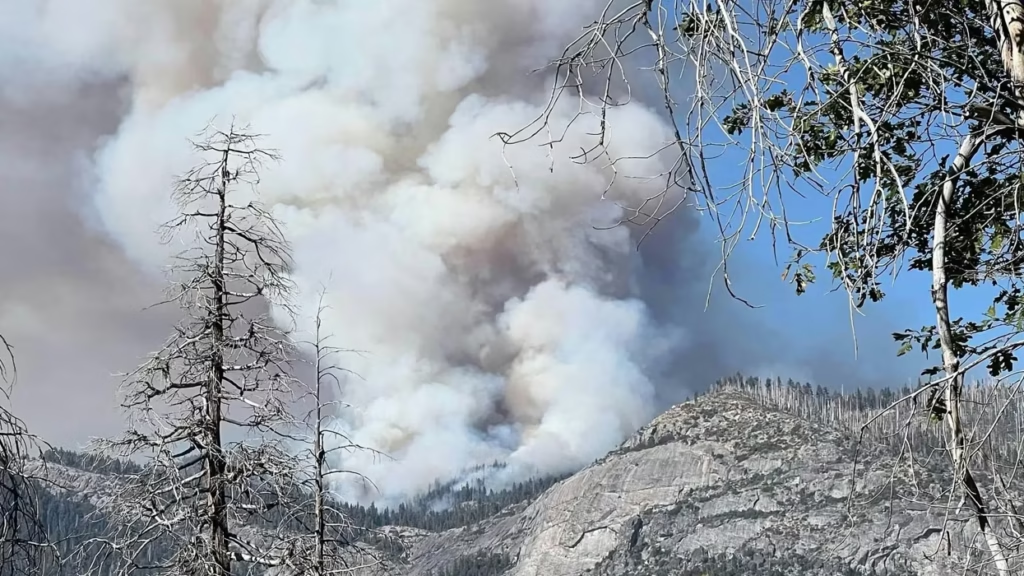
California, United States: Two pilots were killed when a firefighting helicopter crashed while conducting water-bucket operations on the Dome Fire in Yosemite National Park, California, on 20 September 2026. The Federal Aviation Administration (FAA) said the Eurocopter AS32 crashed near Mariposa at about 2:55 p.m. local time, with two people on board. The National Transportation Safety Board (NTSB) is leading the investigation with FAA assistance.
The helicopter was a Eurocopter AS332L1 Super Puma, operated by Precision Helicopters, a McMinnville, Oregon-based contractor involved in aerial firefighting. The helicopter was operating over the Dome Fire rather than on a passenger route. Fire-response officials said the crew was using a water bucket to collect water from Ostrander Lake before returning toward the northern edge of the fire. The aircraft crashed in the rugged area southeast of Ostrander Lake while supporting firefighters on the ground.
The two occupants were the helicopter’s crew and both were killed. Greg King, a Precision pilot and former member of the Alaska Division of Forestry & Fire Protection, was identified as one of the victims. Alaska officials said King had served on wildland fires in the state and had worked extensively alongside the division. The identity of the second pilot has not been released while family notifications are completed. Alaska’s Division of Forestry & Fire Protection said, “This is a devastating loss for our agency and the entire wildland firefighting community. Greg was a dedicated aviator and a dear friend to many of us.” The agency added, “We are mourning both pilots who bravely supported firefighting efforts, and our hearts go out to their families.”
Alaska Division of Forestry & Fire Protection aviation chief Andy Jones also described King’s standing within the state’s aviation community. Jones said, “Greg was one of the best of the best in the community for his piloting skills, his judgment, and his personality.” He added, “He’s a legend in Alaska.” According to Jones, King leaves behind a wife and children, while his wife also works for the Alaska forestry division.
The circumstances that led to the crash remain unknown. Benjamin Cossel, a spokesperson for the interagency team managing the Dome Fire response, said the helicopter had been operating with other aircraft using buckets to reach steep, high-elevation terrain that was difficult for ground crews to access. He said, “They’d been dipping out of Ostrander Lake and then coming back to kind of that northern edge of the fire. And that is where they crashed.” Cossel later said, “We don’t have the full picture yet. It’s still under investigation.”
Cossel said firefighting operations were particularly demanding, with about 13 helicopters assigned to the area because of the difficult terrain and conditions. The pilots’ remains were recovered on 21 September, after which firefighters, law enforcement officers and other first responders joined a procession from the Mariposa area toward Modesto. Officials said the procession was held to return the victims to their families.
Precision also confirmed the deaths of two members of its team. The company said, “It is with unimaginable sadness and broken hearts that we share the loss of two beloved members of our team.” Precision added, “We are devastated by this loss and are struggling to find the words.” The company asked for “privacy and compassion for their families and our team” as it mourned the two employees and requested that the families, loved ones and team be kept in people’s thoughts and prayers.
The crash occurred as the Dome Fire continued to burn through remote and steep terrain in Yosemite. The fire began on 15 September 2026 near Wawona and had grown to more than 3,000 acres by 21 September. The National Park Service’s 21 September morning update listed the fire at 3,222 acres, 15% containment and 581 personnel. The fire had continued moving into the footprint of the 2017 Empire Fire, where heavy dead and down fuels were contributing to spotting concerns. The NPS said, “Fire behavior will remain moderate, with spotting behavior being a big challenge in the full suppression efforts of this fire.”
The previous day’s NPS update said helicopters assigned to the fire were supporting firefighters with water drops, supplies and transportation. The agency also reported that the fire was moving through red-fir fuel, which is conducive to spotting. Steep and rugged terrain had made ground suppression difficult, increasing the importance of aerial support.
At the time of the latest update, Yosemite National Park remained open, although the Chilnualna Falls Trail, trails toward Buena Vista and Crescent Lakes, the Ostrander Lake Trail and areas south of it were closed because of the fire. No evacuation orders were in place. Smoke conditions remained a concern in parts of the park, including Wawona and Yosemite Valley.
The FAA and NTSB are investigating the crash, and authorities have not released a cause. The NTSB said investigators would travel to the scene when fire conditions allow. No finding has been issued linking the accident to weather, visibility, mechanical failure, fire conditions or any other specific factor. The investigation remains ongoing.