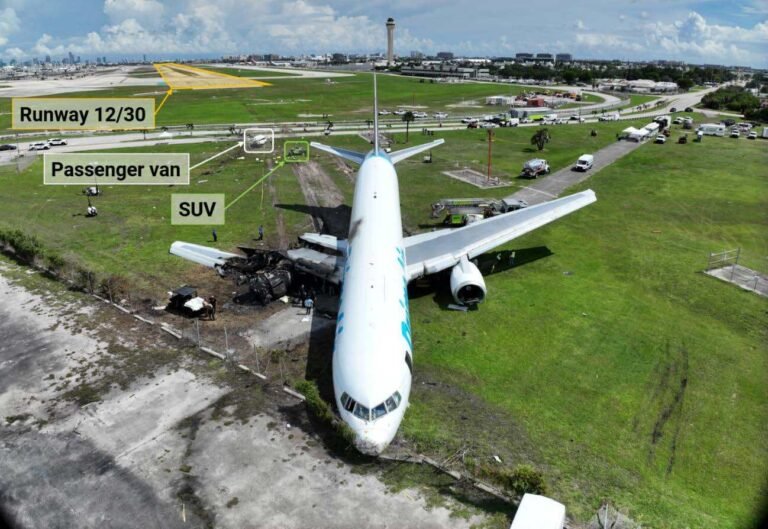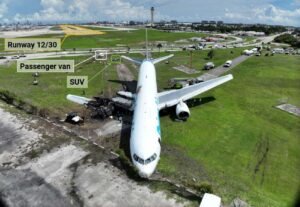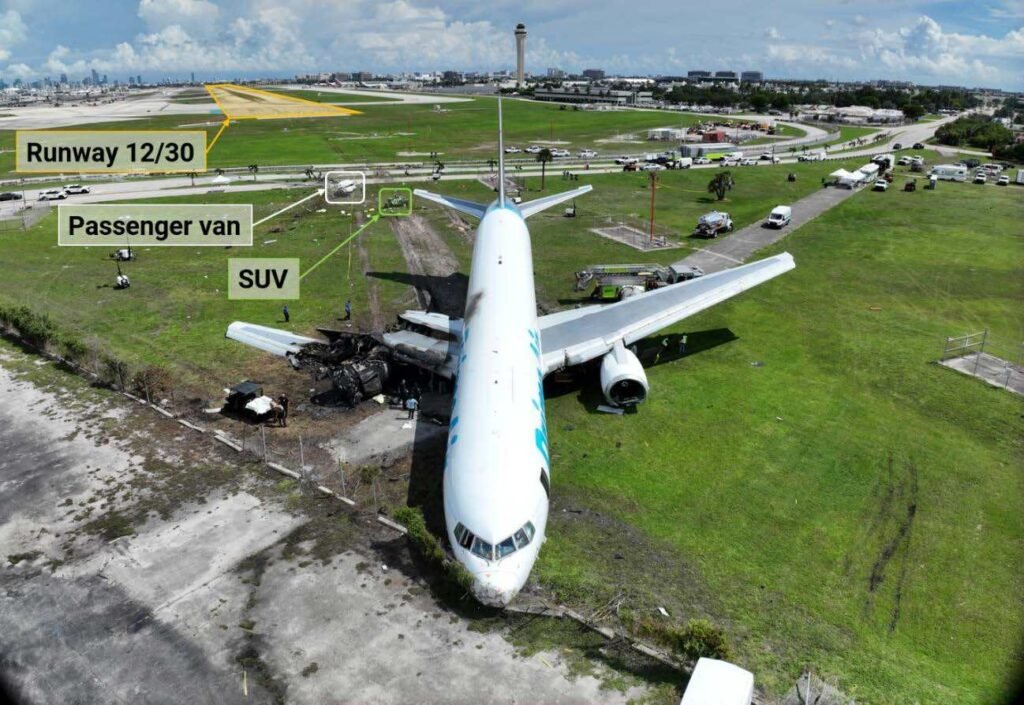
Florida, United States: The National Transportation Safety Board (NTSB) has released its preliminary report into the September 6, 2026 runway overrun involving 21 Air Flight 7598, a Boeing 767-33A operated on behalf of Amazon Air at Miami International Airport. The 12-page report, released on October 1, 2026, says the aircraft crossed Runway 30’s threshold at about 177 knots groundspeed and touched down approximately 3,750 feet beyond the threshold at about 160 knots. The aircraft then crossed the runway end at about 113 knots, struck airport lighting equipment and left the paved surface before hitting two ground vehicles. The investigation remains ongoing and the NTSB has not determined a probable cause.
Flight 7598 was operating from Luis Muñoz Marín International Airport in San Juan, Puerto Rico, to Miami with two crew members aboard. The aircraft struck a Ford Econoline van carrying seven workers from an aircraft-cleaning company on an airport perimeter road, killing five and seriously injuring two. It then struck a Toyota Corolla Cross SUV on NW 67th Avenue, seriously injuring its sole occupant. The two pilots sustained minor injuries. The five people killed were identified by Miami-Dade County as Rolando Aleman Leon, 55; Yoel Rodriguez Naranjo, 53; Julio C. Pineda, 75; Carlos Acosta Fajardo, 53; and Javierkys Reyes Quevedo, 47.
The NTSB’s preliminary recorder data shows that the aircraft’s nose and right main landing gear touched down at 158 knots groundspeed, with the left main gear touching down later at 134 knots. Wheel brakes were applied at 146 knots, then released at 120 knots as the throttles increased to a setting consistent with go-around thrust. Four seconds later, the throttles returned to idle and the brakes were reapplied at 117 knots, with about 415 feet of runway remaining. The aircraft crossed the runway end at 113 knots. The NTSB said there was no indication in the recorded data that speed brakes or thrust reversers deployed.
The cockpit voice recorder also captured several warnings during the final approach. About 1 minute and 42 seconds before the recording ended, one pilot called for flaps 20 and the other cautioned that the aircraft was too fast. Further comments about excessive speed followed, without a consistent verbal response. The recording then captured two “sink rate” warnings and repeated “too low terrain” alerts. A pilot called for flaps 30 about 41 seconds before the recording ended, a sound consistent with touchdown was recorded at about 31 seconds, and a pilot called for a go-around about 15 seconds before the end. The NTSB cautions that the CVR and FDR timelines have not been precisely synchronized.
The preliminary report also details a discrepancy between the cockpit recording and the aircraft’s physical configuration after the accident. The CVR captured a call for flaps 30, while investigators found the flap lever in the 25-degree detent and measured the flap and slat mechanisms as consistent with a flaps-25 configuration. The speed-brake lever was found stowed, while the thrust-reverser levers were found in the first detent. The NTSB did not state when those controls moved to their observed positions. Brake-wear inspections found remaining service life on all eight main wheels.
Weather conditions were also documented. At 1:53 p.m., the Miami airport observation recorded winds from 190 degrees at 17 knots gusting to 26 knots, with thunderstorms, visibility of at least 10 statute miles, scattered cumulonimbus at 2,000 feet and a broken ceiling at 4,800 feet. The NTSB says the local-control-south controller cleared Flight 7598 to land but did not provide wind information. The report notes that FAA Order JO 7110.65BB required wind direction and velocity to be stated when authorizing use of a runway when a tailwind component existed. The NTSB has not said that the missing wind information caused the accident.
The accident aircraft, N1997A, was manufactured in June 1994 and originally delivered as a passenger aircraft before being converted to a freighter in June 2016. It had accumulated about 110,077 flight hours and 24,505 cycles. The captain had about 7,267 total flight hours, including about 150 hours on the Boeing 767, while the first officer had about 2,800 total hours, including about 800 hours on the 767. The aircraft came to rest about 1,200 feet beyond the paved runway surface and sustained substantial damage, including a post-crash fire that heavily damaged the right wing.
On September 6, 2026, at about 1:53 p.m. EDT, 21 Air Flight 7598, a Boeing 767 cargo aircraft operating for Amazon, overran Runway 30 at Miami International Airport after landing and struck two ground vehicles. The aircraft was arriving from San Juan, Puerto Rico.
The crash killed five people on the ground, all occupants of a Ford Econoline van carrying seven people. Three people on the ground suffered serious injuries, while the two pilots sustained minor injuries. The aircraft was substantially damaged and suffered a post-crash fire.
The five people killed were Rolando Aleman Leon, 55; Yoel Rodriguez Naranjo, 53; Julio C. Pineda, 75; Carlos Acosta Fajardo, 53; and Javierkys Reyes Quevedo, 47.
The NTSB has assigned specialist groups to examine aircraft systems, powerplants, structures, crew operations and human performance, ATC, meteorology, aircraft performance, airport factors and survival factors. The agency continues to stress that the preliminary information is subject to change and does not establish the accident’s probable cause.