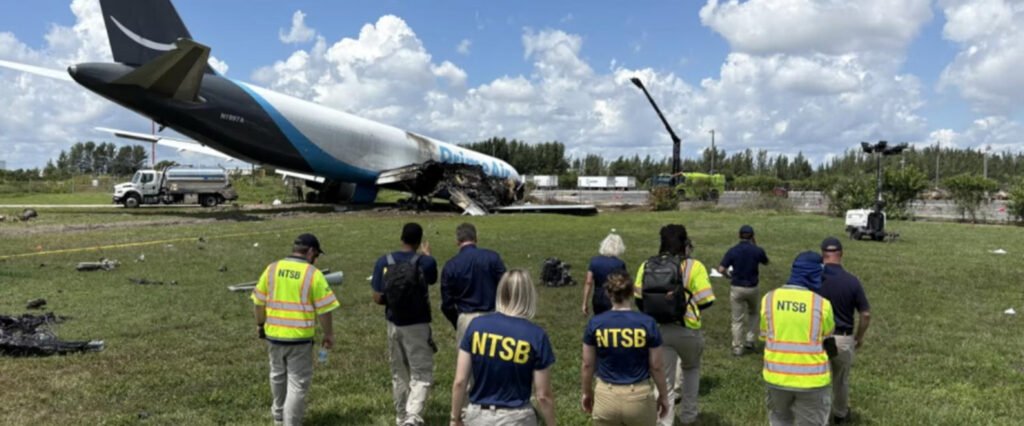
Miami, United States: Amazon has paused its operations with Miami-based cargo carrier 21 Air following the fatal crash of an Amazon Air-operated Boeing 767 at Miami International Airport, with the National Transportation Safety Board continuing to examine the circumstances surrounding the accident.
Amazon said the decision followed its review of the circumstances surrounding the crash and its support for the ongoing investigation. Amazon spokesperson Kelly Nantel said, “After the tragic incident last weekend, we’ve spent time supporting the investigation and reviewing some of the surrounding circumstances, and we’ve decided to pause our operations with 21 Air, the operator of Flight 7598.” She added, “We’ll continue working to support the investigation and everyone affected.”
21 Air, which operated the aircraft for Amazon Air, said it remained focused on the investigation and its affected families. The carrier told Reuters, “We remain focused on supporting the families and loved ones who were impacted by this accident, as well as working closely with the NTSB and all our partners, like Amazon, as the investigation continues. We are confident in our safety policies, procedures and training.”
The NTSB has recovered and read out both the cockpit voice recorder and flight data recorder. The CVR contained more than two hours of good-quality audio across four channels, while the FDR contained about 54 hours of data covering more than 400 parameters. The agency has stressed that the information released so far is preliminary and subject to change.
According to the NTSB, one pilot cautioned that the aircraft was “too fast” about 1 minute and 42 seconds before the end of the cockpit recording. Further comments about excessive speed followed, while the aircraft also generated repeated automated “sink rate” and “too low terrain” warnings during the approach. The crew was cleared to land on Runway 30, and the recording indicates a pilot called for a go-around about 15 seconds before the aircraft left the paved surface.
Flight data showed that the Boeing 767’s nose and right main landing gear touched down at 158 knots. The brakes were applied at 146 knots, while the left main gear touched down at 134 knots. About four seconds later, the brakes were released and the throttles were increased to a setting consistent with go-around thrust. Another four seconds later, the throttles were reduced to idle and the brakes were reapplied at 117 knots. The recording ended with the aircraft at 65 knots. The NTSB said there was no indication in the recorded data that speed brakes or thrust reversers were deployed.
The findings have not been declared the cause of the accident. Investigators are continuing to examine the crew’s actions, aircraft operations and maintenance, weather and other factors before determining what caused the runway overrun. The NTSB’s investigation remains ongoing.
The accident occurred on 6 September 2026 at Miami International Airport when 21 Air Flight 7598, a Boeing 767-33A cargo aircraft operating for Amazon Air, overran Runway 30 while landing. The flight was arriving from San Juan, Puerto Rico, and was the aircraft’s third flight of the day, following earlier sectors between Cincinnati and Miami and Miami and San Juan.
The aircraft travelled about 1,300 feet (396 metres) beyond the end of the paved runway. It struck airport navigational equipment before hitting a 2012 white Ford Econoline van operated by Professional Ocean Service Corporation, a company providing aircraft-cleaning services. Seven people were inside the van. The aircraft then breached a perimeter fence and struck a Toyota Corolla Cross on Northwest 67th Avenue before continuing into a grassy area and another fence line.
Five people on the ground were killed, all of them occupants of the vehicles struck by the aircraft. They were identified by Miami-Dade authorities as Rolando Aleman Leon, 55; Yoel Rodriguez Naranjo, 53; Julio C. Pineda, 75; Carlos Acosta Fajardo, 53; and Javierkys Reyes Quevedo, 47. Five other people were injured, including the aircraft’s two pilots. The pilots, Joseph Carroll, 55, and Jaime Felipe Silva Molina, 37, were treated and released, while three other injured people remained hospitalized in the immediate aftermath, according to Miami-Dade authorities.
The aircraft caught fire after the runway excursion, prompting a major emergency response at the airport. More than 60 Miami-Dade Fire Rescue units and about 200 personnel responded, while airport operations were temporarily halted following the crash.
The Boeing 767 was about 32 years old. It was originally built as a passenger aircraft and operated for several airlines before being converted into a freighter in 2015. The aircraft was being operated by 21 Air for Amazon’s cargo network when the accident occurred.
The NTSB is leading the investigation, with the FAA and other authorities assisting. The agency has not yet issued a probable cause, and the available recorder information remains subject to change as investigators continue analysing the evidence.