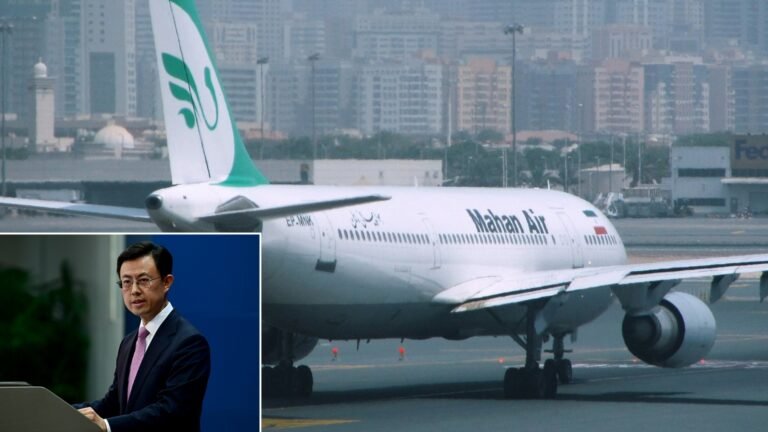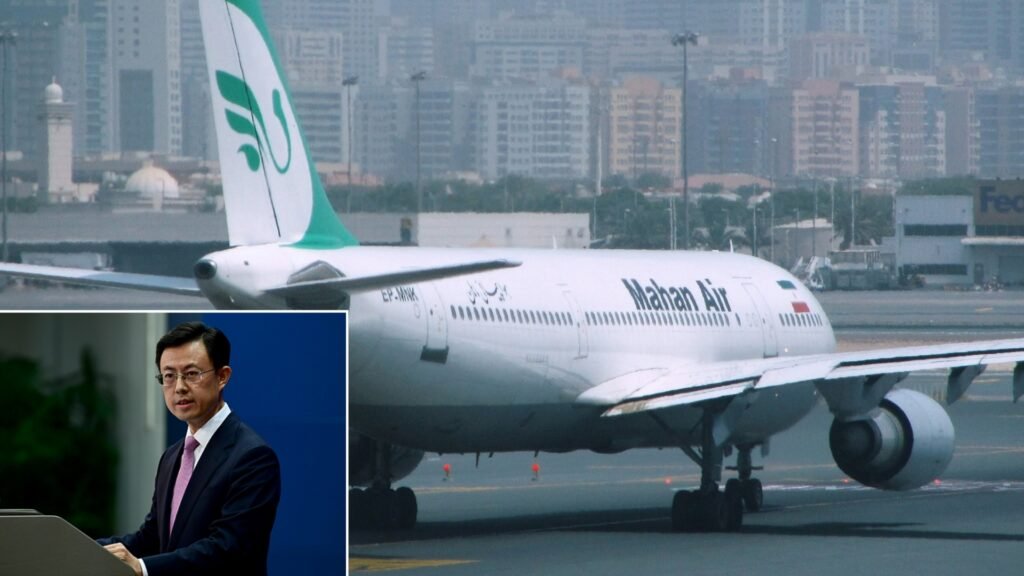
Beijing, China: China has continued receiving Iranian airline flights despite new US sanctions aimed at cutting Iranian carriers off from international aviation services, with a Mahan Air flight from Tehran landing in Guangzhou on September 23, the same day the new US measures took effect.
The development followed an explicit statement from China’s Foreign Ministry on September 22, when spokesman Guo Jiakun said Beijing opposed the US measures and would not treat them as a basis for restricting Iranian aviation links. Asked by AFP whether China would continue receiving Iranian flights after the US threatened countries providing landing services and fuel to Iranian carriers, Guo said: “China opposes illicit unilateral sanctions that have no basis in international law and lack UN Security Council mandate.”
On September 23, Mahan Air commercial flight IRM093, operating from Tehran, landed in Guangzhou at 4:39 p.m. local time, according to FlightRadar24 data. The landing occurred after the US sanctions measures had taken effect.
Staff at Mahan Air’s Shanghai office said on the morning of September 23 that they had received no notice of flight cancellations and were continuing to sell tickets for the following week. Iranian airlines operate regular direct services to Chinese cities including Beijing, Shanghai and Guangzhou.
Beijing’s stated reason is its opposition to what it describes as unilateral sanctions that lack a basis in international law or authorization from the UN Security Council. China has consistently rejected what it calls Washington’s unilateral or “long-arm” sanctions and has maintained economic and diplomatic relations with Iran.
China and Iran are also described by Beijing as comprehensive strategic partners. During Chinese Foreign Minister Wang Yi’s September 16 meeting with Iranian Foreign Minister Seyyed Abbas Araghchi in Beijing, Wang said China’s policy toward Iran maintained continuity and stability and that China would safeguard what it described as Iran’s legitimate rights and interests. Beijing also called for dialogue between Iran and the US and said the continuation of the conflict did not serve the interests of the parties or the wider international community.
China’s September 22 statement came immediately after US Treasury Secretary Scott Bessent warned that the new sanctions would affect foreign companies and airports that continued providing services to Iranian airlines.
On September 21, Bessent told CNBC that Washington expected the sanctions to effectively stop Iranian airlines from operating internationally.
Bessent said: “On September 23rd, all the Iranian airlines will be shut down around the world.” He further warned: “If they land, you cannot provide them with fuel, you cannot provide them with landing services, you cannot sell them tickets or you will be knocked out of the dollar system.”
The US approach does not amount to a direct physical prohibition on foreign airports receiving Iranian aircraft. Instead, Washington is seeking to make continued services commercially and financially risky by threatening secondary sanctions against companies and other entities that support Iranian airlines.
Bessent specifically warned that providing Iranian aircraft with fuel, landing services or ticketing could result in exclusion from the US dollar-based financial system.
The latest pressure followed a September 8 action by the US Treasury Department’s Office of Foreign Assets Control under Operation Economic Outcast. The Treasury said it sanctioned 36 targets connected to Iran’s aviation sector, including Iranian airlines, foreign intermediaries and companies accused of supporting Iran’s aviation network.
The Treasury said the action targeted networks used by Iran to obtain aircraft and sensitive technology and also suspended certain previous aviation-related authorisations. Mahan Air-linked entities were among the targets identified in the Treasury’s sanctions material.
The measures were subsequently expanded through the threat of secondary sanctions against foreign service providers. The stated objective was to put additional financial and operational pressure on Iranian airlines and restrict their ability to maintain international operations.
The impact has already been visible elsewhere. Iranian airlines cancelled or lost access to several international routes on September 23, with reports citing suspended services involving Baghdad, Muscat, Qatar, Georgia and Azerbaijan, while routes to China remained available.
Azerbaijan’s national airline, AZAL, had announced that Iranian airline flights to Azerbaijan would be suspended from September 22 in connection with the latest US sanctions. The situation was initially complicated by conflicting information, with Iran Air saying it had not received an official notification concerning the Baku flights.
As of September 24, the latest official Chinese statements continue to establish Beijing’s position that it opposes the US sanctions and does not regard the measures as having sufficient international-law or UN Security Council authority.
Available flight-schedule data also continues to show Mahan Air services between Tehran and Guangzhou around September 24, although schedule listings should not be treated as confirmation that every planned flight actually operated. The Tehran-Guangzhou route had already been operating before the September 23 sanctions deadline.