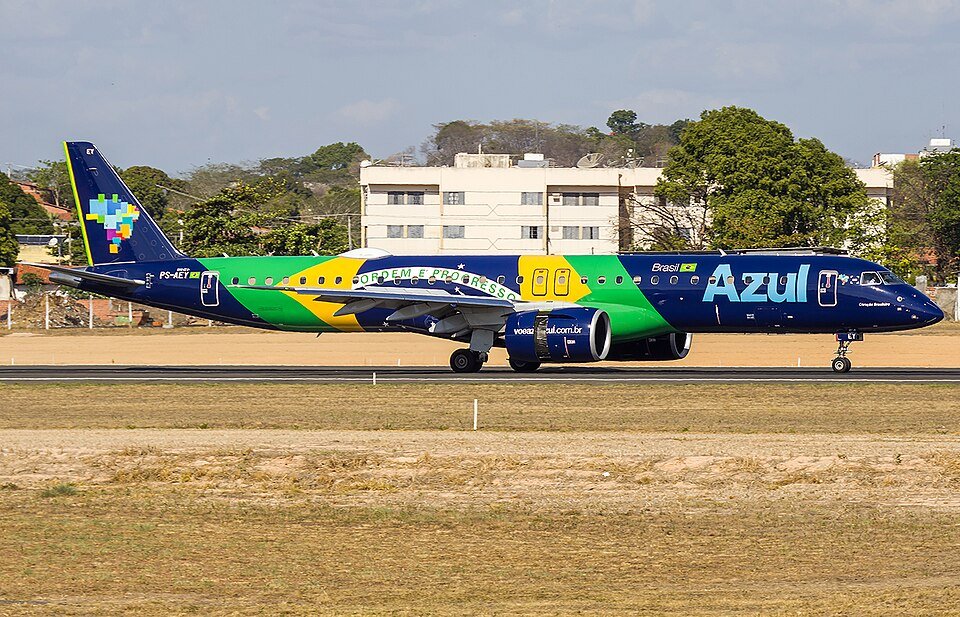
São Paulo, Brazil: Brazilian aircraft manufacturer Embraer said on 22 September 2026 that it had received reports of GPS system instability affecting certain aircraft, including its E2 family, as Brazilian carrier Azul experienced significant operational disruption involving its E2 fleet. Embraer said it was monitoring the situation with operators and the equipment manufacturer, providing technical support and taking steps to address the issue.
The manufacturer said the occurrence could affect airline schedules but does not affect flight safety. “The global E2 fleet is equipped with navigation systems and procedures that allow the aircraft to operate even under conditions of GPS system instability,” Embraer said.
The aircraft involved include the Embraer E190-E2 and E195-E2, which use Honeywell’s Primus Epic 2 avionics suite. Honeywell said it was aware of a global aircraft issue involving the reception of GPS signals and that its teams were “actively assessing the matter” to establish the underlying cause. Neither Embraer nor Honeywell had identified a confirmed cause as of 23 September 2026.
Azul separately confirmed that the instability had affected its E2 operations. The airline said it was taking operational measures that could lead to changes to its route network and the schedules of some flights. The disruption affected flights through major Brazilian airports including São Paulo/Congonhas, Brasília, Confins and Viracopos, with cancellations, delays and passenger queues reported on 22 September. Azul asked passengers to check their booking status through official channels before going to the airport and confirmed passenger assistance under ANAC Resolution 400.
On 23 September 2026 that the disruption at Azul was more extensive than initially indicated. According to its review of flight-tracking data, Azul’s E195-E2 operation progressively declined on the evening of 22 September, and by about 7 p.m. local time no Azul E195-E2 was shown in flight. The first E2 departure identified after the interruption was E195-E2 registration PS-AEH, operating Azul flight AD4978 from Campinas/Viracopos to Brasília, shortly before 10 p.m. local time. Flight-tracking records also show PS-AEH operating AD4978 after the disruption.
The interruption lasted nearly three hours and caused cancellations and delays across Azul’s network. It also found that other E2 operators continued flying during the period when Azul’s E2 fleet was grounded. Porter Airlines was specifically observed operating E195-E2 aircraft in Canada and the United States, while E190-E2 and E195-E2 aircraft operated by other carriers remained active in North America, Europe, Asia, Africa and Oceania.
GPS reception problems had also been reported on E2 aircraft operated by KLM Cityhopper, Binter, Helvetic and Mexicana, although the global number of affected aircraft had not been established. Embraer had received reports from several operators and that some aircraft had been declared AOG (Aircraft on Ground). It estimated that more than 200 E2 aircraft are in service with around 24 airlines, but stressed that the worldwide tally of affected aircraft remained incomplete.
The anomaly appears when an E2 aircraft is powered up on the ground, before dispatch. A system reset can temporarily restore GPS reception, but the problem may return after the restart. Aircraft already airborne were reported able to continue their flights. The issue can nevertheless prevent dispatch when the aircraft cannot meet the navigation requirements needed for a particular route or procedure.
Embraer has said the E2’s alternative navigation systems and procedures allow the aircraft to operate under GPS instability, while Honeywell continues to investigate the GPS-reception problem. As of 23 September 2026, the underlying cause, the complete worldwide number of affected aircraft and any longer-term corrective action had not been publicly announced.