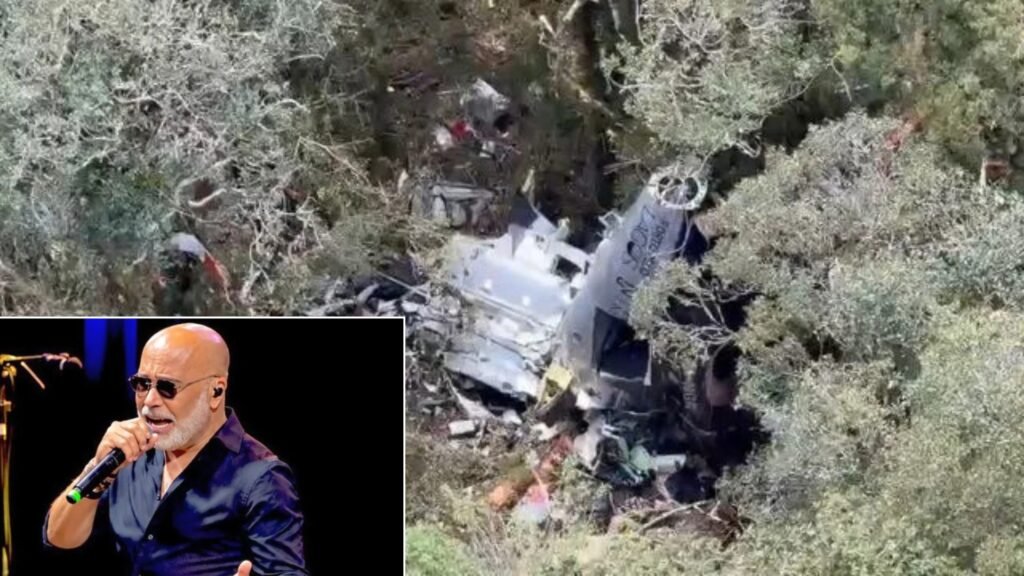
Santa Catarina, Brazil: Five people were killed after a Bell 430 helicopter disappeared during a flight in Santa Catarina, Brazil, on 21 September 2026 and was found crashed in the Serra Catarinense the following day. The victims were Brazilian singer Rick Sollo, businessman Bruno Avelar, videomaker Paulo Soares, pilot Antônio Roberto Nóbrega de Araújo and co-pilot Leopoldo Barros Teixeira.
The helicopter, registered PP-MGR, had departed from Porto Belo, on the coast of Santa Catarina, for São Joaquim, in the mountainous Serra Catarinense. The last known communication with the aircraft was at about 16:00 local time on 21 September, after which it could no longer be contacted. The Corpo de Bombeiros de Santa Catarina began search operations that afternoon, while the Brazilian Air Force (FAB) deployed aircraft to assist the operation.
The flight was part of a longer journey that had begun in Jundiaí, São Paulo. Rick and Avelar had travelled by private aircraft from Jundiaí to the Costa Esmeralda airfield in Porto Belo before transferring to the Bell 430. Public flight-tracking information indicates the first aircraft departed Jundiaí at about 07:25 on 21 September and reached Porto Belo at about 08:31. The Bell 430 then continued toward São Joaquim.
The planned visit in São Joaquim included lunch at Vinícola Leone di Venezia and a meeting with São Joaquim Mayor José Teodoro de Sena Amaral. Rick later intended to continue to Rancho Queimado. In an audio message sent shortly before the disappearance, Rick said: “I’m going now to São Joaquim, I’m going to have lunch there in São Joaquim and then I’ll go down; we’re going to Rancho Queimado.” He also asked for landing coordinates at the later destination.
According to the winery’s manager, the group was expected to arrive at around noon. The helicopter reportedly left Porto Belo at about 11:00, while communication problems were reported later that day. The search was initially concentrated around Vacas Gordas, in Urubici, and another area identified through the last cellphone signal from one of the occupants. The two search areas were about 30 kilometres apart.
Weather complicated the operation. Santa Catarina was experiencing heavy rain, strong winds and reduced visibility, with an alert for hail in parts of the region. Search teams also encountered difficult terrain, fallen trees and flooded areas. However, authorities have not established weather as the cause of the crash.
The wreckage was located at about 12:00 on 22 September 2026, roughly a day after the helicopter disappeared. It was found in a remote, forested area near Santa Bárbara, in the municipality of Urubici, in the Serra Catarinense. Reports described the crash site as difficult to reach, with rescuers facing steep terrain, dense vegetation, rain, fog and poor visibility. Reaching the wreckage from the nearest suitable landing point was expected to require about three hours on foot.
The search operation involved about 40 firefighters, more than 10 vehicles, search-and-rescue dogs and drones equipped with thermal cameras. The FAB also deployed a SC-105 Amazonas aircraft and an H-60 Black Hawk. The SC-105 Amazonas located the wreckage and guided a nearby rescue helicopter toward the site.
The Corpo de Bombeiros Militar de Santa Catarina confirmed that all five people aboard had died. In its statement, the agency said: “The Corpo de Bombeiros Militar de Santa Catarina has just found the wreckage of the missing aircraft in the Serra Catarinense, with, unfortunately, five people without life.” The agency said the next stage would be recovering the victims so that forensic examinations could be carried out.
The aircraft was a Bell 430, a twin-engine helicopter manufactured by Bell Helicopter in 2001. It carried Brazilian registration PP-MGR and serial number 49080.
Brazil’s National Civil Aviation Agency (ANAC) records list the helicopter as being in normal status, with its airworthiness verification certificate valid until 11 August 2027. The aircraft is certified for transport, configured under RBAC 91, and has a minimum certified crew of one pilot, with capacity for seven passengers and eight seats in total.
ANAC records identify JTA Empreendimentos e Urbanismo Ltda. as the operator and owner. The aircraft was transferred to the company on 30 April 2026. It was registered as a private aircraft and was not authorised for commercial air-taxi operations under RBAC 135.
Rick Sollo, 59, whose real name was Geraldo Antônio de Carvalho, was a singer, composer and producer and one half of the Brazilian sertanejo duo Rick & Renner. Born in Monte do Carmo, Tocantins, in 1966, he began performing as a child and later formed the duo with Renner in Brasília in the 1980s. The pair became nationally known during the 1990s, with songs including “Ela é Demais”. Rick was the father of six children and grandfather of two. His last reported performance with Renner was in Sorriso, Mato Grosso, on 19 September 2026, two days before the crash.

Bruno Avelar, 41, was a businessman, writer, speaker and mentor from Belo Horizonte. He founded O Poder do Network, a project focused on networking, entrepreneurship, events and business mentoring. Avelar also had professional links with the Neymar family and participated as a presenter at charitable events associated with the Instituto Projeto Neymar Jr. He had also worked in media and business-related projects.

Paulo Soares was a videomaker who worked with Avelar and accompanied him on professional trips. Hours before the helicopter disappeared, Soares posted video from inside the aircraft during the flight. His final Instagram story carried the words: “I think I was born for this.”

Antônio Roberto Nóbrega de Araújo was the helicopter’s pilot. He was from Acari, Rio Grande do Norte, and was also known as “Seu Antônio”, according to reports following the accident.
Leopoldo Barros Teixeira, the co-pilot, was from Pongaí, São Paulo. His brother said Leopoldo completed his civil aviation course in 2020. He worked in the sugar-cane sector until 2025 before returning to aviation and pursuing his interest in helicopters.
Brazil’s Centro de Investigação e Prevenção de Acidentes Aeronáuticos (CENIPA) has opened an investigation into the accident, with investigators from SERIPA V, based in Canoas, Rio Grande do Sul, also involved.
CENIPA investigators are conducting the initial phase of the investigation, which includes collecting information, examining the wreckage and assessing damage and other evidence to determine the factors that contributed to the accident. CENIPA said the investigation would be completed “in the shortest possible time”, depending on the complexity of the work required at the crash site.
The authorities have not yet released a confirmed cause of the crash. Weather conditions, the flight path, aircraft systems, operational factors and other evidence will form part of the investigation. At this stage, reports linking the crash directly to the severe weather remain unconfirmed.
The recovery of the bodies was complicated by the remote location of the wreckage. Brazilian authorities said the remains would undergo forensic examination and identification as part of the investigation.