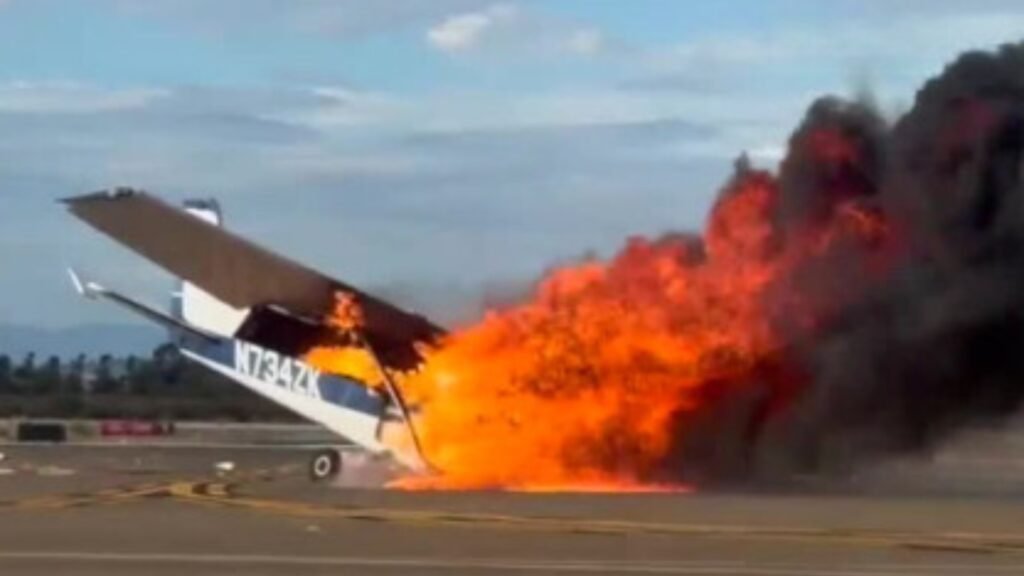
San Diego, United States: Two people were killed after a Cessna 172 crashed and erupted in flames at Montgomery-Gibbs Executive Airport in San Diego, California, during a local flight on September 7, 2026. The aircraft, identified as a 1977 Cessna 172N Skyhawk II registered N734ZK, crashed at about 5:19–5:21 p.m. local time near Runway 28L. The National Transportation Safety Board (NTSB) and Federal Aviation Administration (FAA) are investigating the accident.
San Diego police confirmed two fatalities after receiving a report of the crash at about 5:21 p.m. The aircraft became engulfed in flames, prompting a major response from San Diego Fire-Rescue. Approximately 30 fire personnel responded to the runway as firefighters worked to extinguish the aircraft fire and address a small fuel leak.
San Diego Fire-Rescue Assistant Fire Chief Brian Raines said rescuers initially focused on reaching the occupants but were unable to remove them because of the extent of the damage. “Rescue is always our first priority. That’s what the first units were trying to do. The plane was heavily damaged, and we were not able to extricate any of the victims. We had to focus on extinguishing the fire,” Raines said.
Witnesses who were working in a nearby hangar said that they heard the crash and ran toward the aircraft with fire extinguishers. Witness Mauricio Godinez said, “As soon as we got back to the plane, flames were engulfing the wings,” adding that the wings were “melting, caving in.” Another witness, identified by FOX 5/KUSI as Melissa, said, “We tried our best to go save them, but it was just too much.”
The aircraft was a four-seat, high-wing Cessna 172N Skyhawk II manufactured in 1977, with serial number 17269243 and a Lycoming O-320 engine. The aircraft had departed Montgomery-Gibbs earlier in the day and conducted local maneuvers before returning to the airport. It later departed again at about 4:27 p.m. and began a series of touch-and-go approaches on Runway 28L. The preliminary reconstruction says the accident occurred during the ninth go-around in that sequence.
According to the preliminary reconstruction of ADS-B and air-traffic-control data, the Cessna was approaching Runway 28L while aircraft were also operating on the parallel Runway 28R. The controller provided traffic information and cleared the Cessna for the option on 28L. The pilot acknowledged the traffic and subsequently announced a go-around. ATC instructed the aircraft to extend upwind and issued additional traffic information as the Cessna maneuvered in the airport traffic pattern.
The controller later warned that the Cessna was drifting north while another aircraft was departing westbound. The pilot responded that the aircraft was correcting south. ATC then provided further instructions for the crosswind turn and continued issuing traffic information. The pilot acknowledged the traffic. Shortly afterward, the controller reported winds of approximately 310 degrees at 17 knots, gusting to 22 knots.
The Cessna then announced another go-around. According to the preliminary account, approximately four seconds later an impact sound was heard. The controller immediately informed another aircraft that the Cessna had experienced an accident and said the airport would be closed. A final transmission was subsequently heard from the accident aircraft before communications ended.
Witness information cited in the preliminary aviation reconstruction indicates the aircraft may have entered a stall/spin during the attempted go-around before striking the ground near the holding point for Runway 28L. However, investigators have not determined that a stall or spin caused the accident, and no probable cause has been established. The NTSB investigation remains ongoing.
The aircraft came to rest upright near the holding point for Runway 28L and was consumed by a post-crash fire. Preliminary photographs and observations indicate the cabin was heavily damaged by the fire, while the wings and tail remained attached to the aircraft. The available preliminary reconstruction says there was little evidence of a substantial debris field before the main wreckage.
The identities of the two people killed have not been released by authorities. Investigators had not initially confirmed whether the pilot was experienced or whether the flight was being conducted as a training operation.
The airport was temporarily closed following the crash while emergency crews handled the wreckage and fuel leak. The main runway later reopened after the emergency response and initial scene work. The NTSB will examine the aircraft, flight-track data, air-traffic-control communications, weather, pilot qualifications, maintenance records and other evidence to determine what led to the fatal crash.