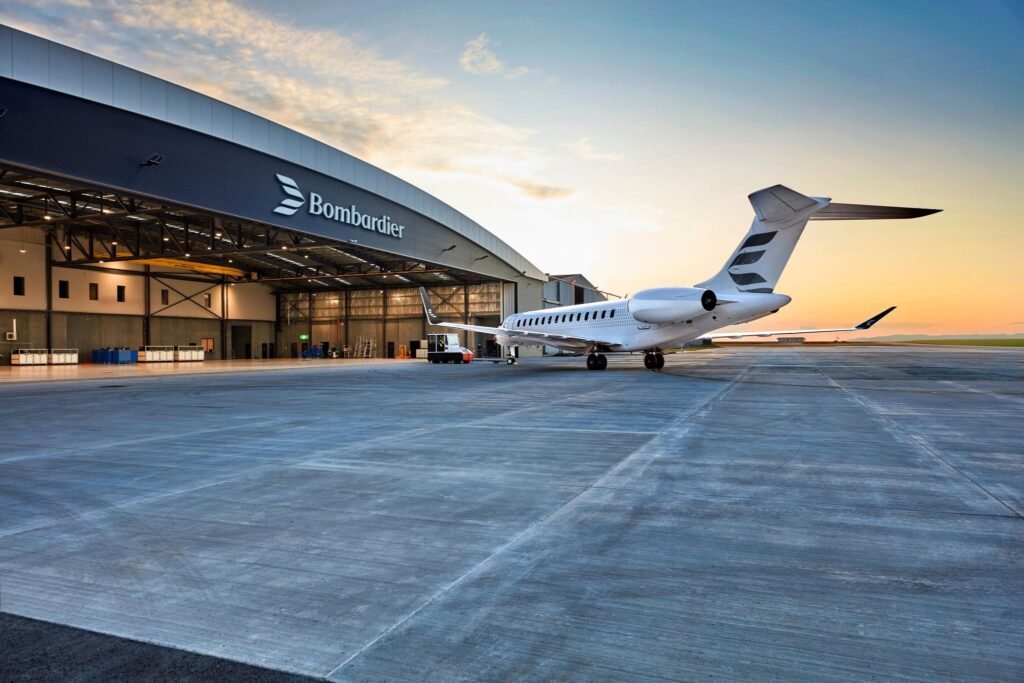
Washington, United States: US President Donald Trump on Monday, September 7, 2026, threatened to block Canadian business-jet manufacturer Bombardier from selling aircraft in the United States unless the company begins manufacturing aircraft inside the country, escalating the latest dispute between Washington and Ottawa over trade, aerospace and industrial policy.
Trump made the announcement in a post on Truth Social on September 7, 2026, saying, “NO MORE SELLING BOMBARDIER IN THE UNITED STATES! Their products aren’t good enough!” He added, “If they want our Market, they must build here, and stop treating America like a ‘piggybank’.”
Trump’s September 7, 2026 statement did not set out a specific legal mechanism, effective date or enforcement procedure for stopping Bombardier aircraft from entering or being sold in the United States. The White House had not immediately explained how the threatened restriction would be implemented, including how it would affect Bombardier aircraft that have already been approved by the U.S. Federal Aviation Administration.
The threat is particularly significant because Bombardier already has a substantial US industrial presence. Bombardier has about 3,500 US employees, 2,800 suppliers in the United States, factories and service centers across the country, and is adding its sixth US service center. The company also manufactures wings for its flagship Global 8000 business jet in Texas.
Bombardier responded late on September 7, 2026, emphasizing the scale of its contribution to the American aerospace supply chain. The company said it spends more than $2.5 billion annually with U.S. suppliers and stated, “Our plan is to continue to invest in our people, our customers and the communities in which we operate across the country.” Bombardier’s own September 7, 2026 statement said its US supply chain includes 2,800 American companies across 47 states.
Bombardier also operates a US based defense facility in Kansas, where Canadian-manufactured aircraft are prepared for special-mission applications. Reuters reported that about half of the approximately 5,100 aircraft operated by Bombardier customers are located in the United States, highlighting the company’s dependence on the American market and the potential consequences of any restrictions on new aircraft sales.
The company’s US footprint extends beyond final aircraft operations. Bombardier’s business jets are closely integrated with American aerospace suppliers, with most of its private jets using US made engines supplied by Honeywell Aerospace and GE Aerospace. Aerospace analyst Richard Aboulafia of AeroDynamic Advisory said he did not expect business-jet customers to cancel Bombardier orders and questioned how the Trump administration could prevent the aircraft from being sold.
The broader US aerospace industry is also deeply integrated with international suppliers. According to the Aerospace Industries Association, the US aerospace and defense sector recorded a $109.2 billion trade surplus, while exports increased 25% year over year in 2025.
Trump’s September 7, 2026 attack came as the US Canada trade dispute was intensifying. Canada was scheduled to introduce retaliatory tariffs against US goods on September 8, 2026, after trade negotiations between the two countries broke down. The Canadian countermeasures cover about $20 billion of US goods, with tariffs ranging from 15% to 50%. The measures took effect shortly after midnight on September 8, 2026.
The Bombardier dispute also revives an earlier aviation confrontation between Trump and Canada. On January 29, 2026, Trump said the United States was decertifying Bombardier Global Express business jets and threatened a 50% tariff on aircraft manufactured in Canada until Canada certified several Gulfstream aircraft produced by U.S.-based Gulfstream Aerospace. Trump had argued that Canada’s certification process was effectively restricting Gulfstream aircraft sales in the country.
Those January 2026 measures were not ultimately implemented as threatened. Canada subsequently certified several Gulfstream aircraft in February 2026, and the threatened Bombardier decertification and 50% aircraft tariff did not take effect.
The Canadian government has also disputed Trump’s characterization of the Gulfstream situation. A spokesperson for Canadian Transport Minister Steven MacKinnon told the Financial Times, “Gulfstream aircraft is and can be freely sold and operated in Canada.”
Bombardier’s position is especially notable because the company has continued expanding its Canadian manufacturing operations even as the US-Canada trade relationship has deteriorated. On September 1, 2026, Bombardier announced an agreement to acquire the assets of MHI Canada Aerospace in Mississauga, Ontario, from Mitsubishi Heavy Industries. The facility manufactures major aerostructures, including wings for Bombardier’s Global 5500 and Global 6500 business jets. The transaction is expected to close later in 2026, subject to regulatory approvals and customary closing conditions, while financial terms were not disclosed.
The acquisition is expected to add approximately 750 employees to Bombardier’s workforce and gives the company greater control over an important part of its supply chain. The move was announced only six days before Trump’s September 7, 2026 demand that Bombardier manufacture aircraft in the United States.
Bombardier’s business also remains financially strong. On August 24, 2026, the company reported second-quarter 2026 revenue of $2.15 billion, an increase of 6% compared with the same quarter in 2025. Bombardier attributed the increase largely to a record contribution from its Services business.
The US market remains critical to Bombardier’s business aviation operations. Customers operate approximately half of Bombardier’s 5,100-aircraft fleet in the United States. Any broad restriction on new Canadian-built Bombardier aircraft could therefore affect not only Bombardier but also US business-jet operators, customers, suppliers, maintenance facilities and other companies connected to its American operations.
The dispute also has implications for Bombardier’s Global and Challenger business-jet families and its wider US customer base. Bombardier competes directly with Gulfstream in the large-cabin business-jet market, making the certification dispute between Canada and Gulfstream an important part of the background to Trump’s latest remarks.
For now, Trump’s September 7, 2026 statement represents a presidential threat rather than a formally announced US sales ban with published implementation rules. The White House had not specified how the administration would prevent deliveries of FAA-approved Bombardier aircraft, while Bombardier has said it intends to continue investing in its US workforce, customers, communities and supplier network.
The latest development therefore places Bombardier at the center of the rapidly escalating US Canada trade dispute, with the Canadian manufacturer facing pressure from Washington to expand aircraft production on American soil while simultaneously maintaining a major US workforce, supplier network, service infrastructure, Texas wing production and Kansas defense operation.