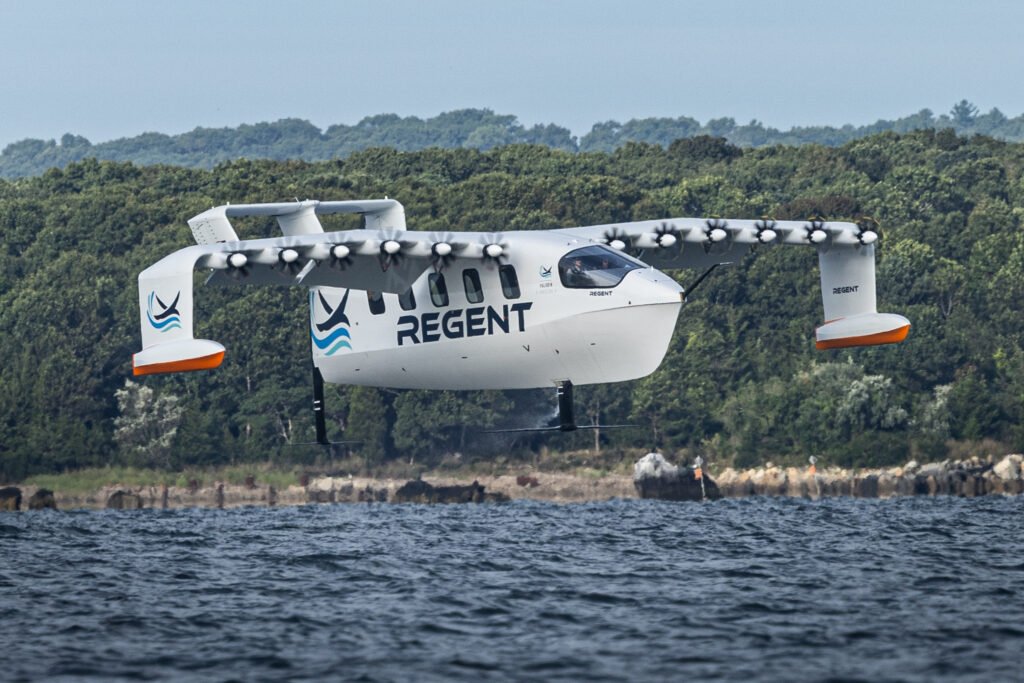
North Kingstown, United States: REGENT Craft’s full-scale Viceroy Seaglider has completed its first human-crewed flight, with the company describing the milestone as the world’s first human-crewed flight of a Seaglider and the largest-ever all-electric wing-in-ground-effect (WIG) craft to fly with people onboard.
The flight was conducted on September 2, 2026, at REGENT’s headquarters on Narragansett Bay in Rhode Island, with two captains aboard. According to REGENT, the Viceroy covered 1,956 feet (596 meters) at an altitude of about 33 feet (10 meters) above the water during the 30-second flight. The company said the test marks a major step toward commercial and defense operations and begins the final stage of the Viceroy’s sea-trial program.
REGENT said the aircraft-like vessel spent the summer undergoing higher-speed hydrofoiling tests to prepare for the crewed flight. The broader 2026 test campaign has combined on-water testing with simulation-based development to refine performance, reduce operational risk and prepare the vehicle for eventual commercial and military use. The company had previously demonstrated flight of its uncrewed Squire Seaglider drone.
REGENT CEO and co-founder Billy Thalheimer said the company had spent five and a half years pursuing the milestone and had “successfully proven safe, efficient ground-effect flight.” He added that the Viceroy could open opportunities in passenger transportation, defense and cargo operations, with REGENT now moving toward production.
Co-founder and CTO Mike Klinker said the flight test validated years of engineering and operational work and gave the company confidence to move toward full-rate production. He described the flight as “smooth and safe” and said the company was now preparing to advance its maritime-mobility concept.
The Viceroy is designed differently from a conventional aircraft. REGENT’s Seaglider operates exclusively over water and uses three modes: it initially floats on its hull, transitions onto hydrofoils as speed increases and then lifts into wing-in-ground-effect flight. During flight, the craft remains within approximately one wingspan of the water’s surface.
The hydrofoils are intended to provide wave tolerance and maneuverability in harbors and coastal areas before the vehicle transitions into flight. REGENT says a triple-redundant digital control system autonomously manages stability, while the certified mariner operating the vessel controls it much like a boat.
The production Viceroy is planned to carry 12 passengers and two crew members, with a targeted top speed of up to 180 mph and a range of up to 180 miles. REGENT says the vessel will use existing port infrastructure rather than conventional airport runways and is intended to provide faster coastal transportation while retaining the accessibility of maritime operations.
The company’s Seagliders are regulated as maritime vessels, with REGENT stating that they will be captained by certified mariners and regulated in the United States by the U.S. Coast Guard and by maritime authorities in other countries.
The crewed Viceroy flight comes as REGENT expands both its commercial and defense programs. The company says it has a global order book spanning six continents and multiple years of manufacturing capacity booked. Earlier this year, luxury coastal travel operator The Twenty Five became REGENT’s first U.S. delivery and launch partner, with an order for up to 60 Viceroy Seagliders for planned operations in the Northeast and Southeast United States.
REGENT is also developing military applications for the Seaglider platform, including contested logistics, MEDEVAC, CASEVAC, intelligence, surveillance and reconnaissance missions and launched effects. The company has a $15 million contract with the US Marine Corps Warfighting Laboratory and a Cooperative Research and Development Agreement with US Special Operations Command.
The smaller autonomous Squire Seaglider has already completed a defense-specific wing-in-ground-effect flight, according to REGENT. The company considers the Squire program an important step toward validating autonomous systems for future defense and commercial applications.
Manufacturing preparations are also underway. REGENT completed construction in June of what it describes as the world’s first Seaglider manufacturing facility, a 255,000-square-foot site at its Quonset, Rhode Island headquarters. The facility is being brought online as the company’s production hub and will support structural assembly, wing and hydrofoil integration, battery and systems installation and water-based testing.
The facility is designed to support end-to-end production of the 12-passenger Viceroy and the Squire drone, with direct waterfront access intended to support sea trials and production testing.
REGENT said the latest Viceroy flight will be followed by a rigorous flight-testing campaign as the company works toward full-scale production and deliveries to commercial and military customers. The milestone therefore represents a transition from proving the basic flight concept with a crew onboard toward demonstrating the performance, reliability and operational capabilities required before the Seaglider can enter service.