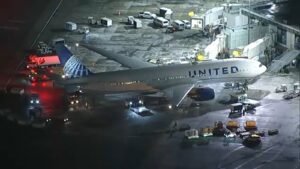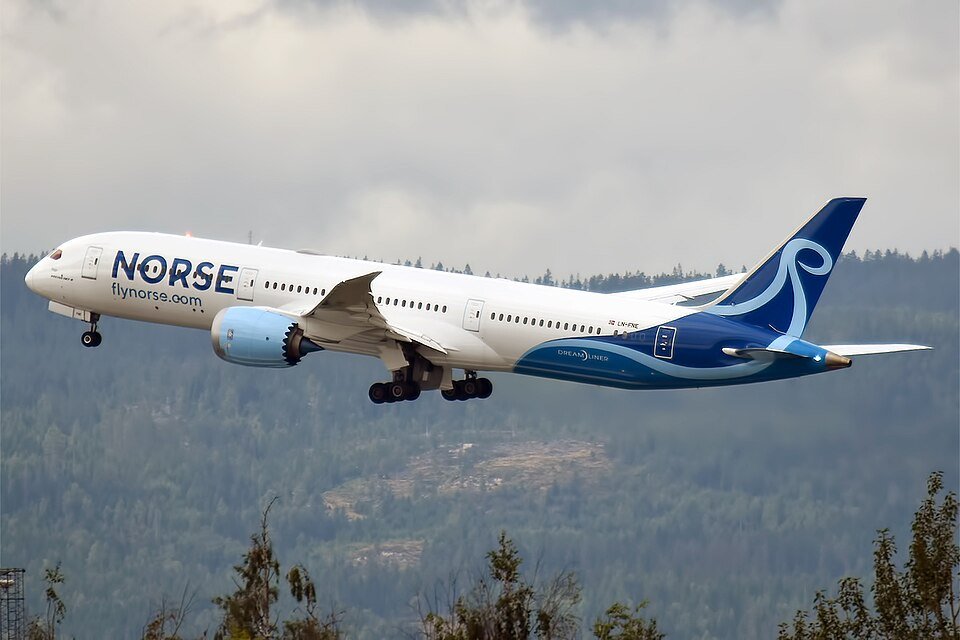
Crawley, United Kingdom: A Norse Atlantic Airways Boeing 787-9 rejected its takeoff from London Gatwick Airport on September 4, 2026 after a reported nose-gear problem, leaving the aircraft disabled on the runway and forcing the airport to temporarily halt flight operations.
The aircraft, a Boeing 787-9 Dreamliner registered G-CKOF, was operating Norse Atlantic flight Z0701 from London Gatwick (LGW) to New York John F. Kennedy International Airport (JFK). It was accelerating for departure from Runway 26L when the crew rejected the takeoff at about 120 knots over the ground, according to preliminary aviation incident information.
Reports said that the rejected takeoff followed a problem with the aircraft’s nose landing gear and that the nose wheels had turned about 90 degrees. The aircraft then stopped on the runway and became disabled. The precise technical cause of the nose-wheel movement has not been officially declared by the airline.
The aircraft remained on Runway 26L while airport emergency teams responded. The incident did not result in any reported injuries among passengers or crew. A passenger onboard, Alice Kavanagh, described the moment the aircraft stopped as frightening, saying the pilot “slammed the brakes on” after a reported technical fault was detected.
The Boeing 787 was subsequently removed from the runway. The aircraft blockage had an immediate effect on Gatwick because the airport effectively operates with one runway at a time. Although Gatwick has two runways, their proximity means they cannot normally be used simultaneously for independent operations. As a result, the closure of Runway 26L temporarily stopped both departing and arriving traffic.
London Gatwick confirmed that the runway remained closed for 50 minutes because of the incident.
“The runway was closed for 50 minutes this afternoon (Friday 4 September) due to a technical issue with a departing aircraft,” a Gatwick spokesperson said. “The aircraft was towed from the runway, which reopened shortly afterwards following a full safety inspection. As always, safety and security is our number one priority.”
The runway reopened after airport teams completed the required safety inspection. Subsequent reporting put the reopening at approximately 14:36 BST, although the airport’s official statement characterized it simply as reopening shortly after the aircraft was removed and the inspection was completed.
The temporary closure created a wider disruption across Gatwick’s flight schedule. Several inbound flights were diverted to alternative airports, with London Luton and London Stansted among the destinations reported for diverted services. EasyJet flights were also affected by the disruption.
Flight-tracking data later showed severe delays affecting more than 330 flights at Gatwick, with an average delay of about 57 minutes. The effects continued after the runway reopened because aircraft, crews and passengers had been displaced during the closure.
For the incident, Gatwick has confirmed only that a technical issue involving a departing aircraft caused the runway closure. The more specific information concerning the nose gear and the reported 90-degree movement of the nose wheels remains preliminary. Further maintenance findings or an official investigation would be needed to establish the exact cause of the rejected takeoff.