Alberta, Canada: The Transportation Safety Board of Canada (TSB) has concluded that a fatal Bell 206L helicopter crash near Fort Chipewyan, Alberta, in February 2024 was likely caused by an unexpected loss of visual references in flat-light and whiteout conditions, followed by spatial disorientation and loss of control.
The final investigation also found shortcomings in pilot training, company risk management and safety procedures, while warning that Canada’s regulatory framework still does not require commercial VFR helicopter operators to provide pilots with the training and technology needed to recover from inadvertent flight into instrument meteorological conditions (IIMC). The TSB authorized the report on May 27, 2026, and released it publicly on August 26, 2026.
The occurrence involved a Hanley Heli Service Inc. Bell Helicopter Textron 206L, registration C-GCHM, serial number 45083. On 12 February 2024, the helicopter was conducting aerial geo-survey work over the western area of Lake Athabasca, near Fort Chipewyan Airport (CYPY), with a survey sensor, known as a “bird,” suspended from a 300-foot longline. The pilot was the sole occupant.
The flight began at 1:17 p.m. Mountain Standard Time after the helicopter had returned to Fort Chipewyan to refuel. Earlier that afternoon, the pilot of Hanley’s second helicopter had observed deteriorating weather and contacted the pilot, advising him to finish his survey line and return to the airport. At about 2:29 p.m., the pilot reported that he had about 10 kilometres remaining on his survey line. He completed it at approximately 2:38 p.m. and turned toward Fort Chipewyan.
As the helicopter approached the airport, visibility deteriorated. At about 3:01 p.m., the pilot reported that visibility was poor and that he was attempting to arrive from the north. Near the airport, he activated the aerodrome lighting system. After overflying a small spit of land about 0.5 nautical miles northeast of Runway 22, the pilot reported that the helicopter was accumulating ice and then said he had lost all visual references and was unsure of his position.
The pilot made a right 180-degree turn over the frozen lake. While reversing course, the second pilot suggested flying toward Lake Athabasca in the hope of regaining visual references and possibly landing along the shoreline. The occurrence helicopter subsequently turned toward the lake and continued eastward over the snow-covered ice.
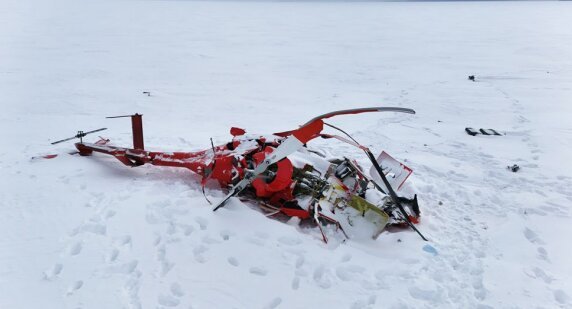
At about 3:15 p.m., the helicopter was approximately 3.3 nautical miles east-southeast of Fort Chipewyan Airport, at 839 feet above ground level and travelling at about 27 knots. Roughly two minutes later, the pilot reported that he had released the external load, had lost control and that the helicopter was spinning. At approximately 3:18 p.m., the Bell 206L struck the frozen surface of Lake Athabasca in a nose-down, right-bank attitude. The pilot was fatally injured and the helicopter was destroyed. There was no post-impact fire.
The emergency locator transmitter activated on impact and its distress signal was detected by the search-and-rescue satellite system. A first search party reached Allison Bay at about 3:40 p.m. but could not locate the helicopter because of low visibility and blowing snow. A second search began after the Royal Canadian Mounted Police and local responders arrived. The external survey equipment and longline were located first, followed about 10 minutes later by the helicopter at approximately 6:10 p.m.
The TSB found no indication that an aircraft system or component malfunction contributed to the crash. The helicopter had basic flight instruments, including an artificial horizon, and was also equipped with a radar altimeter. Investigators found, however, that Hanley pilots routinely operated with the artificial horizon switched off because they believed it was unnecessary for VFR operations.
The TSB also found that on-site survey personnel had reportedly told pilots to leave the artificial horizon off because it interfered with GPS data. The investigation subsequently established that this guidance was inaccurate and that the survey company had no problem operating with the artificial horizon switched on.
The TSB determined that the helicopter flew over a snow-covered, featureless lake beneath an overcast sky while snow squalls were occurring. Those conditions likely created flat light and whiteout, eliminating the visual references the VFR-only pilot needed to maintain spatial orientation. The pilot then inadvertently entered IMC, became spatially disoriented, lost control and was unable to recover from the resulting uncontrolled descent.
The report said the pilot had approximately 2,500 total flying hours, including about 2,150 helicopter hours, but only about 77.5 hours on the Bell 206L. His commercial helicopter licence was restricted to daylight VFR operations. He had completed his commercial helicopter training in 2016 and had last flown by reference to instruments and practised an IIMC recovery procedure during that training in 2015, meaning he had not maintained recent instrument-flight proficiency.
The TSB found that the pilot’s limited experience operating in flat light and whiteout conditions was significant. Investigators concluded that he experienced “plan continuation bias” because his mental model underestimated the danger of continuing toward the airport and later flying over the featureless frozen lake. Once visual references disappeared, the pilot relied on the external environment rather than transitioning to instruments.
The TSB noted that the helicopter became increasingly difficult to control once its airspeed fell below about 60 knots. It also found that if the artificial horizon had been switched off, as was common at Hanley, an IIMC recovery would have been extremely difficult because the pilot would have lacked an indication of the helicopter’s attitude. The pilot ultimately reported that the helicopter was spinning and that he was releasing the external load, but investigators concluded that by then spatial disorientation had already occurred. The impact followed about 60 seconds after the pilot reported losing all visual references.
The investigation also identified weaknesses in Hanley’s safety management. The company had no formal process for proactively identifying operational hazards and mitigation measures, had limited winter operating experience and did not provide specific training for IIMC or operations in flat-light and whiteout conditions. Its operations manual prohibited flight in whiteout but did not provide pilots with procedures or training for avoiding or recovering from a loss of visual references.
The TSB also found shortcomings in the pilot’s training documentation and external-load experience. The pilot had completed two dedicated external-load training flights under supervision, on January 26 and January 30, 2024. Existing records showed 13 hook events before the accident, although Hanley said those records underreported the actual number. The investigation could not determine the exact number of external-load operations the pilot had completed.
The final report identified five findings as causes and contributing factors. The TSB concluded that the overcast sky, snow-covered featureless surface and snow squalls created flat light and whiteout conditions; that the pilot subsequently experienced spatial disorientation and lost control; that his limited experience contributed to plan continuation bias; that Hanley relied on an “avoid-at-all-costs” approach to IIMC; and that the company’s safety system placed insufficient emphasis on proactive hazard identification and risk mitigation.
The Board also identified three broader risks. It warned that without standard operating procedures based on industry best practices, pilot decision-making during challenging situations can be suboptimal. It said pilots and passengers remain at increased risk until Transport Canada requires helicopter operators to improve IIMC training, technology and procedures. The Board further noted that Canadian regulations do not require Class B and Class C external-load training to include emergency decision-making, potentially leaving pilots new to external-load operations without the skills needed to manage emergencies involving loss of visual references.
The issue extends beyond this single accident. The TSB said loss-of-visual-reference accidents are more than twice as likely to involve helicopters than airplanes. Between 2021 and 2024, 8.85% of helicopter accidents in Canada involved loss of visual reference, compared with 2.16% of airplane accidents, excluding rotor-induced whiteout events. Since 2000, such accidents involving airplanes and helicopters have killed or seriously injured 144 people.
The TSB connected the findings directly to its earlier investigation into the fatal 2021 Griffith Island helicopter crash in Nunavut. Following that investigation, the Board issued four recommendations to Transport Canada: require commercial helicopter operators to ensure pilots have the skills to recover from IIMC; require technology that assists with avoiding and recovering from IIMC; require standard operating procedures for single-pilot operations; and strengthen protections for helicopters conducting reduced-visibility operations in uncontrolled airspace.
As of the TSB’s latest assessments in March 2026, those recommendations remained active. Recommendation A24-01 on IIMC recovery training was rated “Satisfactory in Part,” while A24-02 on technology was also rated “Satisfactory in Part.” Recommendations A24-03 on single-pilot SOPs and A24-04 on reduced-visibility operations were rated “Satisfactory Intent.” The TSB said the regulatory changes had not yet fully eliminated the identified safety deficiencies.
For A24-01, Transport Canada has been examining changes to instrument-training requirements and the FAA’s approach to IIMC recovery. However, the TSB said the proposed changes in NPA 2023-005 currently address only part of the commercial helicopter sector. Until all commercial helicopter operators are required to ensure pilots possess IIMC recovery skills, the safety deficiency remains only partially addressed.
On technology, the TSB said the proposed regulatory changes do not yet mandate equipment such as radar altimeters, synthetic vision or terrain-awareness and warning systems for the wider commercial helicopter fleet. The Board therefore continues to rate A24-02 “Satisfactory in Part.”
For single-pilot operations, Transport Canada is developing regulatory amendments and guidance intended to establish consistent SOP requirements under the applicable Canadian Aviation Regulations. The TSB said Transport Canada has targeted 2027 for completion of the regulatory and guidance updates and therefore rated the response “Satisfactory Intent.”
For reduced-visibility operations, Transport Canada is reviewing low-visibility approval standards for fixed- and rotary-wing aircraft. The TSB said the proposed changes, if adopted, would provide helicopter pilots with additional training and equipment protections during night VFR and reduced-visibility operations. That response was also rated “Satisfactory Intent.”
The TSB Chair Yoan Marier said the central safety lesson was that avoidance alone cannot protect pilots when IIMC occurs unexpectedly.
“Helicopter pilots must have the tools and training that they need to recover from IIMC. Relying solely on avoidance isn’t a strategy, it’s a gamble that leaves lives at risk. The TSB has made recommendations to Transport Canada, but helicopter operators don’t need to wait to give pilots the training and the tools they need to recover from it,” Marier said.
The Board stressed that IIMC is, by definition, unintentional, making an “avoid-at-all-costs” strategy insufficient as a complete safety defence. Instead, the TSB advocates a defence-in-depth approach combining avoidance, recognition, recovery, training, technology, procedures and supervision.
Hanley Heli Service has already introduced several safety measures following the accident. The company upgraded its helicopters with Aspen Digital Flight Displays featuring synthetic vision and ADS-B, expanded ground training on weather, risk assessment and decision-making, introduced an online learning system with examinations and instructional material, and brought in a third-party certified training provider for annual pilot competency checks.
Hanley also strengthened Health and Safety Representative training, held a crew resource management discussion and issued an operations memo focused on safety, prevention and risk-based decision-making. The company reinforced that pilots should abort flights when necessary without fear of reprisal.
The TSB has now closed the A24W0016 investigation. Its conclusion is that the accident was not the result of a mechanical failure but of a chain involving deteriorating weather, loss of visual references, flat light and whiteout, limited IIMC proficiency, spatial disorientation, decision-making pressures and inadequate organizational safeguards. The Board’s broader warning is that preventing similar helicopter accidents will require more than telling pilots to avoid bad weather: operators and regulators need to provide effective training, technology and procedures capable of protecting pilots when avoidance fails.