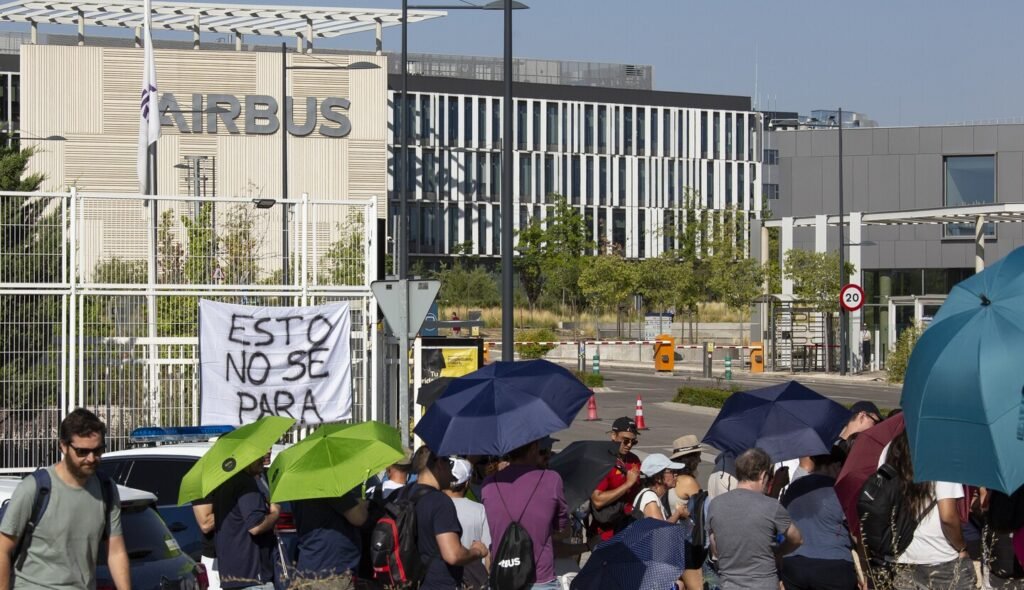
Madrid, Spain: Thousands of Airbus workers in Spain remain on an indefinite strike on August 27, 2026, after rejecting the company’s latest proposal on pay and working conditions. The industrial action began on August 25, 2026 after employees represented by UGT, CGT and ÚTIL voted overwhelmingly to continue the stoppage. A fresh mediation meeting between Airbus and the unions was scheduled at Spain’s Interconfederal Mediation and Arbitration Service (SIMA-FSP) on Thursday, 27, 2026 as both sides seek to break the deadlock.
The dispute involves Airbus facilities in Getafe and Illescas, as well as the San Pablo and Tablada plants in Seville and the Albacete site. Airbus has more than 14,000 employees across Spain. The Cádiz workforce has not yet held its final vote, with its assembly postponed to September 1, but it is following the majority decision of the other centres for now.
The unions are demanding improvements in wages and the restoration of employment conditions they say were changed unilaterally. Their concerns include recovering lost purchasing power, teleworking, holidays, working-time flexibility, transport and cafeteria arrangements, as well as issues surrounding sick-leave payments and employment guarantees. UGT said the central objectives behind the strike are enforcement of existing legal, contractual and collective-agreement obligations, reversal of unilateral company decisions and a genuine collective bargaining process.
Airbus has made several concessions during the mediation process. The company offered a salary increase linked to the consumer price index (CPI), together with an additional component aimed at recovering lost purchasing power. It also agreed to restore the previous teleworking arrangements and individual agreements. Airbus confirmed that it had withdrawn its appeal before Spain’s Supreme Court concerning sick-leave payments and said amounts previously deducted from employees would be returned.
However, the unions considered the offer insufficient because several important issues remained unresolved or lacked firm financial and implementation details. UGT said the company still needed to provide clearer commitments on matters including holidays, working-time flexibility, transport, cafeteria arrangements, job classifications and conditions at Cádiz. The union said negotiations would continue until the workforce’s objectives were addressed.
Airbus has publicly expressed disappointment over the decision to proceed with the indefinite strike and warned that reaching an agreement quickly is critical. The company said it was assessing the additional impact of the stoppage on its production obligations, customer agreements, institutional commitments and reputation. Airbus has also maintained that it wants to continue negotiations and convert its latest proposals into a mutually acceptable agreement.
UGT General Secretary at Airbus Edmundo Otero told Reuters that he saw “elements that give us reason for cautious optimism” over issues including inflation-linked pay, but said greater clarity was still needed. Airbus, meanwhile, said it regretted the decision to continue the indefinite strike and warned that reaching an agreement quickly was critical for the company, its customers and its operations in Spain. An Airbus spokesperson also said the company’s objective remained increased on-site presence, but acknowledged that implementing changes required “listening to our people.”
The current dispute follows a previous round of industrial action in July, when Airbus workers in Spain staged strikes from July 1, 2026 through late July, 2026. The earlier protests were linked to pay, teleworking and wider concerns over employment conditions. The conflict intensified after workers rejected an earlier agreement, prompting Airbus and the unions to turn to mediation through Spain’s Interconfederal Mediation and Arbitration Service (SIMA).
The teleworking dispute has also become a wider issue within Airbus. Airbus had scaled back its planned return-to-office policy following protests and strikes, particularly in Spain. The company had sought to increase office attendance but subsequently retained an average of two remote-working days per week, allowing managers greater flexibility in implementing hybrid arrangements. The July action involved around 40% of Airbus’ 14,000-strong Spanish workforce, while production had not been affected at that stage.
The renewed strike comes at a difficult time for Airbus’ production plans. The company delivered 67 commercial aircraft in July and needs to average roughly 90 deliveries per month through the remainder of 2026 to meet its annual target of 870 aircraft. Any prolonged disruption at its Spanish facilities could therefore add pressure to an already demanding production schedule.
As of August 27, 2026, the strike remains ongoing and indefinite. There is no announced end date. The immediate focus is on the latest SIMA negotiations, with Airbus and the unions attempting to narrow their differences while workers continue the industrial action.