Benin City, Nigeria: The Nigerian Safety Investigation Bureau (NSIB) has identified several safety gaps at Benin’s Oba Akenzua II Airport following the July 23, 2026 runway overrun involving an Enugu Air Embraer ERJ 170-100LR, registration 5N-ENR.
The preliminary findings show that the aircraft’s autobrake system was unavailable before landing, the runway was wet, visibility had deteriorated in moderate rain, and the aircraft touched down about 1,641.5 metres beyond the threshold of Runway 05, leaving roughly 758 metres of the 2,400-metre runway available for stopping. Flight recorder data also showed a tailwind of about 12 knots at the runway threshold, decreasing to 6.4 knots at touchdown.
The investigation also found shortcomings in airport and operational information. The weather information display in the control tower was unserviceable, while an unfinished building obstructed the tower’s line of sight toward part of the aerodrome. The 116.5 MHz “BEN” VOR/DME and aerodrome beacon were unserviceable, although the 109.7 MHz “IBE” ILS/DME remained serviceable. ATC informed the crew that the runway was wet, but the reviewed communications contained no evidence that a Runway Condition Report or Runway Condition Code was transmitted.
NSIB has issued four immediate safety recommendations, A-2026-039 through A-2026-042. They call for the removal of fixed structures belonging to the decommissioned localizer installation beyond Runway 05, an unrestricted view of the aerodrome from the control tower, provision of a suitable tower location for air traffic services, and restoration and maintenance of the meteorological information display system so current weather information can be reliably provided to flight crews.
The findings come from the preliminary investigation, which examined witness statements, flight-recorder data, air traffic control communications and an initial inspection of the aircraft. NSIB has stressed that the investigation remains ongoing and that the preliminary information is subject to further review and analysis; therefore, it has not yet established the final cause of the accident.
The accident occurred on July 23, 2026 at about 14:55 local time while Enugu Air Flight ENU4264 was operating from Murtala Muhammed International Airport in Lagos to Oba Akenzua II Airport in Benin, Edo State. The aircraft was carrying 63 passengers and five crew members.
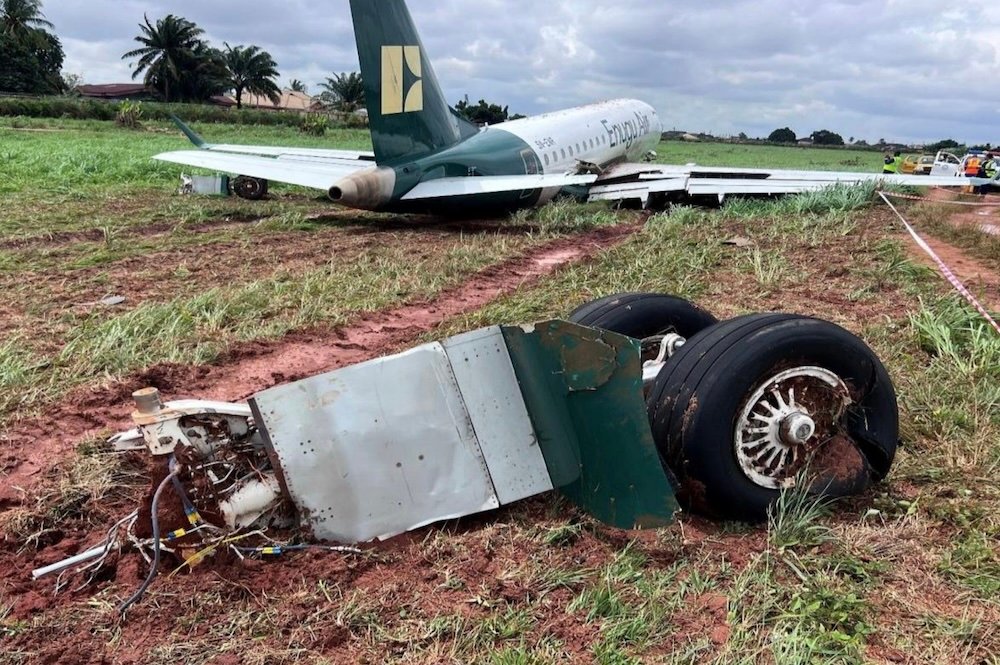
After landing on Runway 05, the E170 overran the runway and entered the unpaved area beyond its end. It struck seven approach-lighting installations and two fixed concrete structures associated with a decommissioned localizer. The impacts caused the landing-gear assemblies to separate, and the aircraft eventually came to rest about 325 metres beyond the runway end. Despite the substantial damage, there was no post-impact fire and all 68 occupants evacuated safely using an emergency escape slide.
The preliminary report states that the crew had been aware during the approach briefing that the autobrake was unavailable and planned to use manual braking. Flight-recorder data subsequently showed increased brake pressure, deployment of the ground spoilers and thrust reversers after touchdown. The NSIB has not identified the autobrake condition as a standalone cause, with the investigation continuing into how the aircraft’s landing performance, weather, runway condition, crew decisions and airport infrastructure interacted.
The crew had also been advised by ATC that the approach path to Runway 23 appeared better than that for Runway 05, but the crew continued with the RNAV approach to Runway 05. The runway was wet, with visibility reported at about 1,500 metres in moderate rain. The preliminary findings therefore point to a combination of operational and airport-safety issues rather than a single confirmed cause.
NSIB said the investigation is being conducted under the accident-prevention principles of ICAO Annex 13 and is not intended to assign blame or liability. The final report will contain the Bureau’s conclusions and any additional safety recommendations after the remaining technical work is completed.