News
Civil Aviation
Pilot Training
Flight School Analysis
Aviation Jobs
Training
Services
About Us
Contact Us

Pilot Killed After Cessna 150 Collides With Pennsylvania State Police Helicopter

Picture of Aviation Today News Desk

Aviation Today News Desk

Carlisle, United States: A Cessna 150 collided with a Pennsylvania State Police Bell 407 helicopter at Carlisle Regional Airport in Cumberland County, Pennsylvania, on Wednesday evening, August 19, killing the Cessna pilot and injuring two state police troopers aboard the helicopter. The collision occurred near a runway at the airport, about 110 miles northwest of Philadelphia. The FAA identified the aircraft involved as a Cessna 150 and a Bell 407. The Cessna pilot, believed to have been the aircraft's only occupant, died in the crash. Authorities had not released the pilot's identity pending notification of next of kin. The Bell 407 was operated by the Pennsylvania State Police and was carrying two members of the department's aviation unit, Cpl. Bryce Corman and Tpr. Jason Mills. The helicopter was conducting a routine training exercise at Carlisle after operating from its Harrisburg base. According to Acting Pennsylvania State Police Commissioner Lt. Col. George Bivens, the helicopter was positioned several feet above a grassy area next to a runway when the Cessna approached from behind. The aircraft came down along the runway before veering sharply to the right at the last moment and striking the helicopter from the rear. “As that Cessna came down along that runway for an unknown reason, it veered hard to the right. At the last moment, it struck the helicopter from the rear,” Bivens said. The Cessna struck the helicopter's rear section, involving the tail rotor and then the main rotor, sending both aircraft into a violent crash. The Cessna broke into multiple pieces, while the Bell 407 lost its rotor blades and tail boom before rolling over and coming to rest on its side, partially on its roof. The two troopers were initially trapped inside the helicopter. Corman was able to push out a window and help Mills escape through the opening. Mills was believed to have suffered more serious injuries and significant bleeding, according to Bivens. Both troopers were taken to Penn State Health Milton S. Hershey Medical Center. Dr. Ashley Ludwig, the hospital's trauma medical director, said they arrived as Level 1 trauma patients but had only minor injuries and were in stable condition. One was expected to be discharged Wednesday night, while the other was admitted for further observation. Pennsylvania State Police Commissioner Col. Christopher Paris said the helicopter crew was conducting routine training when the collision occurred. He said the helicopter pilots would not have been able to see the Cessna approaching from behind. “The pilots would not have been able to even see that airplane approaching them,” Paris said. Governor Josh Shapiro visited the medical center and praised the emergency response and medical teams involved in treating the injured troopers. “Tonight could have been much worse,” Shapiro said, adding that the response was “an example of Pennsylvania at its finest.” Emergency personnel responded to the airport following the crash, and the coroner was called to the scene. Local residents Patrick Brown and Lloyd Slusser also reportedly crossed a fence and ran toward the wreckage to assist after witnessing the crash. The Cessna was reportedly from the local area, but authorities have not disclosed its departure point, destination or the purpose of its flight. The aircraft's pilot was believed to be its sole occupant. The exact cause of the collision remains undetermined. Officials said the Cessna's sudden right turn was made for an unknown reason, and investigators will examine why the aircraft veered from its approach path, the helicopter's position, airport operations and communications. Carlisle Regional Airport does not have an air traffic control tower. Pilots operating there use a common traffic radio frequency, and investigators are expected to examine those communications as part of the inquiry. State police also secured photographs and video that could assist investigators in reconstructing the collision. The FAA and National Transportation Safety Board are leading the investigation, with Pennsylvania State Police assisting. The NTSB said the wreckage would be documented and moved to a secure facility for further examination. Although the FAA and NTSB described the incident as a midair collision, Pennsylvania State Police later said the helicopter was on the ground at the time of the impact. Officials have not yet established whether the Cessna was airborne at the exact moment of contact. The distinction, along with the reason for the Cessna's sudden deviation, remains part of the investigation. No final cause has been determined, and authorities have not attributed the crash to pilot error, mechanical failure, communications issues or any other specific factor.
Image: Western Mass News

Carlisle, United States: A Cessna 150 collided with a Pennsylvania State Police Bell 407 helicopter at Carlisle Regional Airport in Cumberland County, Pennsylvania, on Wednesday evening, August 19, killing the Cessna pilot and injuring two state police troopers aboard the helicopter.

The collision occurred near a runway at the airport, about 110 miles northwest of Philadelphia. The FAA identified the aircraft involved as a Cessna 150 and a Bell 407. The Cessna pilot, believed to have been the aircraft’s only occupant, died in the crash. Authorities had not released the pilot’s identity pending notification of next of kin.

The Bell 407 was operated by the Pennsylvania State Police and was carrying two members of the department’s aviation unit, Cpl. Bryce Corman and Tpr. Jason Mills. The helicopter was conducting a routine training exercise at Carlisle after operating from its Harrisburg base.

According to Acting Pennsylvania State Police Commissioner Lt. Col. George Bivens, the helicopter was positioned several feet above a grassy area next to a runway when the Cessna approached from behind. The aircraft came down along the runway before veering sharply to the right at the last moment and striking the helicopter from the rear.

“As that Cessna came down along that runway for an unknown reason, it veered hard to the right. At the last moment, it struck the helicopter from the rear,” Bivens said.

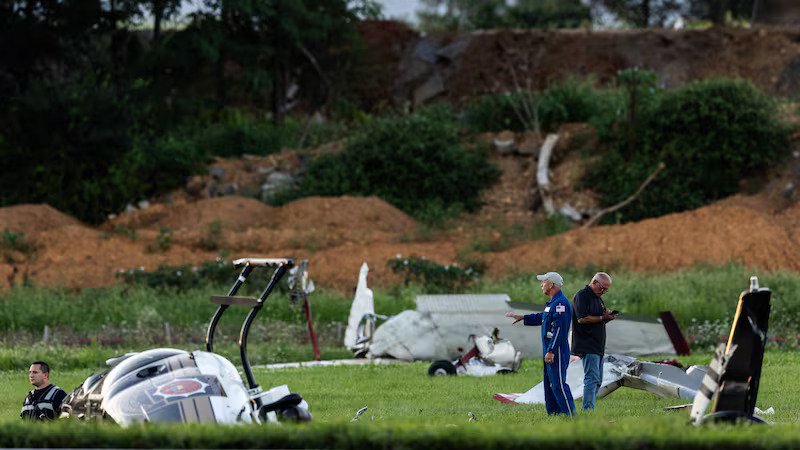
The Cessna struck the helicopter’s rear section, involving the tail rotor and then the main rotor, sending both aircraft into a violent crash. The Cessna broke into multiple pieces, while the Bell 407 lost its rotor blades and tail boom before rolling over and coming to rest on its side, partially on its roof.

The two troopers were initially trapped inside the helicopter. Corman was able to push out a window and help Mills escape through the opening. Mills was believed to have suffered more serious injuries and significant bleeding, according to Bivens.

Both troopers were taken to Penn State Health Milton S. Hershey Medical Center. Dr. Ashley Ludwig, the hospital’s trauma medical director, said they arrived as Level 1 trauma patients but had only minor injuries and were in stable condition. One was expected to be discharged Wednesday night, while the other was admitted for further observation.

Pennsylvania State Police Commissioner Col. Christopher Paris said the helicopter crew was conducting routine training when the collision occurred. He said the helicopter pilots would not have been able to see the Cessna approaching from behind.

“The pilots would not have been able to even see that airplane approaching them,” Paris said.

Governor Josh Shapiro visited the medical center and praised the emergency response and medical teams involved in treating the injured troopers. “Tonight could have been much worse,” Shapiro said, adding that the response was “an example of Pennsylvania at its finest.”

Emergency personnel responded to the airport following the crash, and the coroner was called to the scene. Local residents Patrick Brown and Lloyd Slusser also reportedly crossed a fence and ran toward the wreckage to assist after witnessing the crash.

The Cessna was reportedly from the local area, but authorities have not disclosed its departure point, destination or the purpose of its flight. The aircraft’s pilot was believed to be its sole occupant.

The exact cause of the collision remains undetermined. Officials said the Cessna’s sudden right turn was made for an unknown reason, and investigators will examine why the aircraft veered from its approach path, the helicopter’s position, airport operations and communications.

Carlisle Regional Airport does not have an air traffic control tower. Pilots operating there use a common traffic radio frequency, and investigators are expected to examine those communications as part of the inquiry. State police also secured photographs and video that could assist investigators in reconstructing the collision.

The FAA and National Transportation Safety Board are leading the investigation, with Pennsylvania State Police assisting. The NTSB said the wreckage would be documented and moved to a secure facility for further examination.

Although the FAA and NTSB described the incident as a midair collision, Pennsylvania State Police later said the helicopter was on the ground at the time of the impact. Officials have not yet established whether the Cessna was airborne at the exact moment of contact. The distinction, along with the reason for the Cessna’s sudden deviation, remains part of the investigation. 

No final cause has been determined, and authorities have not attributed the crash to pilot error, mechanical failure, communications issues or any other specific factor.

Leave a Comment

Subscribe to our Newsletter

Recent News

Aviation Today Perspectives