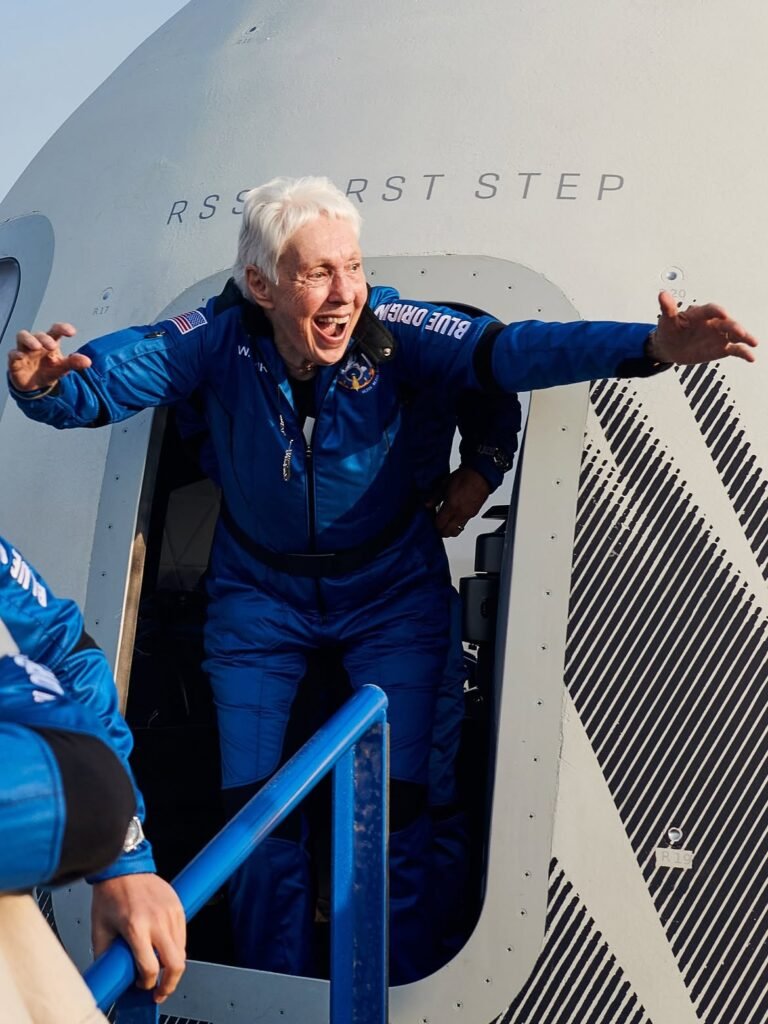
Texas, United States: Trailblazing American aviator Wally Funk, whose lifelong pursuit of spaceflight made her a symbol of perseverance for generations of women in aviation, has died at the age of 87. Funk died on July 8, 2026, at her assisted living residence in Grapevine, Texas, after complications related to recent falls and a leg infection, according to her longtime caregiver and Grapevine City Council member Duff O’Dell.
Best known as one of the Mercury 13 women who successfully completed the same rigorous astronaut screening tests as NASA’s original Mercury astronauts in 1961, Funk spent more than seven decades breaking barriers in aviation despite being denied the opportunity to become a NASA astronaut because of her gender.
Born in 1939, Funk developed a passion for flying at an early age and earned her pilot’s license while still a teenager. She went on to build one of the most accomplished aviation careers in the United States, accumulating more than 19,600 flight hours and training over 3,000 pilots during her career. Some later estimates of her lifetime experience exceeded 30,000 flying hours, reflecting her continued flying and instruction over decades.
In 1961, Funk volunteered for the privately funded astronaut research program conducted by aerospace physician Dr. William Randolph Lovelace II, which later became known as the Mercury 13. The group consisted of 13 women who passed the same demanding physical and psychological examinations administered to NASA’s all-male Mercury 7 astronauts.
At just 21 years old, Funk was the youngest participant in the program and reportedly outperformed many male astronauts in several tests. During one sensory deprivation experiment, she remained isolated for 10 hours and 35 minutes, setting a record at the time. Despite their impressive performances, the women were never admitted into NASA’s astronaut corps because the agency required military test pilot experience, a qualification unavailable to women then and the program ended before its final phase.
Although NASA began accepting women astronauts in the late 1970s, Funk’s applications were rejected because she lacked an engineering degree and military test pilot credentials, despite her extensive aviation experience. Nevertheless, she continued to advocate for women in aviation while pursuing a distinguished flying career.
Funk became the first female flight instructor at a U.S. military base, training Army personnel at Fort Sill, Oklahoma. She later became the Federal Aviation Administration’s first female inspector and the National Transportation Safety Board’s first female air safety investigator, investigating hundreds of aviation accidents and helping shape aviation safety in the United States.
Her lifelong dream of reaching space was finally realized on July 20, 2021, when Blue Origin founder Jeff Bezos invited her to join the company’s first crewed New Shepard mission.
The four-person crew comprised Jeff Bezos, his brother Mark Bezos, Dutch student Oliver Daemen, and Wally Funk. The fully reusable New Shepard suborbital rocket launched from Blue Origin’s Launch Site One near Van Horn, Texas, carrying the crew beyond the internationally recognized boundary of space before returning safely to Earth.
At 82, Funk became the oldest person ever to travel into space, surpassing the record previously held by John Glenn. Although actor William Shatner later broke the overall age record, Funk remains the oldest woman ever to fly into space and the only member of the Mercury 13 to have reached space.
Following her historic flight, Funk became an inspiration worldwide. Her enthusiasm after landing declaring she had waited decades for the opportunity and wanted to “go again” captured global attention. Reuters reported that she was affectionately described by then White House Press Secretary Jen Psaki as “America’s new sweetheart” following the mission.
Blue Origin paid tribute to Funk following her death, calling her “a pioneer in every sense of the word” whose determination inspired generations. NASA, aviation organizations and public officials also honored her enduring contributions to aviation, aerospace and gender equality. Grapevine officials described her life as proof that “dreams have no expiration date.”
Funk’s legacy extends far beyond her historic spaceflight. Her decades as a pilot, instructor, investigator and aviation advocate helped open doors for women in professions that had long been closed to them. From passing astronaut tests in the early 1960s to finally reaching space six decades later, her life became a testament to resilience, determination and the pursuit of dreams despite institutional barriers.