News
Civil Aviation
Pilot Training
Flight School Analysis
Aviation Jobs
Training
Services
About Us
Contact Us

Venezuela Earthquakes Force Closure Of Caracas International Airport Amid State Of Emergency

Picture of Aviation Today News Desk

Aviation Today News Desk

Caracas, Venezuela: Venezuelan authorities declared a nationwide state of emergency after two powerful earthquakes struck the country within seconds of each other on June 24, triggering widespread destruction across Caracas and several surrounding regions, forcing the closure of the nation's main international airport and launching a large-scale search-and-rescue operation. According to the United States Geological Survey (USGS), a magnitude 7.2 earthquake struck approximately 160 kilometers west of Caracas near Morón, followed just 39 seconds later by a stronger magnitude 7.5 tremor. Seismologists described the event as a rare seismic doublet. More than 20 aftershocks were recorded in the hours that followed. The earthquakes caused extensive damage across the capital and nearby states, with multiple residential and commercial buildings collapsing, roads and transportation infrastructure disrupted, and emergency crews deployed throughout affected areas. Interim President Delcy Rodríguez announced a state of emergency during a televised address alongside National Assembly President Jorge Rodríguez and Interior Minister Diosdado Cabello. While extending condolences to families of those killed, Rodríguez did not provide an official nationwide death toll or injury count, saying authorities were still assessing the scale of the disaster. The closure of Simón Bolívar International Airport in Maiquetía, Venezuela's primary international gateway serving Caracas, emerged as one of the most significant impacts on the country's transportation network. Government officials said the airport sustained serious structural damage, prompting the suspension of all flight operations pending safety inspections. Videos circulating on social media showed scenes of panic inside the airport as passengers rushed to evacuate. Witnesses reported ceiling panels collapsing, power interruptions, and debris falling inside terminal areas during the strongest shaking. Reports also indicated damage to pedestrian structures within the airport complex and along transportation routes connecting the facility to Caracas. Metro and rail services were suspended as authorities assessed damage to public infrastructure. Emergency responders worked through the night searching for survivors trapped beneath collapsed structures in several districts of Caracas. Photographs from the scene showed rescue teams digging through rubble as residents gathered outside damaged buildings. Although the Venezuelan government has not yet released official casualty figures, local authorities reported fatalities in parts of the capital. According to municipal officials, three people were killed in Caracas' Baruta district following the collapse of two buildings. In neighboring Chacao district, local authorities reported one fatality and the collapse of four buildings. Officials in the coastal state of Falcón reported at least 22 injuries, while several people were reported missing as rescue operations continued. "High casualties and extensive damage are probable and the disaster is likely widespread," the USGS said, estimating the death toll would most likely range from 10,000 to 100,000. “We have buildings, homes and houses which have collapsed and we are taking care of things with everything we have available in terms of security, civil assistance," Interior Minister ​Diosdado Cabello said on state television. The USGS issued a red alert following the earthquakes, warning of potentially severe humanitarian consequences. The agency's automated assessment suggested a high likelihood of significant casualties and major economic losses due to the magnitude of the event and the affected population density. However, these projections remain preliminary and are not official casualty figures. A tsunami warning was briefly issued after the earthquakes but was subsequently withdrawn. The earthquakes struck during a public holiday period, sending thousands of residents into streets and open areas as buildings swayed across Caracas and surrounding regions. Witnesses described walls cracking, staircases shifting and objects falling from ceilings during the prolonged shaking. Damage has been reported across several states, including Miranda, La Guaira, Aragua, Carabobo and Falcón. In La Guaira, where the country's main airport is located, authorities reported significant structural impacts and disruptions to communications and transportation links. Hospitals were placed on emergency footing as medical facilities prepared for additional casualties. The Venezuelan government also suspended classes for the remainder of the week while engineers assess the safety of educational institutions and public buildings. International assistance efforts are beginning to mobilize. U.S. officials announced the deployment of disaster response personnel, search-and-rescue teams and humanitarian aid resources to support relief operations. Indian Prime Minister Narendra Modi also expressed condolences and said India stood ready to provide assistance if required. Authorities warned residents to remain alert as aftershocks continue and urged the public to avoid damaged buildings until structural assessments are completed. Rescue operations remain ongoing, and officials say casualty figures and damage assessments are expected to evolve as emergency teams gain access to affected areas across the country.
Image: @RT_com (X)

Caracas, Venezuela: Venezuelan authorities declared a nationwide state of emergency after two powerful earthquakes struck the country within seconds of each other on June 24, triggering widespread destruction across Caracas and several surrounding regions, forcing the closure of the nation’s main international airport and launching a large-scale search-and-rescue operation.

According to the United States Geological Survey (USGS), a magnitude 7.2 earthquake struck approximately 160 kilometers west of Caracas near Morón, followed just 39 seconds later by a stronger magnitude 7.5 tremor. Seismologists described the event as a rare seismic doublet. More than 20 aftershocks were recorded in the hours that followed.

The earthquakes caused extensive damage across the capital and nearby states, with multiple residential and commercial buildings collapsing, roads and transportation infrastructure disrupted, and emergency crews deployed throughout affected areas.

Interim President Delcy Rodríguez announced a state of emergency during a televised address alongside National Assembly President Jorge Rodríguez and Interior Minister Diosdado Cabello. While extending condolences to families of those killed, Rodríguez did not provide an official nationwide death toll or injury count, saying authorities were still assessing the scale of the disaster.

The closure of Simón Bolívar International Airport in Maiquetía, Venezuela’s primary international gateway serving Caracas, emerged as one of the most significant impacts on the country’s transportation network. Government officials said the airport sustained serious structural damage, prompting the suspension of all flight operations pending safety inspections.

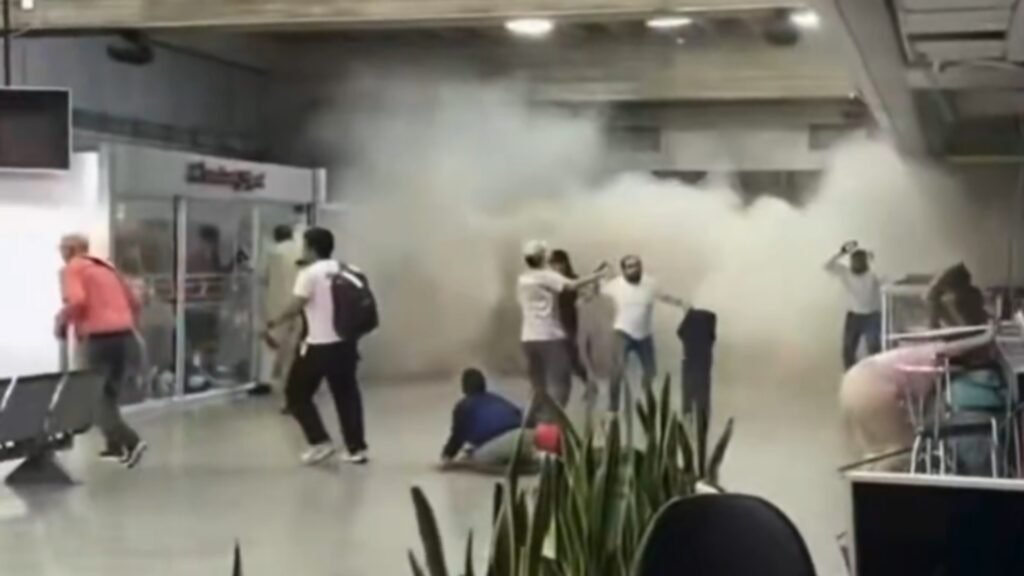
Videos circulating on social media showed scenes of panic inside the airport as passengers rushed to evacuate. Witnesses reported ceiling panels collapsing, power interruptions, and debris falling inside terminal areas during the strongest shaking. Reports also indicated damage to pedestrian structures within the airport complex and along transportation routes connecting the facility to Caracas.

Metro and rail services were suspended as authorities assessed damage to public infrastructure.

Emergency responders worked through the night searching for survivors trapped beneath collapsed structures in several districts of Caracas. Photographs from the scene showed rescue teams digging through rubble as residents gathered outside damaged buildings.

Although the Venezuelan government has not yet released official casualty figures, local authorities reported fatalities in parts of the capital. According to municipal officials, three people were killed in Caracas’ Baruta district following the collapse of two buildings. In neighboring Chacao district, local authorities reported one fatality and the collapse of four buildings. 

Officials in the coastal state of Falcón reported at least 22 injuries, while several people were reported missing as rescue operations continued.

“High casualties and extensive damage are probable and the disaster is likely widespread,” the USGS said, estimating the death toll would most likely range from 10,000 to 100,000. 

“We have buildings, homes and houses which have collapsed and we are taking care of things with everything we have available in terms of security, civil assistance,” Interior Minister ​Diosdado Cabello said on state television. 

The USGS issued a red alert following the earthquakes, warning of potentially severe humanitarian consequences. The agency’s automated assessment suggested a high likelihood of significant casualties and major economic losses due to the magnitude of the event and the affected population density. However, these projections remain preliminary and are not official casualty figures.

A tsunami warning was briefly issued after the earthquakes but was subsequently withdrawn. The earthquakes struck during a public holiday period, sending thousands of residents into streets and open areas as buildings swayed across Caracas and surrounding regions. Witnesses described walls cracking, staircases shifting and objects falling from ceilings during the prolonged shaking.

Damage has been reported across several states, including Miranda, La Guaira, Aragua, Carabobo and Falcón. In La Guaira, where the country’s main airport is located, authorities reported significant structural impacts and disruptions to communications and transportation links.

Hospitals were placed on emergency footing as medical facilities prepared for additional casualties. The Venezuelan government also suspended classes for the remainder of the week while engineers assess the safety of educational institutions and public buildings.

International assistance efforts are beginning to mobilize. U.S. officials announced the deployment of disaster response personnel, search-and-rescue teams and humanitarian aid resources to support relief operations. Indian Prime Minister Narendra Modi also expressed condolences and said India stood ready to provide assistance if required.

Authorities warned residents to remain alert as aftershocks continue and urged the public to avoid damaged buildings until structural assessments are completed.

Rescue operations remain ongoing, and officials say casualty figures and damage assessments are expected to evolve as emergency teams gain access to affected areas across the country.

Leave a Comment

Subscribe to our Newsletter

Recent News