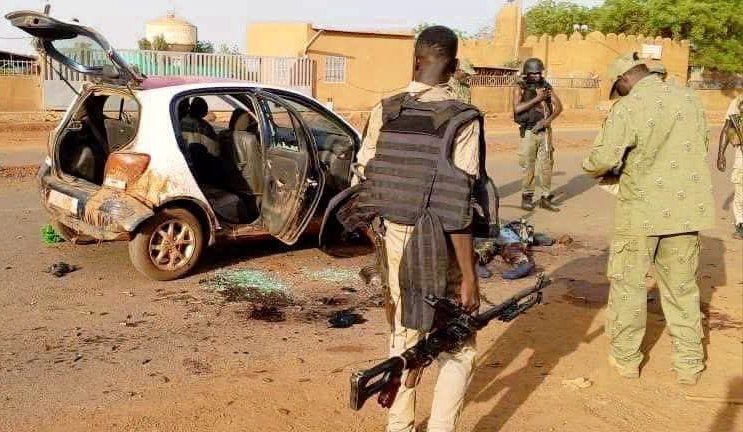
Niamey, Niger: At least 35 people were killed after heavily armed attackers launched a coordinated assault on Niger’s main international airport and an adjoining military airbase in the capital Niamey on June 18, 2026, marking the second major attack on the strategic facility this year.
According to Niger’s Ministry of Defence, the attack left 11 members of the security forces and two civilians dead. Security forces repelled the assault, killing 22 attackers and arresting approximately 20 suspects. Weapons and ammunition were also seized during the operation.
The attack targeted Diori Hamani International Airport and the adjacent military installation, a key security hub that hosts Niger’s air force assets and serves as the headquarters of the joint military force formed by Niger, Mali and Burkina Faso under the Alliance of Sahel States (AES).
Witnesses reported hearing sustained gunfire and explosions beginning around 6:00 a.m. local time. The fighting lasted for more than two hours as security forces battled the attackers around the airport complex.
According to sources cited by Al Jazeera and AFP, some of the assailants arrived at a security checkpoint near the airport by taxi before engaging security personnel. Gunfire echoed across the area for hours as troops responded to the assault.
Witnesses described scenes of panic around the airport, while soldiers later established checkpoints and conducted searches on roads leading to the facility.
Four people were also wounded during the attack, according to preliminary figures released by the Defence Ministry.
Despite the violence, Nigerien authorities said the airport remained secure and operational. In a statement broadcast on national television, the Defence Ministry said, “The international airport, which is fully secured, remains open to air traffic.”
The ministry added that a “large-scale operation” was underway to pursue those involved in the assault. Hours after the attack, Niger’s National Civil Aviation Agency confirmed that airport operations had resumed normally.
Responsibility for the attack was claimed by Jama’at Nusrat al-Islam wal-Muslimin (JNIM), an al-Qaeda-linked militant group that operates across the Sahel region.
JNIM said it had carried out what it described as a “suicide attack” against Diori Hamani International Airport and a neighboring military base. The claim was published through the group’s media outlet, Az-Zallaqa Foundation.
The attack underscores the growing threat posed by jihadist groups across the Sahel, where al-Qaeda-linked and Islamic State-affiliated organizations continue to compete for territory and influence.
The airport is considered one of Niger’s most strategically important facilities. In addition to serving as the country’s primary international gateway, the complex houses military aircraft, drones and air force infrastructure. It also serves as a command center for the Alliance of Sahel States, the regional bloc created by Niger, Mali and Burkina Faso following military takeovers in the three countries.
The symbolism and military significance of the airport make it an attractive target for extremist groups seeking to challenge state authority.
“The symbolism of the airport as headquarters for AES will drive intent by militants to target it,” security analyst Beverly Ochieng of Control Risks told the Associated Press.
The June 18 attack was the second major assault on the airport complex this year. On January 29, militants linked to Islamic State’s Sahel Province launched a large-scale attack on the same facility, targeting military assets and drone infrastructure. Nigerien authorities said that the attack was repelled after fierce fighting.
The latest assault reflects an evolving militant strategy in which extremist groups are increasingly expanding operations from remote rural regions into major urban centers.
Ibrahim Yahaya Ibrahim, Deputy Project Director at the International Crisis Group, said the attack also reflects competition between rival jihadist factions operating in the region.
“JNIM in Niger is trying to mark its territory. This is a message to the government but also to IS (Islamic State),” he said.
Niger has faced escalating insecurity since the military seized power in a 2023 coup. Along with neighboring Mali and Burkina Faso, the country remains at the center of one of the world’s deadliest jihadist insurgencies.
The three military-led governments have shifted away from traditional Western security partnerships and strengthened cooperation with Russia while continuing operations against armed groups linked to al-Qaeda and Islamic State.