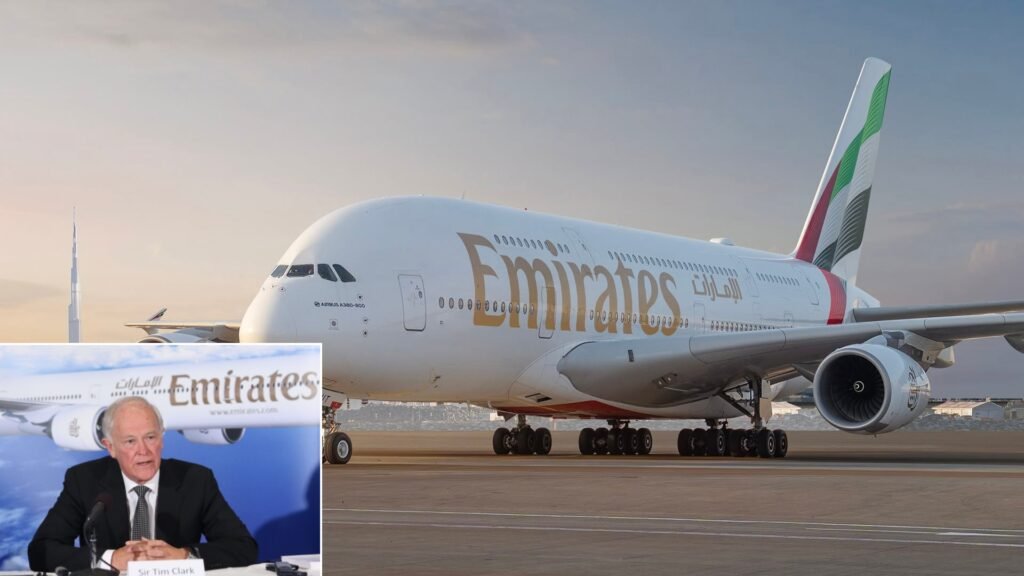
Berlin, Germany: Emirates President Sir Tim Clark has declared that the Dubai-based carrier will rebound “hard and fast” from the aviation disruption caused by ongoing conflict in the Middle East, while warning European airlines against assuming the current challenges facing Gulf carriers will provide a lasting competitive advantage.
In Berlin ahead of the Berlin Air Show, Clark said Emirates remains committed to maintaining capacity despite the operational and financial pressures created by regional airspace closures and geopolitical instability.
“My message to all of them, be careful what you wish for, we will be back very hard and fast,” Clark said, referring to European airlines that have benefited from reduced competition as Middle Eastern carriers were forced to scale back some operations.
The conflict, which has affected airspace across parts of the Middle East since late February, has disrupted operations for major Gulf carriers including Emirates, Qatar Airways and Etihad Airways. The restrictions created opportunities for several European airlines to increase capacity on routes to Asia and other long-haul markets.
Despite the challenges, Clark stressed that Emirates has no plans to reduce services. “We have no intention of cutting back, reducing, or anything else,” he said.
According to Clark, the airline will continue routing passengers through Dubai to destinations including India and Australia while implementing additional operational safeguards such as carrying extra fuel on affected routes.
The Emirates chief also warned that prolonged instability could have severe consequences for weaker airlines, particularly low-cost carriers operating with thinner margins.
“If this crisis goes on for too long, there will be some casualties, likely in the budget airline sector first,” Clark said.
Clark’s comments echoed concerns raised by International Air Transport Association (IATA) Director General Willie Walsh, who recently warned that rising fuel costs, airspace restrictions and operational disruptions could accelerate consolidation within the airline industry.
Beyond the regional crisis, Clark renewed Emirates‘ long-running campaign for access to Berlin, arguing that the airline has contributed significantly to the German economy through aircraft purchases and supplier relationships.
“We have brought enormous economic wealth to Germany just by virtue of what we’ve bought,” Clark said. “We have very compelling reasons to be allowed to go to Berlin.”
Emirates has secured airport slots in Berlin but has yet to receive the regulatory approvals required to launch services. Clark said the airline continues to see strong demand for the German capital and has been lobbying successive governments for access since the 1990s.
The Emirates president also pushed back against criticism from Lufthansa regarding the competitive position of Gulf carriers.
“It is a listed company, and it needs to fight its own corner without going to the government and hiding behind its skirts,” Clark said in response to claims that Gulf airlines enjoy unfair advantages.
Fleet planning was another major topic during the briefing. Clark reiterated Emirates‘ concerns regarding the performance of Rolls-Royce Trent XWB-97 engines powering the Airbus A350-1000, saying the airline remains unconvinced that the aircraft currently meets its operational requirements in Gulf conditions.
“I don’t think we are in a position to take the A350-1000 until we’ve seen whatever engine improvements they make,” Clark said.
He added that the aircraft performs well in temperate climates but faces greater challenges in the Gulf environment, where high temperatures, dust and demanding operating conditions place additional stress on engines.
While Emirates has expanded its fleet with Airbus A350-900 aircraft and remains heavily reliant on its Airbus A380 and Boeing 777 fleets, Clark indicated that a future replacement for the A380 could eventually reopen discussions regarding the larger A350-1000 once engine durability concerns are resolved.
Clark also expressed confidence in Boeing’s progress on the long-delayed 777X programme, stating that Emirates expects to receive its first aircraft in 2027 after years of delays.
Addressing speculation about succession plans, the 76-year-old executive said he has no immediate intention of retiring and remains focused on guiding the airline through the current period of uncertainty.
“We have a team of people working in Emirates, some of them are lifers like me, who live and breathe the carrier,” Clark said. “So if I was to step out personally, I would be quite confident that the people left in place to run the business are so well attuned to the criticality of the message that it would not be affected by my absence.”
Clark’s remarks come as airlines worldwide grapple with higher fuel costs, airspace restrictions and ongoing aircraft delivery delays, with industry leaders closely watching how quickly Gulf carriers can restore normal operations once regional conditions stabilize.