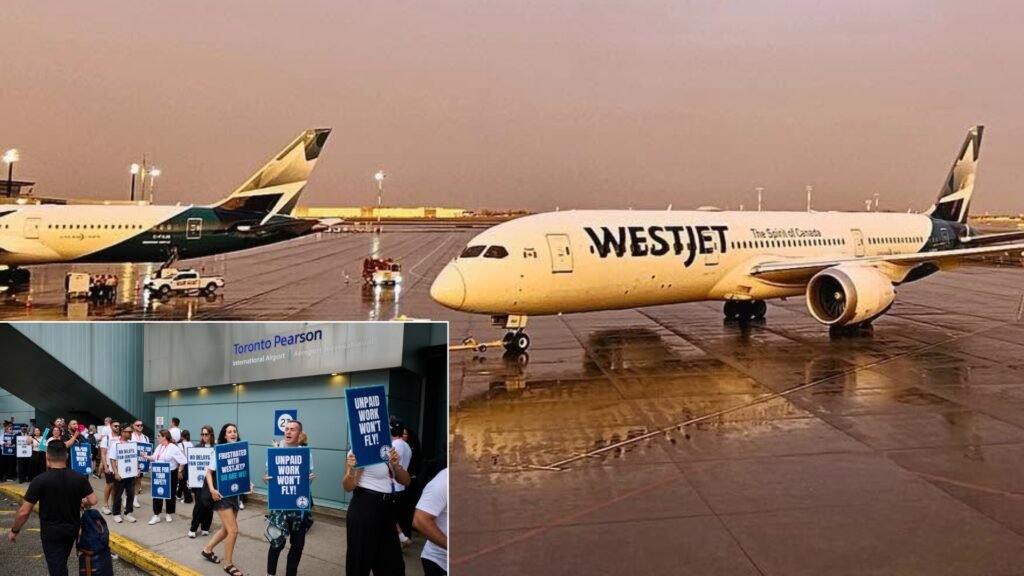
Calgary, Canada: WestJet flight attendants launched a nationwide strike on Sunday after negotiations between Canada’s second-largest airline and the Canadian Union of Public Employees (CUPE) failed to produce a new collective agreement, triggering widespread flight cancellations during one of the country’s busiest summer travel weekends.
The strike involves approximately 4,400 cabin crew members represented by CUPE and follows months of contract negotiations centered on wages, compensation for duties performed on the ground, scheduling, and broader quality-of-life improvements. The previous collective agreement expired on December 31, 2025.
WestJet said the work stoppage forced the cancellation of hundreds of flights and significantly disrupted operations across its network. According to the airline, approximately 250,000 passengers have been affected by the disruption. Aviation analytics firm Cirium reported that more than 600 flights had been cancelled by Sunday morning, while FlightAware also recorded hundreds of cancellations across the carrier’s network.
The industrial action began after the union issued a 72-hour strike notice on July 30. WestJet responded with a lockout notice while both sides continued negotiations until shortly before the deadline. Despite last-minute bargaining efforts, no agreement was reached.
At the center of the dispute is compensation for work performed before takeoff and after landing. CUPE argues that flight attendants should be paid from the time they report for duty until they complete their shifts, rather than primarily for time when the aircraft is in motion. The union maintains that pre-flight safety checks, boarding, passenger assistance, deplaning and other ground responsibilities deserve dedicated compensation.
WestJet disputes the claim that this work is unpaid, stating that its existing “credit hour” compensation model already accounts for flight time, delays and various ground duties through a blended pay system rather than a conventional hourly wage.
Following the start of the strike, WestJet publicly released details of what it described as its final contract proposal. The airline said the offer included a 13% wage increase effective October 2026, annual wage increases of 2.5% through 2029, retroactive pay to January 1, 2026, and additional compensation for all hours worked before and after flights, which it said represented an increase equivalent to approximately 12% of salary. The proposal also included higher meal allowances, expanded vacation benefits, annual health-care spending accounts, improved maternity leave provisions, scheduling enhancements, reduced maximum duty periods, additional rest time, and compensation for certain operational disruptions such as reassigned duties and hotel delays.
WestJet Group Chief Executive Officer Alexis von Hoensbroech said the airline remained committed to reaching a negotiated settlement, describing the proposal as an industry-leading package that addressed the union’s stated priorities while supporting the airline’s long-term sustainability. He said the company believed an agreement remained achievable despite the strike.
CUPE’s WestJet Component President Alia Hussain said the union continued to seek a fair contract that properly recognizes the value of cabin crew work. She stated that members were prepared to return to the bargaining table and emphasized that compensation for unpaid ground duties remains a significant issue alongside broader contractual improvements.
The dispute mirrors a wider movement among North American flight attendants seeking compensation for time spent working before aircraft doors close and after flights arrive at the gate. Similar disputes have recently taken place at Air Canada, where cabin crew secured boarding pay earlier this year following industrial action. In recent years, Delta Air Lines became the first major North American carrier to introduce dedicated boarding pay, with American Airlines and Alaska Airlines later implementing similar compensation models.
WestJet currently operates under a credit-hour pay system, with compensation varying according to seniority. According to the airline, the structure combines flight hours and several non-flying duties into a single rate of pay rather than paying separately for each duty performed during a shift.
The strike comes during a peak summer travel period and a three-day holiday weekend in Canada, increasing its impact on passengers and businesses. WestJet normally operates more than 600 flights daily and transports tens of thousands of passengers across Canada, the United States, the Caribbean, Central America and Europe. The airline holds roughly 30% of Canada’s domestic aviation market.
The Canadian Chamber of Commerce described the work stoppage as a significant disruption for travellers and businesses, warning that prolonged industrial action could affect tourism, supply chains and economic activity during one of the busiest travel periods of the year.
Canada’s federal government acknowledged the disruption, with Jobs Minister Patty Hajdu expressing disappointment that negotiations failed to reach a settlement while reiterating that durable agreements are generally achieved through collective bargaining. As of publication, the government had not announced any formal intervention in the dispute.
WestJet said affected passengers would be eligible for refunds or rebooking options where applicable and advised customers to monitor their flight status before travelling. Meanwhile, both the airline and CUPE indicated they remain willing to resume negotiations in an effort to reach a new collective agreement.