Washington, United States: The US Air Force has awarded Lockheed Martin a $694 million contract to produce and field the AGM-183A Air-Launched Rapid Response Weapon (ARRW), moving the troubled hypersonic missile programme from prototyping and flight testing into production after years of technical setbacks and funding uncertainty.
The contract was awarded on September 29, 2026, and publicly announced by the US Air Force on October 26, 2026. Lockheed Martin confirmed the award in a separate announcement on October 27. The service has not disclosed how many missiles will be produced or when deliveries are expected, citing operational security concerns.
Air Force Secretary Troy Meink described the decision as a turning point in the service’s advanced weapons development programme. “By moving ARRW from test to production, we’re providing our combatant commanders with a credible, high-speed strike weapon capable of penetrating the most advanced anti-access and area-denial systems,” Meink said.
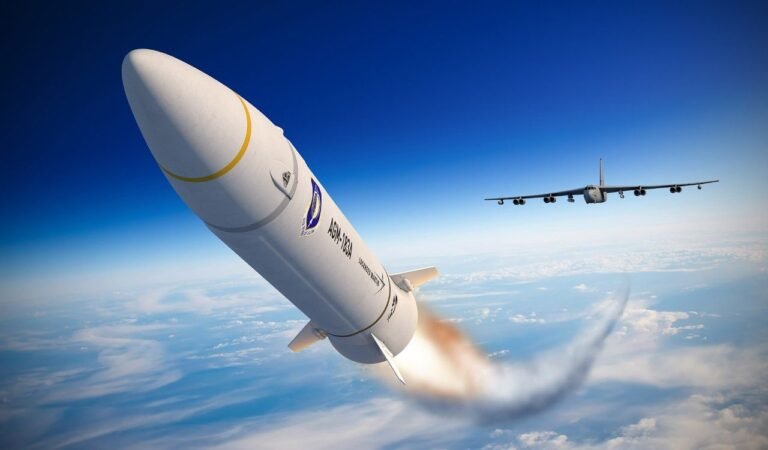
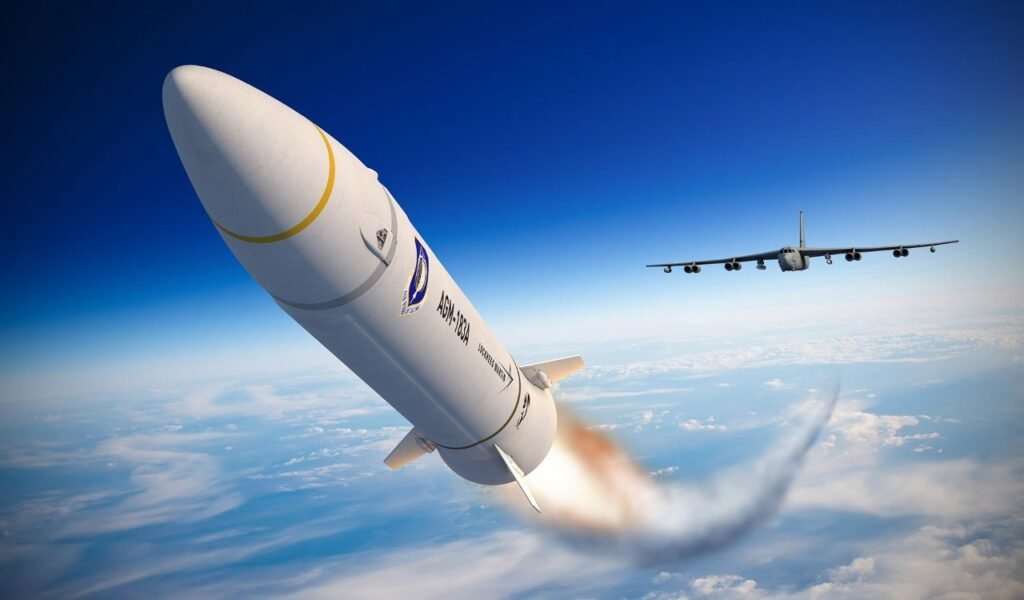
The AGM-183A ARRW is a boost-glide weapon designed to travel faster than Mach 5, or five times the speed of sound. It uses a solid-fuel rocket booster to accelerate the weapon before releasing a hypersonic glide vehicle that maneuvers towards its target.
The system is intended to strike high-value, time-sensitive targets from stand-off distances, allowing launch aircraft to operate farther from heavily defended areas. Its speed and manoeuvrability are designed to complicate interception by advanced air-defence systems.
The Boeing B-52 Stratofortress is the programme’s initial planned launch platform. The missile has also reportedly been tested on the B-1 bomber, although the Air Force has not announced operational deployment on that aircraft.
Air Force Chief of Staff Gen. Kenneth Wilsbach said the weapon would offer commanders an additional strike option in contested environments.
“Fielding ARRW enhances our ability to hold targets at risk anywhere around the world,” Wilsbach said. “This hypersonic weapon provides the Joint Force a flexible and rapid response option for highly contested environments.”
ARRW development began in 2018, building on hypersonic research conducted by the US Air Force and the Defense Advanced Research Projects Agency (DARPA). Lockheed Martin initially received a design contract worth up to $480 million, with the programme originally targeting an operational capability by 2022.
The missile encountered repeated setbacks during flight testing. An early launch attempt in April 2021 failed, and further unsuccessful tests followed before the programme achieved a successful flight test in May 2022.
Funding uncertainty subsequently threatened the programme’s future. In March 2023, Air Force acquisition officials indicated that the service would not proceed with missile purchases at that stage, turning its attention towards the smaller Hypersonic Attack Cruise Missile (HACM) and other hypersonic technologies.
The service’s position changed in 2025, when Air Force leadership signalled renewed interest in purchasing ARRW. Funding for procurement was included in the fiscal 2026 budget, leading to the September 2026 production contract.
Alongside the contract announcement, Lockheed Martin began expanding Building P-20 at its facility in Troy, Alabama. The project will add 47,000 square feet of production space, tripling the facility’s existing capacity for ARRW manufacturing.
The company expects the expansion to generate new US jobs over the next four years, adding to its nearly 4,000 employees in Alabama. The expanded facility will use advanced manufacturing, robotics and digital technologies.
Lockheed Martin said it had invested $67 million in the production facility’s expansion and equipment before receiving government funding. The company also cited its broader planned investment of $8 billion to $9 billion through 2030 to meet munitions demand.
Tim Cahill, president of Lockheed Martin Missiles and Fire Control, said the award demonstrated the company’s ability to move advanced weapons from development into production. He added that ARRW would expand its weapons portfolio and strengthen the US Air Force’s strategic capabilities.
The production contract advances ARRW towards fielding, but the Air Force has withheld the number of missiles ordered and their delivery schedule for operational security reasons.
The service’s fiscal 2027 budget request includes $452 million for ARRW production and remains subject to congressional approval. Future Years Defense Plan projections cited by Air & Space Forces Magazine indicate annual procurement spending of $556 million to $621 million between 2028 and 2031.
The contract marks a reversal for a programme whose future was uncertain three years ago. However, the pace of production, delivery and integration with operational aircraft will determine when the weapon becomes available to combat units.