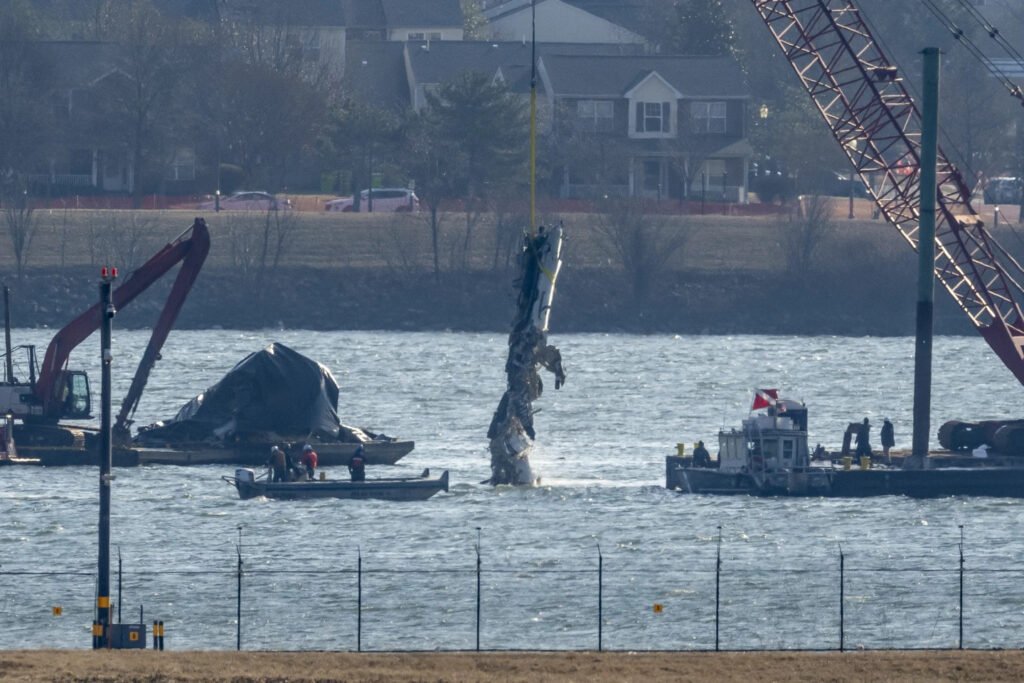
Washington, United States: The United States government has formally acknowledged partial fault in the January 29 mid-air collision between the U.S. Army Black Hawk helicopter and a commercial regional jet near Ronald Reagan Washington National Airport, a disaster that claimed 67 lives and stands as the deadliest aviation accident on U.S. soil in more than two decades.
In a 209-page federal court filing responding to a wrongful-death lawsuit filed by the family of victim Casey Crafton, the Department of Justice stated that the government “owed a duty of care to Plaintiffs, which it breached, thereby approximately causing the tragic accident.” The admission of liability is rare in aviation cases and directly acknowledges failings by both military and civilian aviation entities.
According to the court filing, the Army helicopter crew did not maintain “appropriate and safe visual separation” from the approaching regional jet, a Bombardier CRJ-700 operating as American Eagle Flight 5342 from Wichita, Kansas, carrying 60 passengers and four crew. The helicopter was conducting a night-vision goggle training mission.
The Justice Department also acknowledged that an air traffic controller at Reagan National Airport failed to follow Federal Aviation Administration (FAA) procedures for visual separation of aircraft, a critical lapse in a congested airspace where civilian and military traffic intersect.
Although the government admitted it bore responsibility, it said that other parties, including American Airlines and its subsidiary PSA Airlines, also played roles and have filed motions to dismiss claims against them.
The collision occurred at approximately 8:46 p.m. EST over the Potomac River, just before the regional jet was to land on Runway 33. All 64 occupants of the passenger aircraft perished along with the three soldiers aboard the helicopter. Prior investigations identified the helicopter’s altitude exceeding its designated flight path limits and questioned whether night-vision equipment and a malfunctioning altimeter may have hindered the crew’s ability to detect the oncoming jet.
Among those killed were members of the figure skating community, coaches, and family members returning from a competition, a factor that drew public attention and intensified scrutiny of safety practices.
Legal experts described the government’s admission as unusual and a significant development for the families seeking compensation. The move allows lawsuits to proceed under the Federal Tort Claims Act, a statute that waives sovereign immunity under defined circumstances.
A widow of a passenger killed in the collision had filed a wrongful-death lawsuit against American Airlines, the Federal Aviation Administration (FAA) and the U.S. Army, alleging the carriers and government agencies failed in their duty to protect the flying public; the suit, filed on behalf of her late husband, claims oversight lapses and ignored warning signs contributed to the crash and seeks accountability and compensation for victims’ families.
Separately, lawmakers have responded with legislative action. The U.S. The Senate recently passed bipartisan safety legislation requiring advanced tracking systems, such as Automatic Dependent Surveillance–Broadcast (ADS-B), on military helicopters operating near civilian airports, a measure aimed at preventing similar tragedies.
NTSB preliminary findings indicate that faulty altitude data and gaps in air traffic control oversight were significant factors in the January 29 Potomac River mid-air collision, suggesting that the U.S. Army Black Hawk helicopters may have been flying higher than its intended altitude because onboard barometric altimeters were under-reading actual height, while air traffic controllers relied on inadequate situational information and procedures that failed to detect or resolve these discrepancies before impact.
The board’s early analysis also highlighted systemic weaknesses in how visual separation responsibilities and helicopter route structures were managed in the congested Reagan National Airport airspace, underscoring both technical and procedural lapses that contributed to the fatal convergence of the helicopter and the American Airlines regional jet.
The National Transportation Safety Board (NTSB) continues its independent probe. A final probable-cause report, expected in early 2026, will provide a definitive technical explanation of the collision and recommendations to improve airspace safety.