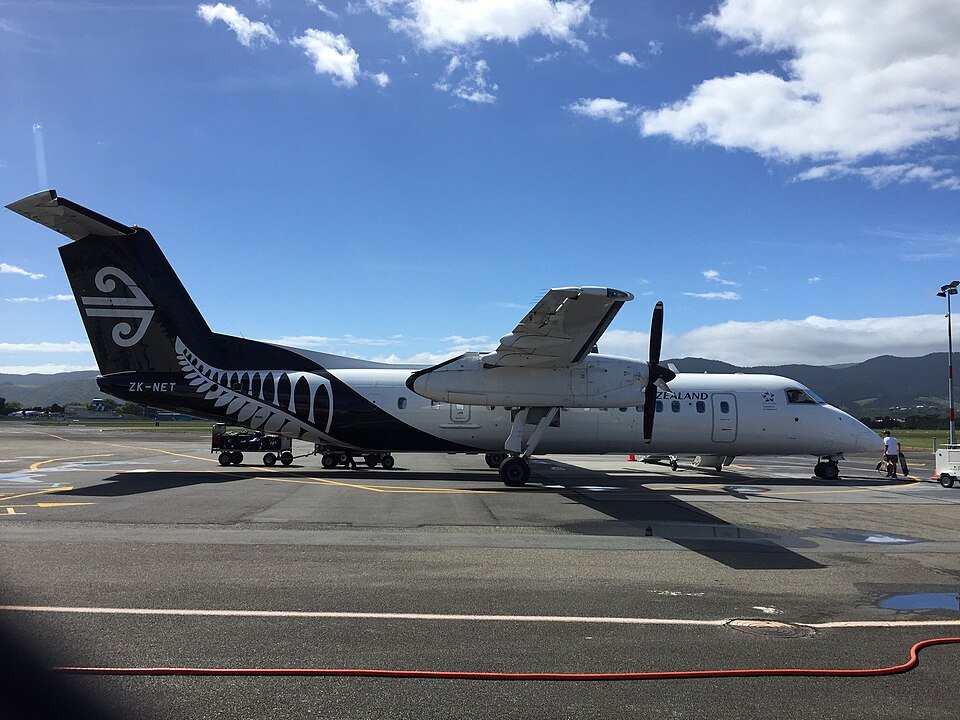
Wellington, New Zealand: New Zealand’s Transport Accident Investigation Commission (TAIC) has found that an Air New Zealand Q300 descended about 2,500ft below its programmed approach profile at Timaru in June 2023 incident after the aircraft remained in vertical-speed (V/S) mode instead of returning to VNAV. The final report released on 1 October, 2026 also identified wider safety issues involving the Q300’s flight-management system, crew monitoring, training, safety culture and regulatory oversight.
TAIC’s investigation found that the crew selected V/S mode during the transition through the applicable altitude-setting procedure. The Q300’s flight-management system required pilots to use a manual workaround because it could not automatically manage the required smooth descent through the transition. The crew was then expected to return the aircraft to VNAV.
That change was missed. The aircraft therefore continued descending in V/S mode rather than following the programmed vertical profile. TAIC found that the crew did not immediately recognise the deviation because both pilots were focused on visually identifying the Timaru aerodrome lights, reducing their monitoring of the aircraft’s instruments and flight path.
The aircraft descended to 1,156ft, about 2,500ft below the programmed approach profile and below the applicable minimum safe altitude of 2,000ft. The captain eventually identified the deviation, leveled the aircraft and climbed back towards the approach profile before the aircraft continued safely to land.
TAIC found that the aircraft’s altitude-alerting system did not provide an effective safeguard because the altitude alerter had not been set to provide a warning before the minimum safe altitude. The investigation found this was part of normal Q300 operating practice at the time because pilots expected to return to VNAV shortly after the transition.
The Commission also identified a pattern of similar events. Its investigation examined six earlier Q300 occurrences involving flight-path deviations and identified further occurrences after the investigation began. TAIC said the repeated events showed that the risks associated with the Q300’s descent-mode procedures had not been adequately controlled.
Training and crew resource management were also examined. TAIC found shortcomings in how the risks associated with pilots joining the Q300 operation with varying levels of multi-crew experience were addressed. The Commission identified the need for stronger training and monitoring of flight-path deviations and crew decision-making.
The investigation also examined the integration of Air Nelson and Mount Cook Airline into Air New Zealand in 2019. TAIC found that differences in safety culture remained within the Q300 operation and that the integration, together with the disruption caused by the COVID-19 pandemic, had affected the development of a consistent safety culture.
TAIC also identified issues with Civil Aviation Authority (CAA) oversight of Air New Zealand. The Commission found that regulatory oversight had not fully kept pace with organisational changes and identified concerns about the effectiveness and independence of safety oversight.
Overall, TAIC identified nine safety issues covering the Q300 flight-management system, operating procedures, crew performance, training, safety culture, Air New Zealand’s management of known risks and CAA oversight.
Air New Zealand and the CAA have since taken action on seven of those nine issues. Air New Zealand changed its altitude-alerter policy shortly after the occurrence and later introduced additional verbal cross-checks for flight-mode changes. The airline also implemented further training and safety-culture measures for Q300 crews.
Two issues remain subject to TAIC recommendations. The Commission has recommended that Air New Zealand continue working with De Havilland Canada towards a technical solution that removes the need for the manual Q300 descent-mode workaround.
TAIC has also recommended that the CAA work through the International Civil Aviation Organization (ICAO) to promote longer cockpit voice-recorder recording requirements for aircraft equipped with CVRs.
The incident occurred on 13 June 2023 during an Air New Zealand Q300 flight to Timaru, New Zealand. The aircraft, ZK-NEM, was carrying 33 passengers and three crew when it descended below the intended approach profile. It reached 1,156ft before the captain detected the deviation and corrected the flight path. The aircraft landed safely, with no injuries or damage reported.
TAIC published its final report on 1 October 2026, concluding that the event resulted from a combination of crew actions and wider system and organisational factors rather than a single error.