Abuja, Nigeria: The Airline Operators of Nigeria (AON) has warned that its member airlines could shut down domestic operations nationwide if aviation unions again disrupt the operations of any Nigerian airline.
The warning followed an AON General Meeting held on 23 September 2026 at the Transcorp Hilton Hotel in Abuja, where operators reviewed the disruption caused by aviation unions at Lagos and Abuja airports on 11 August. AON said it would not accept a repeat of what it described as a “violent, disruptive action” against any domestic carrier.
AON stated: “should the events of August 11, 2026, repeat themselves again against any domestic airline, the entire AON member airlines will immediately shut down operations.”
The latest warning is not an announcement of a strike or current shutdown. Nigerian airlines are continuing to operate, while the underlying dispute between operators and aviation unions remains unresolved.
The August action centred mainly on alleged non-remittance of the 5% Ticket Sales Charge (TSC) collected from passengers and disagreements over employees’ rights to join trade unions.
In its September position, AON also raised concerns about airport security, arguing that the August disruption went beyond a conventional labour dispute because union members blocked access to airline terminals, check-in areas and operational workplaces.
The association referred to the concept of “unlawful interference” under ICAO Annex 17 and called for a review of airport-security procedures and emergency-response arrangements, including the role of Aviation Security (AVSEC) personnel.
AON said the August disruption affected passengers beyond Lagos and Abuja because both airports serve as important domestic hubs. It said the consequences included passenger rebooking, accommodation, refunds, crew repositioning and aircraft rescheduling.
The operators also warned that repeated disruptions could affect investor confidence and aircraft lessors’ willingness to commit to the Nigerian market. That is AON’s assessment of the potential economic impact.
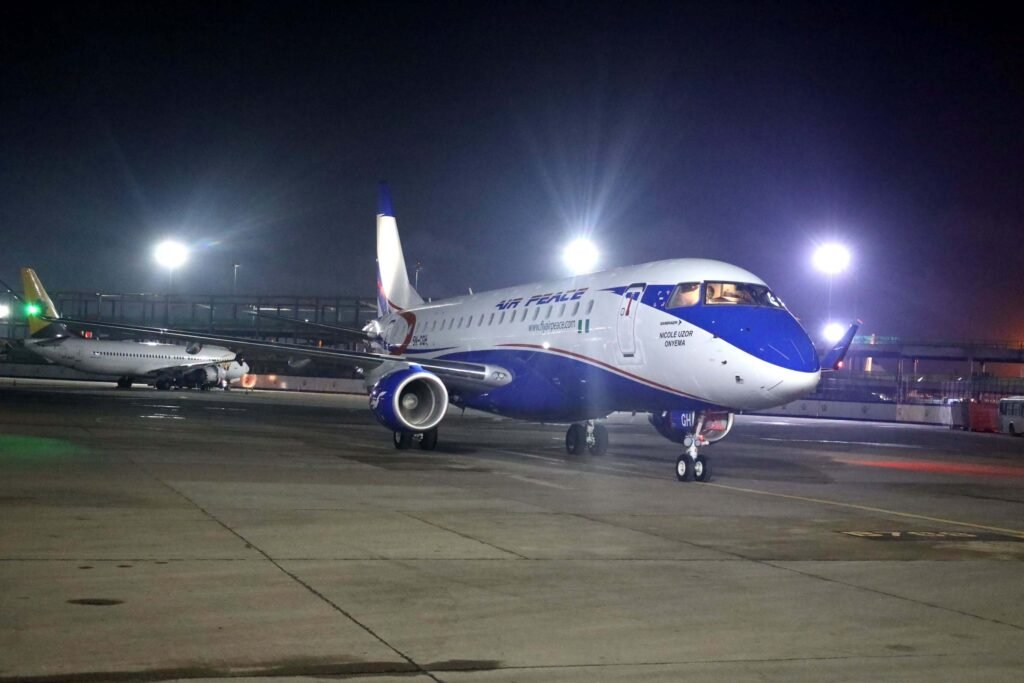
The latest warning follows the 11 August 2026 picketing of Air Peace operations at Murtala Muhammed Airport in Lagos and Nnamdi Azikiwe International Airport in Abuja.
AON said more than 70 Air Peace flights were affected and estimated the airline’s losses at more than ₦2 billion. More than 30 United Nigeria Airlines flights were also affected, with about 13,000 passengers impacted, according to figures cited by the operators.
United Nigeria Airlines and Enugu Air were also among carriers affected by the wider disruption.
Air Peace Chief Operating Officer Oluwatoyin Olajide said the airline had suffered losses exceeding ₦2 billion and questioned why it had been singled out when the TSC dispute involved the wider industry.
She said: “if the issue is industry-wide, why was Air Peace singled out for violent and disruptive picketing?”
Air Peace also alleged that some employees were physically assaulted during the action and called for an investigation involving the Federal Government, security agencies, airport authorities and aviation regulators.
The dispute began before the August disruption. On 4 August 2026, the National Union of Air Transport Employees (NUATE) and the Air Transport Services Senior Staff Association of Nigeria (ATSSSAN) warned that they could picket airlines accused of failing to remit statutory charges.
The unions said the charges were collected on behalf of aviation agencies including the Nigeria Civil Aviation Authority (NCAA), Nigerian Airspace Management Agency (NAMA), Nigerian Safety Investigation Bureau (NSIB), Nigerian College of Aviation Technology (NCAT) and the Nigerian Meteorological Agency (NiMet).
The unions subsequently issued a strike/picketing notice on 7 August, demanding payment of outstanding charges and action concerning workers’ unionisation rights.
The exact amount under dispute has been reported differently by the parties. Reports cited figures of approximately ₦15 billion to ₦17 billion, while union statements referred to wider airline obligations exceeding ₦25 billion. Air Peace disputed the figures and maintained that it was complying with applicable NCAA repayment directives.
On 11 August, NUATE and ATSSSAN, with support from the Nigeria Labour Congress (NLC) and Trade Union Congress (TUC), picketed Air Peace operations in Lagos and Abuja. Contemporary reports also identified the National Association of Aircraft Pilots and Engineers (NAAPE) among the unions involved.
The action blocked access to Air Peace departure terminals and check-in areas, disrupting scheduled flights. The NCAA intervened the same day and urged the unions to suspend the action.
NCAA Director-General Capt. Chris Ona Najomo appealed to the unions to “sheathe their swords and exercise restraint” while awaiting the return of Aviation and Aerospace Development Minister Festus Keyamo.
The NCAA said a meeting previously convened by Keyamo had not taken place because airline operators did not attend. The regulator nevertheless assured passengers that “flight safety remains uncompromised” and said it continued to exercise its statutory safety oversight responsibilities.
The Federal Airports Authority of Nigeria (FAAN) also said it was coordinating with airlines, aviation agencies and security authorities to minimise the disruption and maintain airport operations. FAAN said it remained committed to keeping Nigerian airports “safe, secure, functional and accessible.”
The industrial action was suspended later on 11 August following Keyamo’s intervention. ATSSAN General Secretary Frances Akinjole confirmed: “It has been suspended. The Minister intervened, so we are having a meeting with him in Abuja on Thursday.”
Airlines resumed operations on 12 August, although passenger backlogs remained.
This means the August 11 industrial action is not currently ongoing. The present development is a new AON warning that any similar disruption in the future could trigger a coordinated shutdown by its member airlines.
On 13 August, Keyamo held an emergency meeting with airline operators, aviation unions and aviation-agency heads.
The government directed the NCAA and other agencies to obtain payment schedules from airlines with outstanding statutory obligations. Finance directors were instructed to meet individual airlines and agree realistic repayment plans, taking airline operating costs and economic conditions into consideration.
The government also addressed the unionisation dispute. Keyamo said workers should be able to decide whether they wanted to belong to a union rather than having that decision made by airline management. The NCAA was directed to facilitate unions’ access to airline workers to distribute membership forms, with possible regulatory action against airlines that prevented such access.
Air Peace maintained that its employees had voluntarily chosen not to unionise and that the airline had not prevented them from exercising that choice.
The stakeholders agreed to reconvene to review implementation of the measures. The unions later rejected the airlines’ description of the August disruption.
On 18 August, ATSSAN General Secretary Frances Akinjole said the unions had followed the required notice procedure and maintained that the action was lawful. He also rejected the suggestion that the unions should be responsible for compensating passengers affected by the disruption.
Akinjole said Air Peace had been selected first because, according to union figures, it had the largest alleged TSC exposure, while other airlines could subsequently have faced similar action.
By 11 September, the dispute was still generating public disagreement. AON spokesperson Prof. Obiora Okonkwo said Air Peace and United Nigeria Airlines had initially been targeted. ATSSAN President John Ogbe, however, rejected the suggestion that the unions’ objective was to disrupt airline operations.
Ogbe said: “Our effort is not to cause disruption but to collaborate.” The dispute also entered a police process in September, with ATSSAN saying its officials had been invited by the Nigeria Police Force over complaints connected with the August picketing.
The September AON communiqué covered issues beyond the union dispute. The operators rejected suggestions that airlines deliberately delay or cancel flights and said disruptions impose financial and reputational costs on carriers.
AON attributed operational delays and cancellations to several factors, including adverse weather and harmattan, aircraft-parking congestion at Lagos and Abuja, limited operating hours at some secondary airports, VIP airspace movements, bird strikes, foreign-object damage, high fuel costs, air-traffic-flow restrictions and inadequate airport infrastructure.
The association said Jet A1 prices had exceeded ₦2,500 per litre and that fuel availability remained unreliable at some secondary airports.
It also cited limitations involving check-in facilities, passenger screening and exit points, baggage systems and ground-support equipment.
AON also called for domestic airlines to be involved at an early stage of the ongoing reconstruction and rehabilitation of Murtala Muhammed International Airport, Lagos.
The association welcomed the infrastructure work but said airlines should have input because they are major users of the terminal.
AON said airlines should be “carried along at the early stage” so operational requirements, passenger flows and aircraft movements can be considered before the project is completed.
As of 29 September 2026, the August industrial action has not resumed, and there is no current nationwide airline shutdown.
Instead, the Nigerian aviation industry is facing a renewed standoff between airline operators and aviation unions.
The unions’ original concerns involved TSC/statutory payments and workers’ unionisation rights, while AON’s latest position focuses additionally on airport access, operational disruption and aviation security.
The immediate development is therefore AON’s conditional warning: if a similar disruption happens again against any domestic airline, AON says all its member airlines could immediately suspend nationwide operations.
The August action affected more than 70 Air Peace flights and more than 30 United Nigeria Airlines flights, but the latest AON warning concerns a potential future shutdown involving all AON member airlines, not an ongoing strike.