Secunda, South Africa: The South African Civil Aviation Authority (SACAA) has released its preliminary accident report into the crash of a Cessna 172M (registration ZS-JBO) that occurred on 27 May 2026 near Graceland Golf Course, Secunda, Mpumalanga Province, South Africa. The accident involved one person on board, a 20-year-old Saudi Arabian student pilot conducting a solo training flight. The student survived with serious injuries, while the aircraft was destroyed by an in-flight fire following an attempted go-around.
The aircraft, operated by Aviation Junction under Part 141 training operations, departed Secunda Aerodrome (FASC) at approximately 0930 UTC for a solo training sortie in the general flying area. The flight was conducted during daylight under visual meteorological conditions (VMC). Before departure, the student pilot completed the required pre-flight inspections and refuelled the aircraft with 60 litres of Avgas. No defects had been recorded in the aircraft’s flight folio before the flight.
According to the preliminary investigation, the accident sequence began when the student returned to Runway 29 at Secunda. During the final approach, with the wing flaps selected to 30 degrees, the aircraft encountered windshear, prompting the pilot to initiate a go-around. During the manoeuvre, the pilot attempted to retract the flaps, but they failed to retract. The aircraft’s indicated airspeed then decreased, activating the stall warning. Although the student managed to recover from the developing stall, he soon noticed smoke inside the cockpit, followed almost immediately by fire.
Realising the aircraft could no longer continue safely, the student pilot selected a field near Graceland Golf Course for a forced landing. While flying over the golf course perimeter fence, he attempted to unbuckle his seatbelt but found it jammed. In the report investigators state that the pilot used the cockpit fire to burn through the seatbelt material, allowing him to free himself. He then opened the aircraft’s left-side door and jumped from the aircraft approximately six to eight feet above the ground, moments before it crashed.
The pilot sustained serious facial injuries from the jump and burn injuries to both arms and his right leg. Golf course workers who witnessed the accident reported hearing the aircraft approach followed seconds later by a loud bang. They observed grey-to-black smoke rising from the wreckage and found the aircraft engulfed in flames upon reaching the site. The workers rescued the injured pilot by moving him away from the advancing grass fire before emergency services arrived. He was initially treated at a hospital in Secunda before being transferred to a specialist hospital in Gauteng for facial surgery.
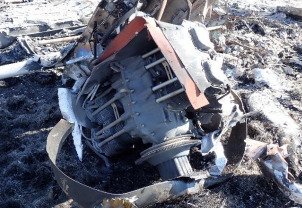
The accident occurred at approximately 1030 UTC, around 2.33 kilometres from Secunda Aerodrome, at an elevation of 5,195 feet. There were no fatalities, no passengers, and no injuries to people on the ground. The aircraft was destroyed by the post-impact fire.
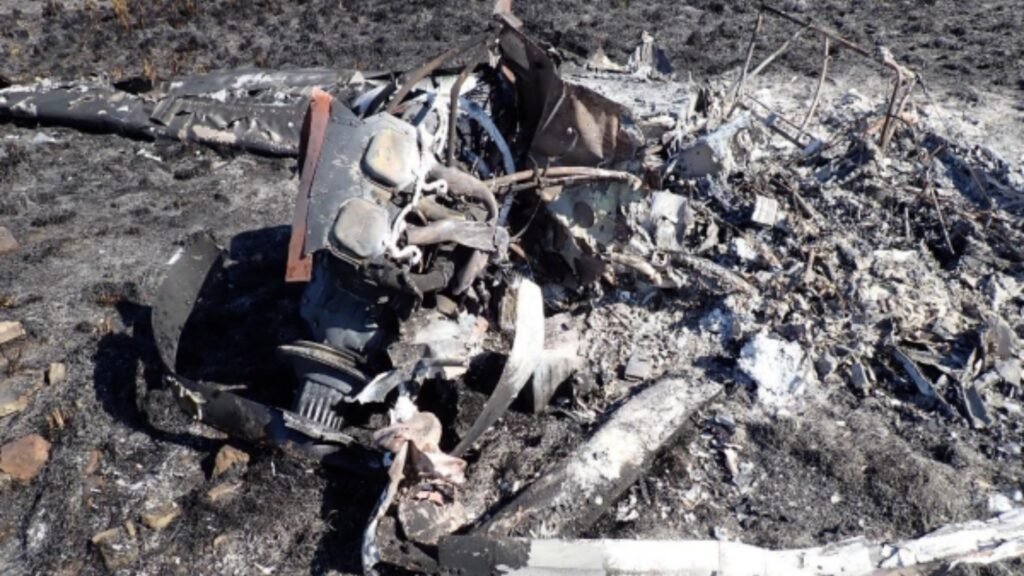
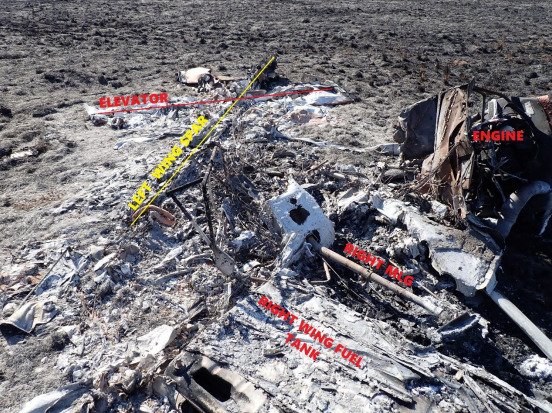
Investigators noted that the aircraft’s nose landing gear and left main landing gear had separated from the fuselage, while both propeller blades were found bent backwards. However, because the fire destroyed much of the aircraft, investigators stated it is not yet possible to determine precisely how the aircraft impacted the ground. The cockpit and cabin were almost completely consumed by fire, making identification of several components difficult.
The pilot held a valid Student Pilot Licence (SPL) and had accumulated 74.2 total flying hours, including only 4.1 hours on the Cessna 172M, having transitioned from a Tecnam Echo earlier in 2026. His Class 2 aviation medical certificate was valid until November 2028 with no restrictions.
The aircraft, a 1975-built Cessna 172M, had accumulated 22,791.5 airframe hours. It held a valid Certificate of Airworthiness and Certificate of Release to Service, with its latest maintenance inspection completed only weeks before the accident. The report also notes the aircraft had previously been involved in four earlier occurrences between 2003 and 2022, including a forced landing following engine power loss, a wind-related ground damage event, a hard landing, and a nose-wheel collapse after a bounced landing.
Weather conditions recorded at nearby Ermelo Aerodrome around the time of the accident indicated 210-degree winds at 5 knots, 10 kilometres visibility, 20°C temperature, no cloud, and a QNH of 1028 hPa. The report stresses that these findings do not assign blame or liability, and that the investigation remains ongoing. At this stage, no safety recommendations have been issued.