Alaska, United States: The US National Transportation Safety Board (NTSB) has released its final investigation report into the fatal crash of Bering Air Flight 445, concluding that degraded pilot situational awareness, inadequate airspeed management, operation above the aircraft’s maximum allowable weight, shortcomings in Bering Air’s safety management, and insufficient Federal Aviation Administration (FAA) oversight combined to cause the accident. The report also identified deficiencies in weather forecasting for supercooled large droplet (SLD) icing and issued new and reiterated safety recommendations aimed at improving commuter airline safety.
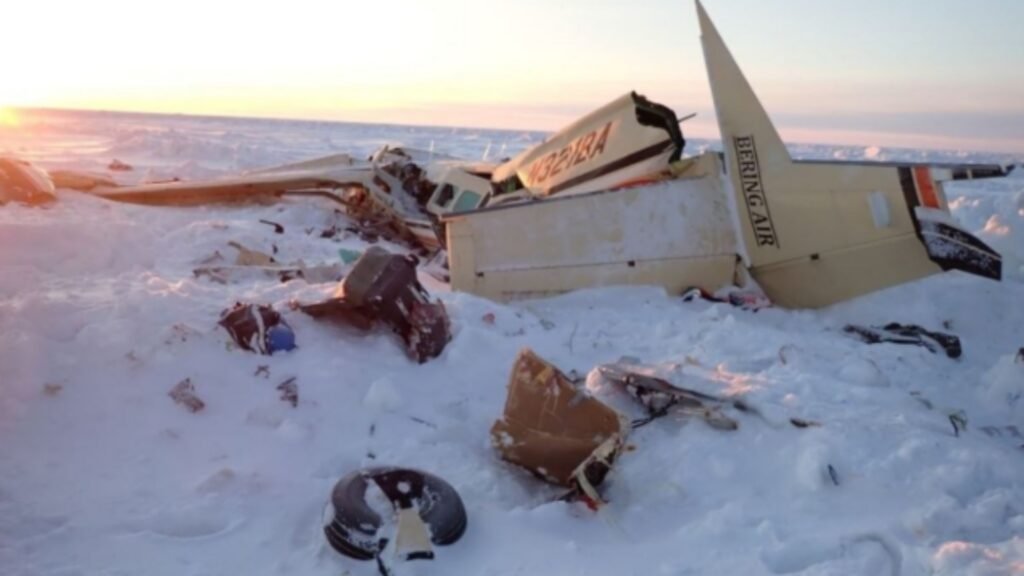
The accident occurred on February 6, 2025, at about 3:20 p.m. Alaska Standard Time when a Textron Aviation Cessna 208B Grand Caravan EX, registration N321BA, operating as Bering Air Flight 445, crashed onto pack ice in Norton Sound while approaching Nome Airport, Alaska. The Part 135 scheduled commuter flight had departed Unalakleet Airport on the final leg of a three-flight rotation carrying one pilot and nine passengers. All ten occupants were killed.
According to the NTSB, the pilot and dispatcher reviewed weather conditions before departure, with forecasts indicating instrument flight conditions, light snow and occasional moderate icing. However, no official weather products warned of the severe supercooled large droplet icing conditions the flight would later encounter.
Air traffic control advised the pilot that both runways had been temporarily closed for snow and ice removal and suggested slowing the aircraft to avoid arriving before they reopened. The pilot reduced engine power, causing the aircraft’s airspeed to decrease. Around the same time, the aircraft entered moderate-to-severe icing conditions containing supercooled large droplets.
Flight data showed the aircraft’s airspeed continued to fall despite increased engine power. At about 3:19 p.m., the Low Airspeed Awareness (LAA) system activated and automatically disengaged the autopilot after airspeed dropped below approximately 99 knots. Within seconds, the aircraft’s speed fell further, its pitch increased, and it entered an aerodynamic stall before rapidly descending.
Air traffic control instructed the pilot to climb after observing the aircraft’s low altitude and later issued a low-altitude alert, but no response was received. The aircraft impacted pack ice about 12 miles offshore of Norton Sound and approximately 32 miles east of Nome.
Because the aircraft was not required to carry a cockpit voice recorder or flight data recorder, investigators reconstructed the accident using Garmin G1000 avionics data, ADS-B tracking, air traffic control communications and examination of the wreckage. The evidence enabled investigators to establish the sequence of events leading to the fatal loss of control, forming the basis of the NTSB’s final findings and safety recommendations.
In its final report, the NTSB concluded that the aircraft experienced an aerodynamic stall after the pilot failed to maintain adequate airspeed while operating in icing conditions. Investigators found that following the automatic disengagement of the autopilot, the pilot did not effectively monitor the aircraft’s rapidly decreasing airspeed or increasing angle of attack, resulting in a loss of control from which recovery was not possible.
The investigation determined that the aircraft encountered supercooled large droplet (SLD) icing, a hazardous condition beyond the certification limits of the Cessna 208 B’s TKS ice protection system. Although post-accident examinations found no evidence of any pre-impact mechanical failure and confirmed the TKS system functioned as designed, the icing conditions exceeded those for which the aircraft was certificated.
The NTSB also identified operational shortcomings at Bering Air. Investigators found the aircraft departed above the maximum allowable gross take-off weight for flight into known or forecast icing conditions. The report stated that the operator had routinely used an increased maximum take-off weight permitted under a supplemental type certificate, even though the aircraft’s flight manual prohibited that higher weight in icing conditions. The Board further concluded that Bering Air’s safety management system failed to adequately identify and mitigate operational risks, while internal weight-and-balance practices and oversight were insufficient.
The investigation also criticised the FAA’s oversight of the operator, concluding that inspectors failed to identify or correct Bering Air’s use of improper weight limitations during operations in icing conditions. Additionally, the Board found shortcomings in Alaska’s aviation weather products, noting that available forecasts did not adequately communicate the potential for supercooled large droplet icing despite meteorological conditions supporting its development.
As part of its final report, the NTSB issued multiple safety recommendations to the FAA, National Weather Service and Bering Air. These include strengthening oversight of Part 135 operators, improving compliance with aircraft weight limitations, enhancing pilot training for operations in severe icing, expanding weather products that identify supercooled large droplet icing in Alaska, and improving operational risk management to help prevent similar accidents.