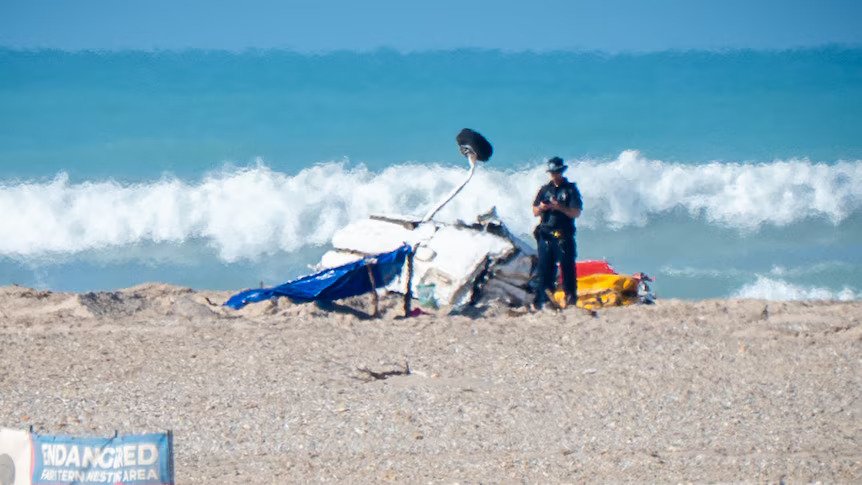
Goolwa, Australia: The Australian Transport Safety Bureau (ATSB) in its final report has found that an unauthorised spin manoeuvre likely preceded the fatal crash of a Cessna 210N near Goolwa, South Australia, on 6 February 2026. The aircraft, registered VH-RDH, collided with water during a left-turn spin, killing all three occupants. In its final report released on 28 October, the ATSB concluded that the flight instructor likely initiated the spin to allow the commercial pilot in the front-left seat to practise recovery actions, despite the aircraft not being approved for intentional spins. The pilot likely mishandled the recovery during the initial stage of the spin, while the instructor did not intervene in time to prevent it from becoming fully developed.
The six-seat Cessna 210N departed Goolwa Airport at approximately 4:08 pm local time for a private local-area flight. The occupants comprised a flight instructor in the front-right seat, a commercial pilot licence holder in the front-left seat and a passenger holding a recreational pilot licence in the second-row left seat. The purpose of the flight was for the commercial pilot licence holder to accumulate experience flying the Cessna 210 under the supervision of the operator’s check and training instructor.
According to the ATSB, the aircraft initially tracked east along the coast at about 2,350 feet for approximately five minutes before turning south and then west towards the mouth of the Murray River. As it approached the Murray Mouth, its altitude increased to 3,375 feet while its ground speed decreased to 74 knots. The aircraft then entered a rapid descent. Radar data recorded it at an uncorrected altitude of 2,700 feet at 4:20:57 pm, with the final radar return at 1,200 feet eight seconds later. Witness video showed the aircraft rotating to the left in a steep, nose-down attitude, with its left wing low and landing gear retracted, before it collided with the water. Witnesses reported that the engine sounded as though it was running until impact.
The ATSB found that the instructor had previously conducted unauthorised spin manoeuvres in aircraft that were not approved for intentional spinning. Interviews identified seven separate flights involving spin-violation activity before the accident flight. Investigators retrieved recorded data from four of those flights, capturing six spins through onboard video, Airservices Australia tracking data and electronic flight bag records. The report found that the instructor had progressively lowered the entry altitude of the manoeuvres. Earlier successful recoveries during the initial phase of spins likely increased the instructor’s confidence in conducting them at lower heights.
The report also detailed the instructor’s previous employment with an operator at Aldinga Airport, where the instructor had been assessed as competent to conduct spin and aerobatics flights in 2006 and to deliver spin and aerobatics training in 2009. The ATSB recorded two incidents reported to Recreational Aviation Australia during that employment: a runway excursion in 2018 and a near collision in 2022. The former operator also reported a history of student complaints and concerns about the instructor’s flying practices, including steep turns and wingovers during trial instructional flights.
The investigation documented several earlier spin-related incidents. In February 2024, during a flight review in an RAAus-registered aircraft, the instructor reportedly proceeded with spin exercises after a pilot questioned whether the aircraft could be used for spinning. The pilot subsequently became nauseous following exercises involving stalls, spins and spiral dives, and the flight review was not completed. The ATSB also examined previous spin demonstrations in VH-RDH involving other pilots who were undertaking Cessna 210 flying-experience flights at Goolwa. These included demonstrations and recovery exercises in December 2025 and January 2026. The report identified instances in which pilots followed through on the controls or manipulated them during recovery under the instructor’s direction.
The ATSB found that the previous spin violations had not been reported to the aircraft operator or the Civil Aviation Safety Authority (CASA), and no action was taken to stop the activities. Pilots interviewed during the investigation described several reasons for not reporting the manoeuvres, including trusting the instructor’s judgement, accepting assurances that the exercises were permitted, feeling insufficiently experienced to challenge the instructor, believing they lacked the authority or responsibility to intervene, and having limited confidence in reporting outcomes. The operator had a safety management system and reporting process, but none of the pilots who experienced the spin demonstrations submitted a report.
The ATSB’s analysis found that the accident flight’s profile was consistent with the aircraft being set up for a spin entry. The instructor had previously conducted spin entries in the same area, with recoveries taking place during the initial phase. The Cessna 210N had not been tested or certified for recovery from a fully developed spin, and intentional spinning was prohibited. The ATSB considered it likely that the instructor intended to allow the pilot in the left seat to practise recovery from an initial-stage spin rather than deliberately establish a fully developed spin.
Investigators also considered why the aircraft was not recovered. The pilot had received only a short in-flight briefing on spin recovery and had not been given ground instruction or a pre-flight briefing on the manoeuvre. The ATSB considered it likely that the pilot mishandled the recovery and that the instructor failed to intervene in sufficient time to prevent the aircraft from entering a fully developed spin and recover within the height available. Video analysis showed a significant reduction in the aircraft’s rate of rotation shortly before impact, indicating that it was responding to recovery inputs.
The ATSB found no evidence of structural failure before the collision. The aircraft’s fuel quality was satisfactory, and its last 100-hour inspection had been completed on 11 December 2025. Its maintenance release was current at the time of the accident. The investigation also examined the instructor’s medical history. The post-mortem examination identified severe coronary artery narrowing, indicating a higher risk of a cardiovascular medical event than predicted by the instructor’s last aviation medical examination. However, the ATSB said it could not determine whether a medical event contributed to the accident. As the aircraft appeared to be recovering from the spin before impact and only the instructor was trained to recover from a spin, investigators considered it most likely that the instructor was handling the controls at that stage.
The ATSB reiterated that spins must not be deliberately induced in aircraft that are not certified or approved for intentional spinning. It also highlighted the need for reporting systems to address barriers that prevent pilots and other aviation personnel from reporting unsafe flying practices. The investigation’s findings identify safety factors and are not intended to apportion blame or legal liability.