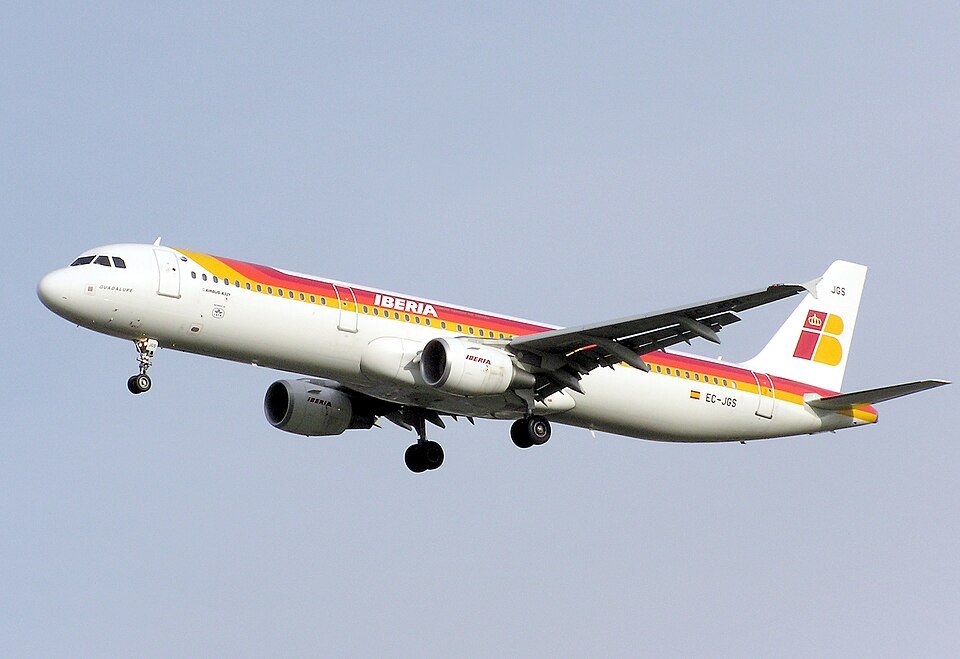
Las Palmas de Gran Canaria, Spain: A potential mid-air collision involving an Iberia Airbus A321 and an Air Europa Boeing 787-9 was narrowly avoided over the Atlantic Ocean on July 10, 2026, after both aircraft received coordinated Traffic Collision Avoidance System (TCAS) resolution advisories while flying at the same altitude on the same airway in opposite directions.
According to Spain’s Civil Aviation Accident and Incident Investigation Commission (CIAIAC), the incident occurred at about 01:23 UTC in the oceanic sector of the Canary Islands Flight Information Region/Upper Information Region (FIR/UIR). The Iberia Airbus A321, registration EC-OLE and flight call sign IBE0140, was operating on airway N857 at flight level 360 (FL360), or approximately 36,000 feet, while flying northeast between the ETIBA and BIPET reporting points.
At the same time, another aircraft, identified by CIAIAC as a Boeing 787-9 registered EC-NBM with flight call sign AEA05, was flying in the opposite direction on the same airway and at the same flight level.
The two aircraft’s conflicting trajectories triggered a TCAS Traffic Advisory (TA) on the Iberia aircraft, followed by a TCAS Resolution Advisory instructing the A321 to descend. The Boeing 787-9 simultaneously received a TCAS RA instructing it to climb.
The Iberia aircraft followed the automated avoidance instruction and descended approximately 500 feet before receiving a LEVEL OFF command. The Boeing 787-9, meanwhile, climbed approximately 400 feet in accordance with its TCAS instruction and continued the maneuver until receiving a CLEAR OF CONFLICT warning.
The opposing vertical maneuvers separated the aircraft and prevented a possible collision. CIAIAC said both aircraft subsequently continued their respective flights and landed safely, with no injuries or personal damage reported.
The incident has been described as a serious loss-of-separation event because the two aircraft were operating on the same airway, at the same flight level and in opposite directions over oceanic airspace. The TCAS systems installed on both aircraft provided the final safety barrier by issuing complementary climb and descent commands, allowing the aircraft to move vertically away from each other.
The incident reflects the importance of TCAS as a last line of defense in commercial aviation. While the system does not replace air traffic control separation procedures, it is designed to detect conflicting aircraft and issue coordinated instructions to pilots when a collision risk develops. In this case, one aircraft was instructed to descend while the other was directed to climb, allowing both crews to respond in opposite vertical directions.
CIAIAC has opened an investigation into the occurrence. The authority’s preliminary information indicates that the event took place in Spanish-controlled oceanic airspace over the Atlantic, and its account confirms that both aircraft successfully completed their flights after the TCAS alerts.