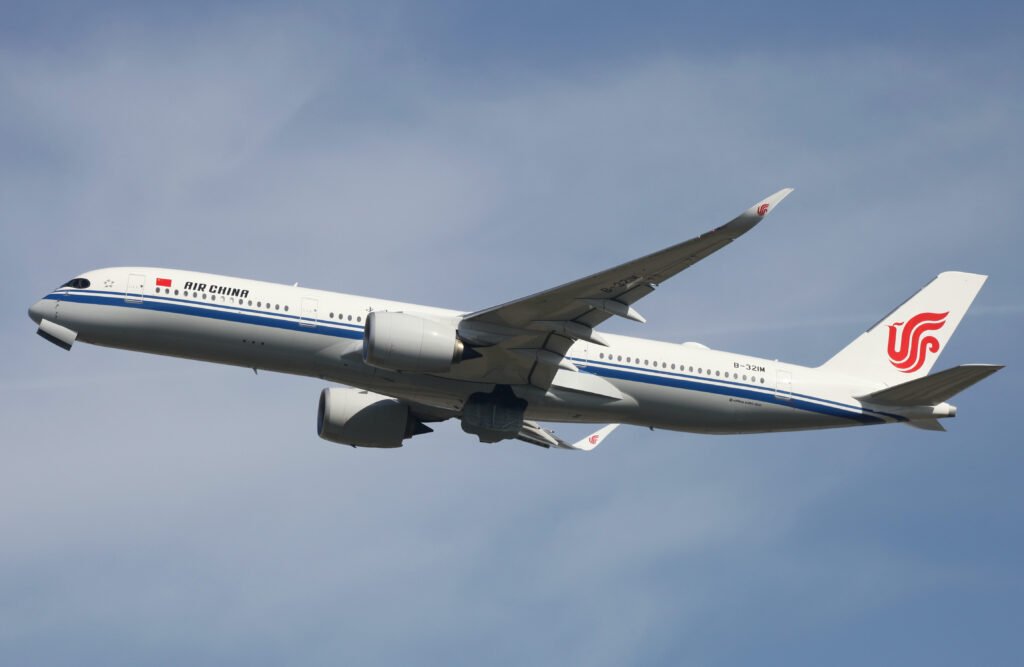
Tuva, Russia: An Air China Airbus A350-900 operating as Flight CA967 from Shanghai Pudong to Milan Malpensa was involved in a serious airspace incident over southern Siberia after it climbed through an occupied flight level, coming dangerously close to a cargo aircraft.
According to preliminary radar and ATC data, the Air China aircraft began a climb from 34,100 feet to 36,000 feet without receiving explicit clearance from Russian air traffic control. During this unauthorized climb, the aircraft came within approximately 300 to 400 feet vertically of an SF Airlines Boeing 767 freighter cruising at 35,000 feet on a crossing path. The incident occurred over the Tuva region of the Russian Federation at approximately 21:39 UTC.
TCAS Resolution Prevents Collision
Both aircraft were equipped with functioning Traffic Collision Avoidance Systems (TCAS), which detected the impending conflict and issued resolution advisories. Crews on both aircraft responded promptly to TCAS instructions. No collision occurred, and both flights continued to their respective destinations without further incident.
The separation between the two aircraft fell significantly below the minimum vertical separation required under ICAO standards, which is 1,000 feet for aircraft at cruising altitude.
Controller-Pilot Communication Discrepancies
Cockpit audio recordings released on social media and reported by the South China Morning Post revealed apparent miscommunication between the Air China crew and Russian air traffic control. In the exchange, the SF Airlines pilot questioned the climb while addressing the Air China crew:
SF Airlines pilot: “I saw your plane climbing… only 20 nautical miles away. Such a crossing altitude is very inappropriate.”
Air China pilot: “I asked the controller to climb.”
SF Airlines pilot: “Did the controller instruct you to climb?”
Air China pilot: “No. Thank you.”
The Air China pilot allegedly blamed “overlapping radio transmissions” for the confusion, indicating a possible misinterpretation of clearance.
Russian controllers can also be heard instructing nearby aircraft to maintain level flight to avoid further conflict during the incident.
Investigation
Authorities from the Civil Aviation Administration of China (CAAC) and Russia’s Federal Air Transport Agency (Rosaviatsiya) have launched a joint investigation. Both regulatory bodies have confirmed that standard incident reporting procedures have been initiated and that flight data recorders, cockpit voice recordings, and ATC logs will be reviewed.
Officials are examining possible causes including frequency congestion, language barriers, and incorrect readbacks. The Tuva region lies within a transition area where communication overlaps and limited coverage have previously been noted in operational reports.
No passengers or crew were injured during the incident. Flight CA967 continued to Milan Malpensa, arriving on schedule. The SF Airlines Boeing 767 also completed its scheduled route without diversion.
Authorities have not yet released the final investigation timeline. Air China has not issued a public statement as of this report.