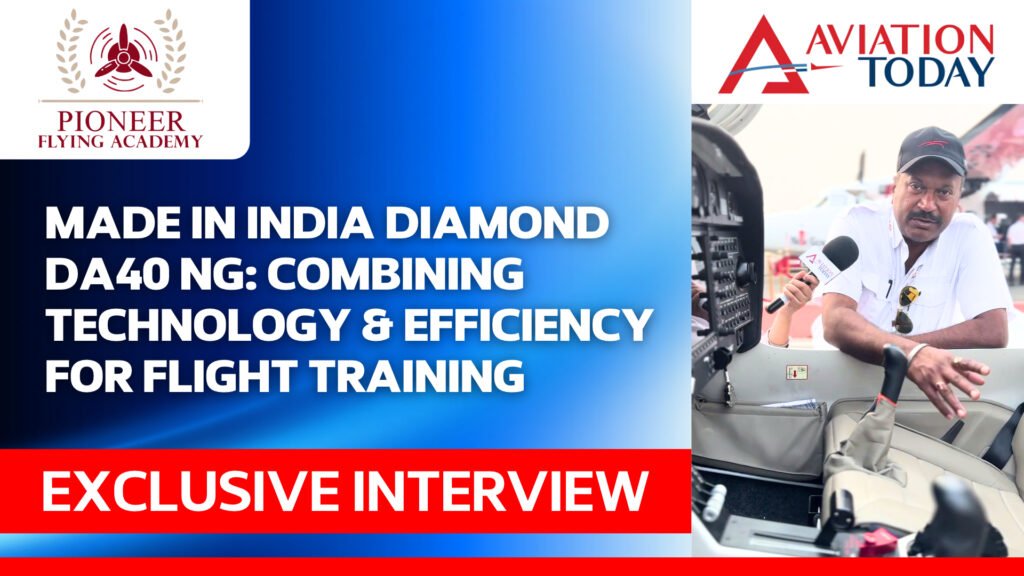
Hyderabad, India: Speaking to Aviation Today during Wings India at Begumpet Airport, Hyderabad, Capt. Puneet Kumar, Flying Instructor at Pioneer Flying Academy, explained the features and capabilities of the Diamond DA40 NG training aircraft while highlighting how its upcoming manufacturing in India by Shakti Aviation Industries is expected to significantly reduce pilot training costs, improve aircraft availability, lower maintenance expenses and ensure faster access to spare parts.
He also provided a detailed walkthrough of the aircraft’s construction, cockpit technology, flight controls and the advantages it offers as a modern training platform.
Conversation In Details
Aviation Today: Can you explain the key features of the Diamond DA40 NG training aircraft and how its upcoming manufacturing in India will benefit pilot training and aircraft operations?
Capt. Puneet Kumar: The aircraft on display is the Diamond DA40 NG (New Generation), a four-seat aircraft primarily designed for flight training while also being suitable for personal flying. He explained that the aircraft is constructed almost entirely from composite fibre material, with very little metal used apart from the engine, making it lightweight and efficient. The aircraft is currently owned and operated by Pioneer Flying Academy.
Capt. Kumar said one of the most significant developments is that the DA40 NG will soon be manufactured in India by Shakti Aviation Industries. According to him, this will substantially reduce the cost of pilot training because, at present, no training aircraft are manufactured domestically. Since aircraft and spare parts currently have to be imported, operating and maintenance costs remain high. Local production, he noted, will improve aircraft availability across the country while making servicing and maintenance facilities more affordable and accessible.
Giving a detailed tour of the aircraft, Capt. Kumar explained that the DA40 NG is a low-wing aircraft, meaning its wings are attached to the lower section of the fuselage. Inside the cockpit, he pointed out the aircraft’s four-seat configuration, with two seats in the front and two at the rear.
He demonstrated the aircraft’s central control stick, explaining that pushing it forward causes the aircraft’s nose to descend while pulling it back makes the aircraft climb. Moving the control stick left or right lowers the respective wing, allowing the aircraft to bank and turn during flight.
Capt. Kumar further explained that the DA40 NG features a modern glass cockpit, where primary flight information is displayed digitally on large electronic screens. He noted that traditional analogue instruments are retained only as standby instruments, while the digital displays provide pilots with comprehensive flight data and replicate essential information for improved situational awareness.
Discussing the engine controls, he said the aircraft uses a single computerized throttle lever, unlike many older aircraft that require multiple levers to manage engine power and other functions. The pilot simply provides the required input, after which the onboard computer automatically determines and delivers the appropriate engine output.
He also highlighted the aircraft’s adjustable rudder pedals, explaining that while the seats remain fixed, the pedals can be moved forward or backward using a release lever to suit pilots of different heights, improving ergonomics and comfort during flight training.
Capt. Kumar then identified several standby cockpit instruments, including the Emergency Locator Transmitter (ELT), radio compass, altimeter, artificial horizon, and airspeed indicator, while also pointing out the aircraft hour meter, which records the total flying hours accumulated by the aircraft.
Returning to the importance of domestic manufacturing, Capt. Kumar explained that if even a small cockpit component or switch requires replacement today, operators must source it from the aircraft’s country of manufacture, resulting in additional costs and delays. Once manufacturing begins in India, these components can instead be obtained from local suppliers, making maintenance considerably faster and more economical.
He noted that training aircraft undergo frequent use, meaning minor components often require replacement because of continuous handling by student pilots. Currently, operators either maintain expensive inventories of spare parts or wait approximately 10 to 20 days for imported replacements to arrive. Local manufacturing, he said, will eliminate much of this waiting period while reducing maintenance costs.
Capt. Kumar concluded that domestic production of the Diamond DA40 NG would not only strengthen India’s flight training ecosystem but also improve aircraft availability, reduce operational expenses and establish what he described as the first aircraft to be manufactured in India, marking a significant milestone for the country’s aviation training sector.