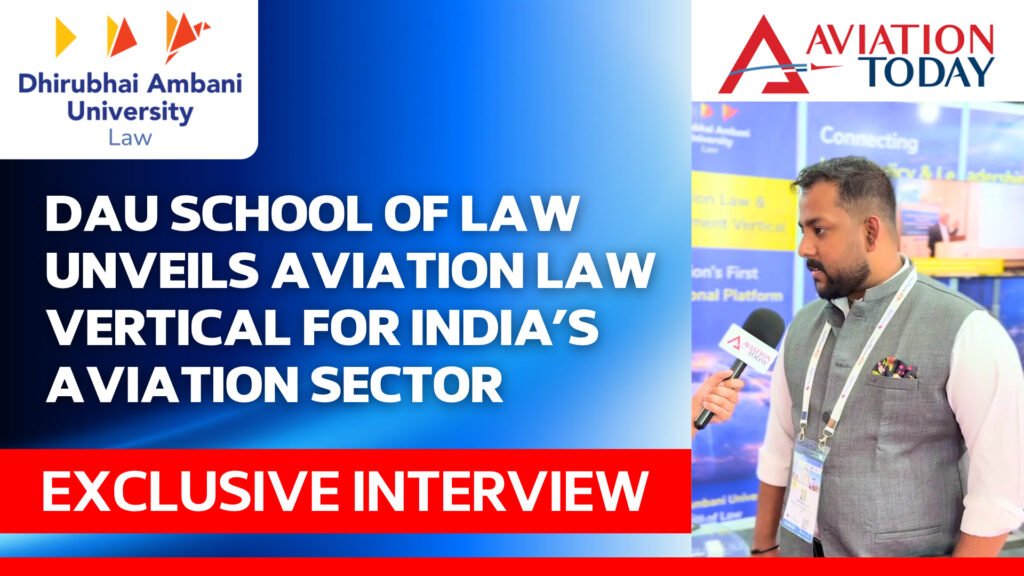
Hyderabad, India: Speaking to Aviation Today during Wings India at Begumpet Airport, Hyderabad, Mr. Sivadath Madhu Menon, Assistant Professor at the School of Law, Dhirubhai Ambani University (DAU), explained how the university’s specialised LL.M. in Aviation Law aims to bridge the knowledge gap between legal education and the aviation industry.
He discussed why aviation law is often misunderstood as a niche subject, how the programme equips lawyers and industry professionals with technical and regulatory expertise, India’s aircraft leasing challenges, the importance of harmonising with international aviation standards, collaborations with airlines and regulators, and how such initiatives can contribute to India’s ambition of becoming a global aviation hub.
Conversation In Details
Aviation Today: What gap in Indian aviation law does the LL.M. in Aviation Law at DAU aim to fulfil?
Mr. Sivadath Madhu Menon: Aviation is one of the world’s most highly regulated sectors. While many consider aviation law to be a niche discipline, the real issue is a lack of awareness about the industry’s technical and operational aspects. The LL.M. programme is designed to bridge that gap by going beyond legal concepts and exposing students to the aviation ecosystem. It covers subjects such as air crash investigation, aviation economics and the overall aviation industry. Based on DAU’s experience, nearly 90% of aviation lawyers and in-house legal professionals learn about aviation only after entering the industry. However, many still feel they lack a complete understanding of several critical aspects. The programme therefore provides both foundational and advanced knowledge, enabling legal professionals to navigate the rapidly evolving aviation sector more effectively.
Aviation Today: How will this programme help strengthen India’s competitiveness over the next decade?
Mr. Sivadath Madhu Menon: India has a large aviation industry, with around 40–50% of its commercial aircraft acquired through leasing. For aviation leasing and financing lawyers, understanding the industry’s operational realities is essential. He noted that India faced significant challenges in aircraft leasing and financing following the Go First crisis. As the world’s third-largest aviation market, however, the government has taken supportive steps, including strengthening the implementation of the Cape Town Convention. He also pointed to aircraft production backlogs and delivery delays, which make leased aircraft even more important for airlines. Since aviation is a highly regulated industry, informed legal and industry professionals are crucial. Through specialised verticals such as Aviation Law, AI & Data Privacy, Construction Law and ESG, DAU aims to contribute to the vision of Viksit Bharat by developing skilled professionals for emerging sectors.
Aviation Today: How important is harmonisation with organisations such as ICAO, EASA and the FAA?
Mr. Sivadath Madhu Menon: International aviation is fundamentally built on global conventions and harmonised regulatory standards. Aircraft certification by authorities such as EASA or the FAA plays a crucial role in enabling airlines to operate internationally. Without such recognition, airline operations can be restricted. Therefore, international consensus is essential, while policymakers have a key responsibility in ensuring that national regulations remain aligned with global aviation standards and continue supporting the sector’s growth.
Aviation Today: What challenges have you identified, and how do you plan to overcome them?
Mr. Sivadath Madhu Menon: Rather than viewing challenges as limitations, DAU believes in creating opportunities. The university conducts executive development programmes for aviation professionals, with participants averaging around 16 years of industry experience. These programmes focus on capacity building and improving understanding of regulatory frameworks. Better-informed senior leaders make better decisions, which ultimately contributes to the long-term growth and development of the aviation industry.
Aviation Today: At a major platform like Wings India 2026, how do you view partnerships and collaborations with airlines?
Mr. Sivadath Madhu Menon: Initially, many questioned why a law school was participating in an aviation event. However, after introducing its aviation law programme, DAU received an encouraging response from aircraft manufacturers (OEMs), airlines and regulators. These organisations recognise the need for continuous training and professional development in a rapidly changing aviation environment. DAU’s role is to strengthen the legal and regulatory understanding of the industry, and participation in Wings India has demonstrated the growing demand for specialised aviation law education and industry collaboration.
Aviation Today: Do you believe these initiatives will help fulfil India’s ambition of becoming a global aviation hub?
Mr. Sivadath Madhu Menon: He said India still has significant work ahead, but every transformation begins with an important first step. Events such as Wings India create momentum for the country’s aviation sector and encourage continued growth. Global aerospace companies, including Boeing, along with the wider European aviation market, increasingly view India as a major growth opportunity. He expressed confidence that India is moving in the right direction and could eventually become one of the world’s largest aviation markets and economies.