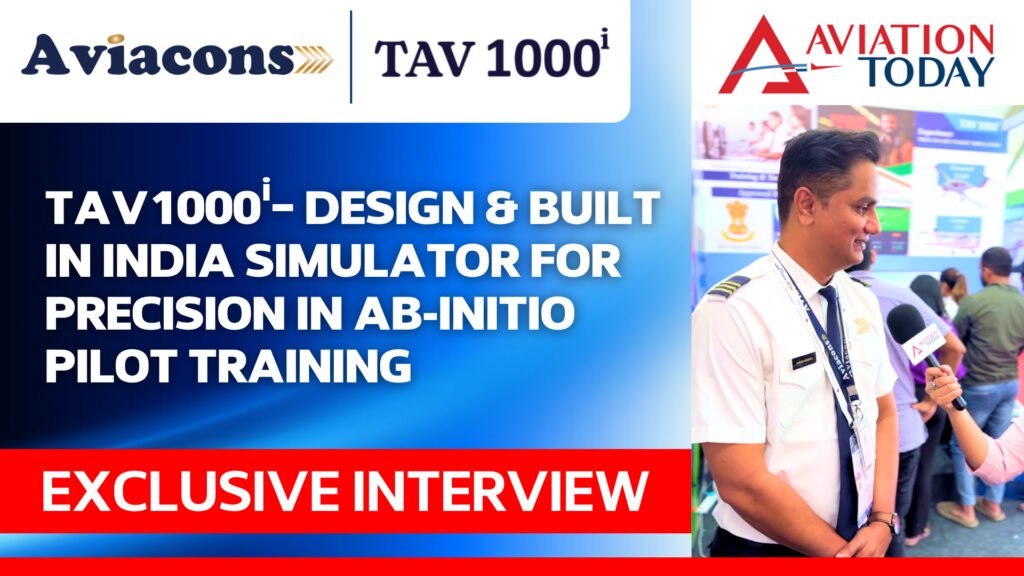
Hyderabad, India: Speaking to Aviation Today during Wings India at Begumpet Airport, Hyderabad, Capt. Kiran Kissan, Chief Theoretical Knowledge Instructor & Technical at Aviacons, explained how the TAV-1000 flight simulator is helping bridge the gap between classroom learning and practical flight training.
He highlighted that the simulator provides aspiring pilots with an early hands-on experience in a realistic cockpit environment, enabling them to apply theoretical knowledge before entering an actual aircraft.
He also discussed the benefits of G1000 glass cockpit familiarization, muscle memory development, enhanced situational awareness through the ultra-wide visual system, the significance of the indigenous Make in India initiative, and how DGCA-approved simulator hours can reduce training costs while improving aircraft utilization.
Conversation In Details
Aviation Today: How does the TAV-1000 help bridge the gap between classroom theory and actual flight training for pilots?
Capt. Kiran Kissan: Simulators are a very important part of flight training. When an aspiring pilot begins ground school, the TAV-1000 flight simulator helps bridge the gap between classroom learning and practical flight training. It provides a realistic environment where students can apply the theoretical knowledge they have gained during their ground classes before transitioning to actual flying.
Aviation Today: What role does glass cockpit familiarization play in pilot training?
Capt. Kiran Kissan: The glass cockpit is one of the most modern concepts introduced into the aviation industry. It is easier for pilots to read and interpret information compared to traditional analog instruments. The TAV-1000 is equipped with the Garmin G1000 glass cockpit system, allowing students to gain early hands-on experience with modern cockpit technology. This helps build their confidence before they begin real flight training.
Aviation Today: How important is muscle memory for student pilots?
Capt. Kiran Kissan: Aviation is all about muscle memory. Flying is a skill that is developed through continuous practice and repetition. Our objective is to introduce students to the TAV-1000 at an early stage so they can build the muscle memory required for flying. This early exposure enables them to transition into actual flight training much more smoothly.
Aviation Today: How does the ultra-wide visual system enhance training precision?
Capt. Kiran Kissan: Human beings rely on several senses, and vision is one of the most important for pilots. Pilots need to understand where they are flying, the prevailing weather conditions, and the attitude of the aircraft at all times. The ultra-wide visual display on the TAV-1000 provides students with a broader and more realistic view of their surroundings, significantly improving their situational awareness during training.
Aviation Today: Compared with imported simulators, how does an indigenous simulator support pilot training?
Capt. Kiran Kissan: The idea behind developing the TAV-1000 is to support the Government of India’s Make in India initiative. We are trying to source as many components as possible from within India, which helps reduce manufacturing costs. As a result, the simulator becomes more affordable for flight schools, enabling more training organizations to install it at their premises and provide simulator practice to their students.
Aviation Today: Once approved by DGCA, how will simulator hour logging benefit pilot training?
Capt. Kiran Kissan: Logging simulator hours is a very important aspect of pilot training. During the required 200 hours of flight training, students must complete a specified number of instrument flying hours. Instead of conducting all those hours in an actual aircraft, DGCA-approved simulator hours can be credited on the TAV-1000. This will reduce flying costs, ease aircraft scheduling pressure, lower aircraft utilization, and allow more aircraft availability for cadets undertaking visual flight training. That is what I believe in.